Real estate affiliate marketing is earning a commission when someone you refer buys a product, or paying other people for the same. In real estate it has a limit that other niches don’t: what you refer decides whether the fee is allowed.
This guide sorts real estate affiliate marketing by what is being referred, lists three legal traps, shows how to disclose affiliate links and works out what a product page can earn. It is general information, not legal advice.
What is real estate affiliate marketing?
Real estate affiliate marketing is a performance deal: you put a tracked link on your site, email or social posts, and the company pays you when a visitor buys. You can also run the other side and pay affiliates for leads or sales on your own offer.
Most real estate affiliate marketing is for products agents buy, such as tools for photos, email or scheduling, plus courses and books. The money is small next to a closed sale, which is why the rest of this guide spends more time on rules than on rates. On the technical side, Google’s outbound links guide, last updated 2025-12-10, names 3 link values: sponsored for paid links, ugc for user content and nofollow.
Searches for affiliate marketing real estate also mix in two other ideas. One is the paid referral, which the next sections cover. The other is a legal term for ownership ties between companies. Mixing them up is how people end up with a payment arrangement they can’t defend.
Is a real estate affiliate the same as an affiliated business arrangement?
No. An affiliated business arrangement is an ownership link between companies, such as a brokerage with a stake in a title company. The CFPB’s Regulation X allows it only when the person making the referral gives a written disclosure of the relationship and does not require anyone to use that provider.
An affiliate in the web sense has no ownership in the company. It is a tracked link, often with a cookie that lasts 30 days or more in the program’s own terms. The two get confused because both involve a referral and a payment, but the rules differ:
- A web affiliate link for a product falls under advertising rules and needs a disclosure.
- An ownership arrangement for settlement services needs the written disclosure above, plus a free choice for the customer.
- A pay-per-referral deal for settlement services is a different matter again, covered next.
If a company offers you a “real estate affiliate program” for mortgages, title or insurance, treat it as a legal question before it is a marketing one. Real estate affiliate marketing for products is simple by comparison: one link, one disclosure and one sale at a time.
Can you take a fee for real estate affiliate marketing?
It depends on what you refer, so real estate affiliate marketing starts with a sorting step. A tool or course is an ordinary affiliate sale. A lender, title company or inspector is a settlement service, and under Regulation X nobody may give or accept a fee, kickback or other thing of value for referring that business on a federally related mortgage loan.
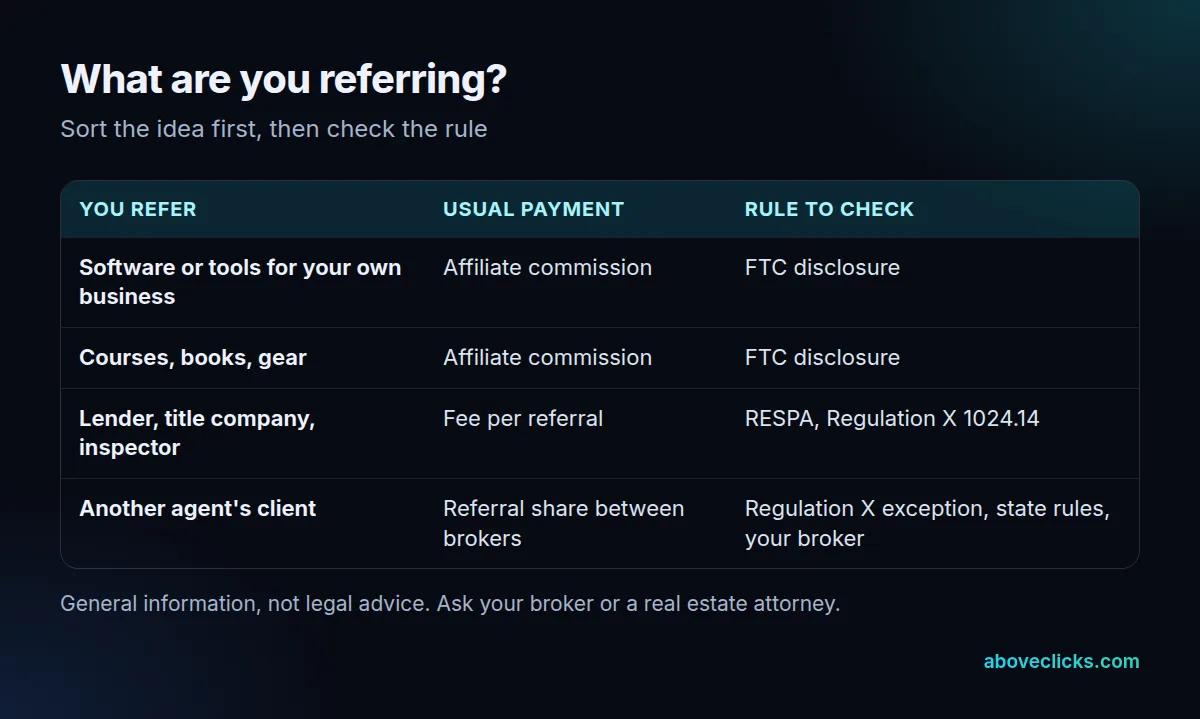
Three traps catch people in real estate affiliate marketing, and the table above shows where each one sits:
- A fee per referral for settlement services. The rule says a company may not pay another company, or its employees, for the referral of settlement service business. A “thing of value” is broad: it includes commissions, discounts, trips, free services and credits, and the payment need not be money.
- A pattern tied to volume. An agreement can be unwritten. When a thing of value is received repeatedly and is connected in any way with the volume or value of the business referred, that is evidence of an agreement.
- A split for no work. A portion of a charge is allowed only for services actually performed. A fee for no or nominal services is an unearned fee.
Some payments are permitted, including a bona fide payment for services actually performed and payments under cooperative referral arrangements between real estate agents and brokers. That exception covers fee divisions within brokerage arrangements when all parties act as real estate brokers; it doesn’t extend to deals between brokers and mortgage brokers.
Records of such arrangements must be kept for 5 years. State licensing rules add their own limits, so ask your broker before you sign any referral agreement. Agents who want affiliate marketing for real estate leads from other agents should use the written brokerage route, not a web affiliate link.
How do you choose affiliate programs for real estate agents?
Start with what the program sells, then check how it pays and whether its terms fit your site. A tool you use yourself is the safest category, because you can describe it from experience.
Run each candidate through three questions:
- What is referred? If it is a lender, title company or inspector, stop and ask a lawyer.
- How is it paid? A one-time commission and a recurring one need different traffic. Check the tracking window and the minimum payout in the program’s own terms.
- Would you recommend it without the payment? If not, the page will read like an advert and earn little trust.
Example: an agent with a page of 2,000 visits a month about scheduling software would compare two programs by commission and tracking window, then choose the tool the agent actually uses. Affiliate marketing for real estate agents works best when the tool is one the agent already pays for. Don’t copy a program’s product descriptions; Google treats copied descriptions as thin content, which the last section explains.
Skip programs that pay for the visitor’s personal details if the visitor doesn’t know that is the product. The page should say who receives the details and why.
How should affiliate marketing for real estate agents be disclosed?
Clearly and next to the link, on every page that carries one. The FTC’s endorsement rules say a connection that might materially affect the weight or credibility of an endorsement, and that readers don’t expect, must be disclosed clearly and conspicuously. Payment, or the possibility of being paid, counts.

The FTC’s own example is a blog that reviews coffee makers with affiliate links: because the blogger receives part of each sale, the reviews should clearly and conspicuously disclose it. The same logic applies to an agent’s “best tools for agents” page, and to any real estate affiliate marketing post on social media.
The rules also reach whoever hires others. The guides say an advertiser should give its influencers guidance on disclosure and monitor their compliance. If you run an affiliate program for your own offer, put the disclosure rule in the program’s terms and check your affiliates’ posts.
For search engines, add a rel value too. Google’s outbound links guide asks you to mark paid links with rel="sponsored", and says nofollow is also accepted though sponsored is preferred. The link attribute doesn’t replace the written disclosure for readers.
How much can real estate affiliate programs earn?
Less than most guides imply, once you do the arithmetic. Real estate affiliate marketing for products pays per sale, so traffic is the limit. Income is visits, times the share who click, times the share who buy, times the commission. We don’t quote program payout rates, because they change and differ by company.
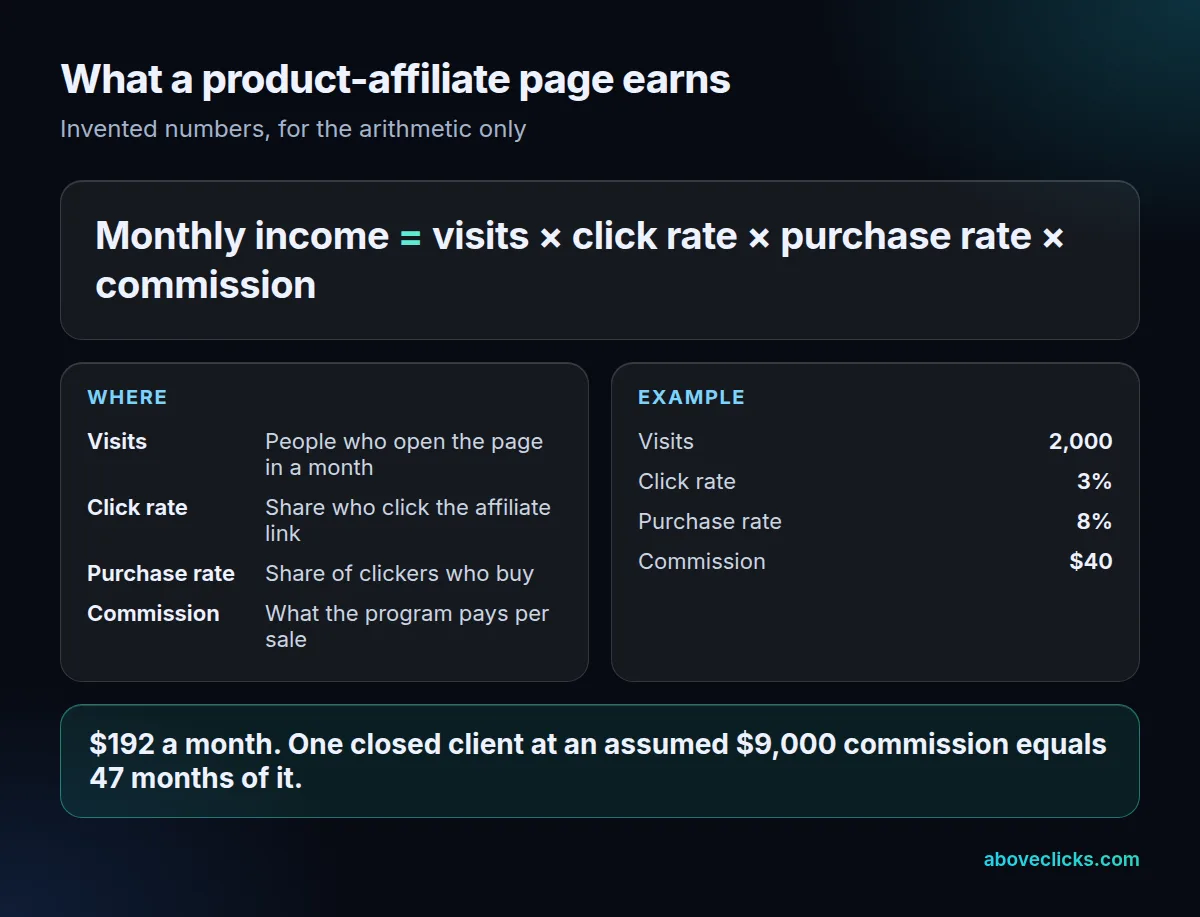
The example uses invented numbers, not a market average. A page with 2,000 visits a month and a 3% click rate gives 60 clicks. At an 8% purchase rate that is 4.8 sales, and at a $40 commission it earns $192 in a month.
Now point the same 2,000 visits at your own enquiry route, such as a valuation form. Assume 1% enquire, which is 20 people, and 5% of them become clients, which is 1 client. At an assumed $9,000 commission, that one client equals about 47 months of the affiliate page ($9,000 ÷ $192). That is a comparison of two invented routes, not a forecast for your site.
That is why our real estate marketing work judges pages on booked viewings and valuations, not on clicks. Affiliate links can sit beside a useful page, but they shouldn’t replace the page that captures your own leads. The real estate digital marketing page shows how we set that up, and the marketing platform guide covers where those leads are tracked.
How do you keep affiliate pages from looking thin?
Add something the merchant’s own page doesn’t have. Real estate affiliate marketing pages rank only when they help the reader more than the merchant’s page does. Google’s spam policies define thin affiliation as product links with descriptions and reviews copied from the merchant, with no original content or added value.
The same policy says affiliate pages can be thin when they are part of a program that spreads the same content across a network of affiliates. Using affiliate links through a page, with the links treated appropriately, is not itself the problem.
What adds value on a real estate page:
- Your own use: screenshots of your set-up, what you changed after 30 days, what you dropped.
- Local detail: how the tool fits your market’s listing and showing routine.
- A named author and a date, so readers know who is recommending it.
The order matters in affiliate marketing for real estate. Build the page that serves a reader first, then add the link. Affiliate marketing for real estate sites follows the same rule as the rest of your content: help the reader first. Our agent marketing plan guide shows where an affiliate page fits next to listing and enquiry pages. If you want a second opinion on your site, our free audit reads it with read-only access, and more guides are under industries.