Flodesk vs Klaviyo comes down to how much store data your emails need. Flodesk is a design-first email and checkout tool for creators and small sellers; Klaviyo is built on orders, browsing and checkouts, with email and text on one customer profile.
This guide compares the 7 differences that decide it, works through how each one counts what you pay for, and covers how to move to Klaviyo without emailing anyone twice. We work in Klaviyo, so read the Klaviyo side with that in mind.
Flodesk vs Klaviyo: what is the difference?
The data behind each email. Flodesk centres on good-looking emails, forms and sales pages; Klaviyo centres on what each shopper did in your store, and sends automatically when it happens.
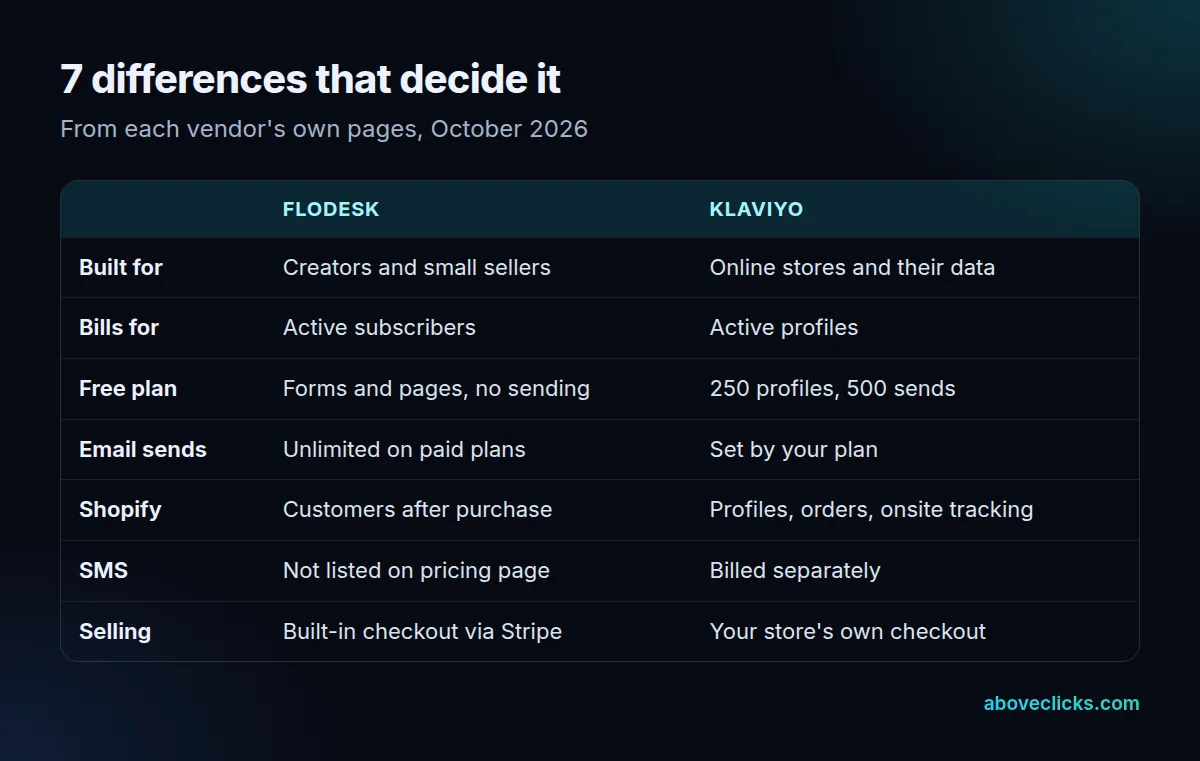
In Flodesk, a subscriber is mostly an email address, a name and the segments you put it in. You design a newsletter, pick a segment and send. Flodesk also sells products itself through its own checkout, so a creator with no online store can run a list and a shop from one account. Its integrations page lists 16+ native integrations, Shopify among them, as of October 2026.
In Klaviyo, a profile fills up with orders, product views, started checkouts and consent per channel, and flows fire on those events. That’s what lets a segment say “bought twice, not in the last 90 days” without anyone exporting a spreadsheet.
So read the Flodesk vs Klaviyo question as a question about your business. If you sell a few products or courses and your emails are mostly brand stories, design matters most. If you run a store with hundreds of products and repeat buyers, the store data matters most.
How does Flodesk pricing compare with Klaviyo’s?
They count different people. Flodesk bills by active subscribers with unlimited sends on paid plans; Klaviyo bills by active profiles, which can include shoppers who never opted in to marketing.
On Flodesk’s pricing page, as of October 2026, plans for up to 1,000 subscribers start at $25 a month for Lite, $28 for Pro and $54 for Everything, or $19, $25 and $49 a month with annual billing. Flodesk pricing scales with your active subscriber count: unsubscribed, bounced and cleaned contacts don’t count. When the count passes your tier, Flodesk moves you up at the next billing date and warns you at 90%, 95% and 100% of the limit. Flodesk retired its old flat-rate unlimited plan for new members on December 2, 2025, so older reviews that quote one price for any list size are out of date.
Klaviyo’s active profile guide explains, as of October 2026, that any profile you can email counts as active, including someone who gave an email at checkout without opting in. Its free plan covers 250 active profiles and 500 email sends a month. Paid plans are priced through a calculator, so we don’t quote them here. The billing guide adds that your plan must cover your active profiles at the end of each billing cycle, or Klaviyo moves you up a plan.
Flodesk vs Klaviyo: a worked billing example
Take an invented store whose export has 1,000 opted-in subscribers, 600 customers who bought without ticking the marketing box, and 300 unsubscribes.
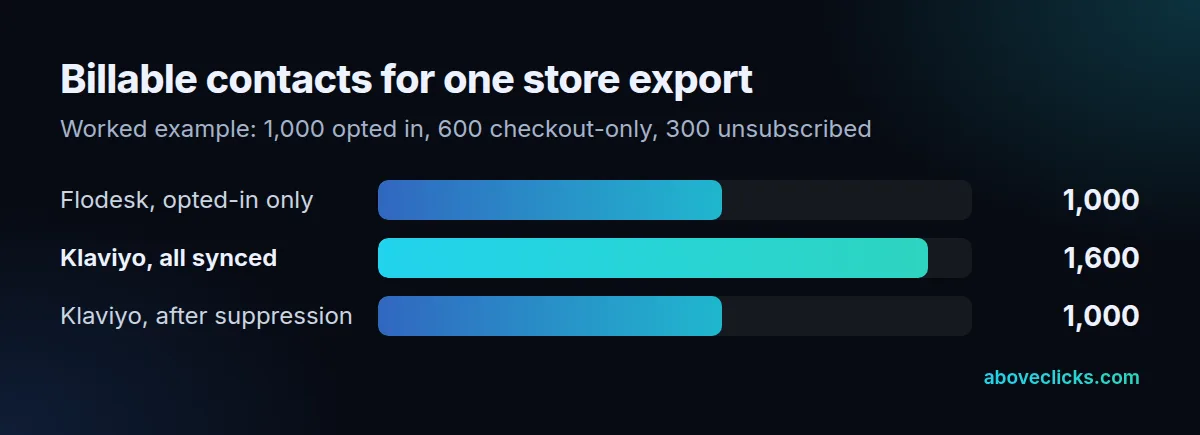
If you import only the opted-in subscribers into Flodesk, it bills 1,000, the first tier. If Klaviyo syncs every Shopify customer, the 600 checkout-only shoppers are emailable, so it counts 1,600 active profiles. Suppress those 600 and the active profiles drop back to 1,000; Klaviyo notes the billing figure can take up to 72 hours to refresh after a cleanup. The unsubscribes count on neither. Run the same split on your own export before you compare any Klaviyo vs Flodesk price.
Does Flodesk have a free plan?
Yes, but it doesn’t send email. As of October 2026, Flodesk’s free plan covers forms, landing pages and link-in-bio pages for growing a list, and you need a paid plan to send to it.
Flodesk’s pricing page also offers a free trial of the paid features with no credit card; when it ends, the account drops to the free plan and keeps its subscriber data. Lite allows up to 25,000 subscribers and 1 seat, Pro adds unlimited workflows and 2 seats, and Everything adds sales pages, unlimited checkouts and abandoned cart automations, with 3 seats.
That makes the free plans hard to compare, and Flodesk pricing only starts to matter once you send. Klaviyo’s free plan sends up to 500 emails a month to 250 active profiles, which is enough to test a real welcome flow before paying. On Flodesk, a test send means starting the trial. If you’re comparing on cost alone, our Omnisend vs Klaviyo guide shows the same billable-count method for another pair.
Does Flodesk integrate with Shopify?
Yes. Flodesk has a native Shopify integration that syncs customers after purchase and supports abandoned cart emails. Klaviyo’s integration brings in profiles, orders, onsite browsing and sign-up forms.
Flodesk’s integrations page says, as of October 2026, that once connected you can segment customers by purchase history and send post-purchase sequences, and that WooCommerce connects through Zapier rather than natively; Zapier links Flodesk to over 8,000 apps.
Klaviyo’s Shopify guide adds onsite tracking, which records what identified shoppers view before they buy. It also notes that, depending on your Shopify privacy settings, Klaviyo may not track visitors in 4 regions (the EU, EEA, UK and Switzerland) without consent. In Flodesk vs Klaviyo terms, both see who bought; Klaviyo sees more of what shoppers do before they buy.
Consent starts in Shopify for both. Shopify’s subscriber guide says to send promotional emails only to customers who agreed to receive marketing, and warns that purchased lists damage your sender reputation. Whatever the “agreed to receive marketing emails” box says is what either platform should treat as consent.
Does Flodesk have SMS marketing?
Not on its current plans: Flodesk’s pricing page lists email, forms, workflows and checkout features, but no text messaging, as of October 2026. Klaviyo sends SMS from the same profile as email.
Klaviyo’s billing guide shows mobile messaging (SMS, MMS, WhatsApp and other mobile channels) as a separate part of the bill from the email plan, as of October 2026. It also notes that a profile that unsubscribes from SMS alone still counts as an active email profile, because consent is kept per channel.
For a store, that matters most in flows. A cart flow can send an email, wait 4 hours, then send a text to people who opted in to texts. On Flodesk, adding SMS means a second tool, a second consent list and a second unsubscribe to keep in step. If texting isn’t in your plan for the next 12 months, this row of Flodesk vs Klaviyo matters little.
Is Flodesk good for ecommerce?
It’s good for creators and small sellers who sell a short list of products, courses or memberships. For a store with a large catalogue and repeat buyers, Klaviyo’s segments built on orders and browsing usually do more.
Flodesk’s strength is selling without a store. Its Checkout page covers physical and digital products, subscriptions, courses and quick invoices, with payments through Stripe at Stripe’s standard rate and no Flodesk platform fee, as of October 2026. A coach or a small brand can sell from a sales page and follow up by email in one account.
Klaviyo works the other way: your store keeps the checkout, and Klaviyo uses every order and product view to decide who gets what. Ask how you sell. If most orders come through Shopify, the store data decides the Klaviyo vs Flodesk choice. If you’re on Shopify and only need simple email, also read Shopify Email vs Klaviyo.
Deliverability isn’t the tie-breaker either way. Google’s sender guidelines require anyone sending more than 5,000 messages a day to Gmail accounts to set up SPF, DKIM and DMARC, keep the spam rate below 0.3% and support one-click unsubscribe, as of October 2026. That applies on both platforms, and our email deliverability service checks the setup on either.
How do you move from Flodesk to Klaviyo?
By CSV, in a fixed order: unsubscribes first, then subscribers, then flows rebuilt and switched off, then Flodesk disconnected from Shopify before Klaviyo connects.
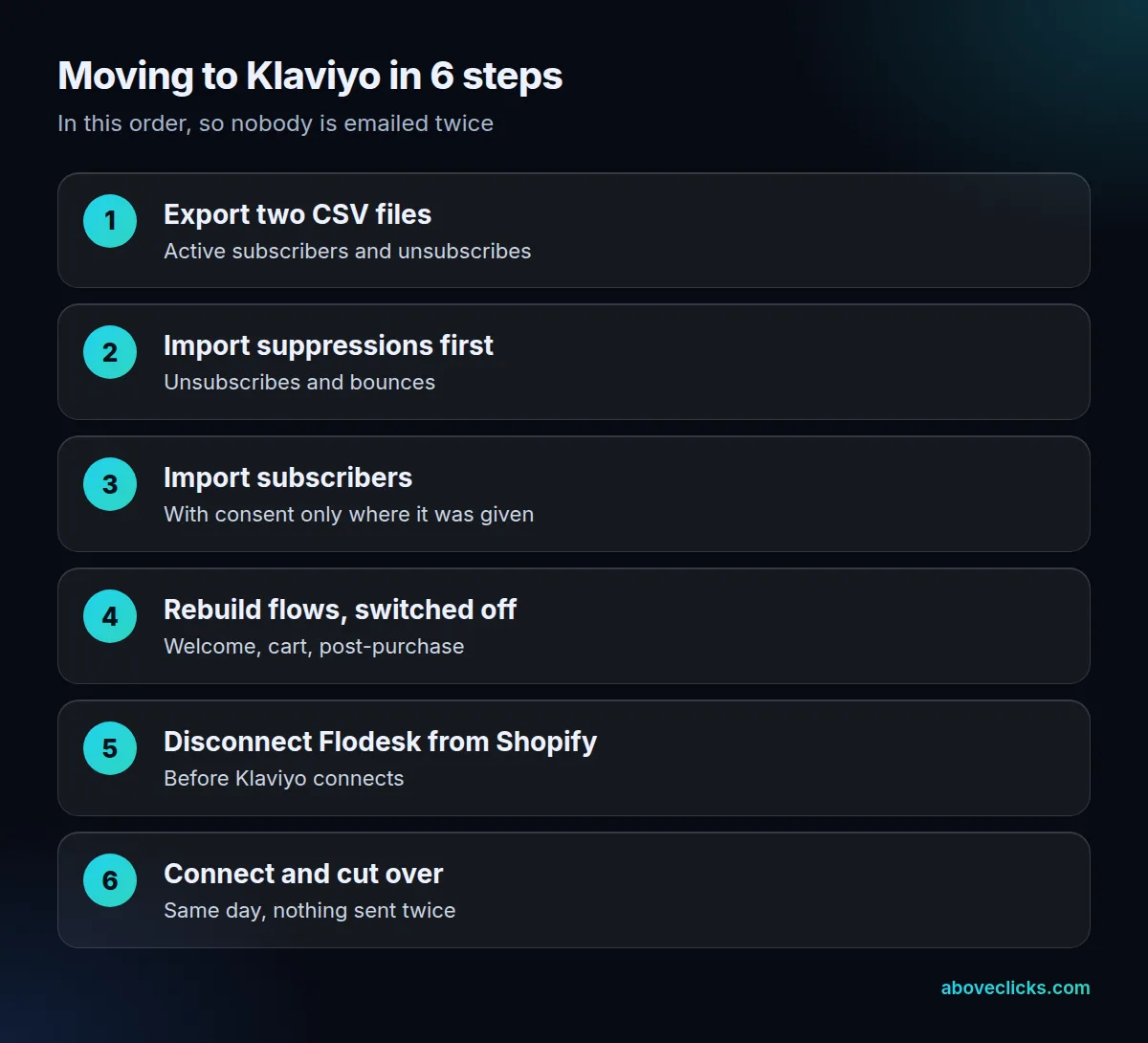
Klaviyo’s migration article lists built-in importers for 3 tools, Mailchimp, Campaign Monitor and Salesforce Marketing Cloud, as of October 2026; any other platform, Flodesk included, comes in from a CSV file. Flodesk includes CSV data exports on its plans. Export unsubscribes in a separate file and bring them in as suppressions before the first send, so nobody who left your list hears from you again. Once the suppressions are in, Klaviyo’s billing guide notes the count of active profiles can take up to 72 hours to refresh.
The Shopify step matters most. Klaviyo’s Shopify guide warns that leaving a prior email app connected can send double opt-in emails to your existing subscribers. Rebuild the welcome, cart and post-purchase flows in Klaviyo while they’re switched off, then switch them on and Flodesk’s off on the same day.
When we move a store, our Klaviyo migration starts with a free audit: a PDF plan within 2 workdays of what moves, what gets rebuilt and what to leave behind, then suppressions and consent, lists, flows and forms, and a cut-over with nothing sent twice. If you’re already on Klaviyo and unsure it’s set up well, our Klaviyo email marketing team can review it, or start with the free audit. More comparisons are in buying guides.