Listrak vs Klaviyo comes down to how you want to buy and run your email program. Listrak sells an enterprise platform with a managed-service team through a demo and a quote; Klaviyo sells a self-serve platform with published prices.
Both are built on store data, so this guide skips the feature checklists and compares the 7 Listrak vs Klaviyo differences that decide it: how each one is bought and priced, Shopify, text messages, service, reviews and how to switch without emailing anyone twice. We work in Klaviyo, so read the Klaviyo side with that in mind.
Listrak vs Klaviyo: what is the difference?
Mostly the buying model. Listrak is sold to retailers as a platform plus a strategy team; Klaviyo is bought online and run by your own team, with paid help if you want it.
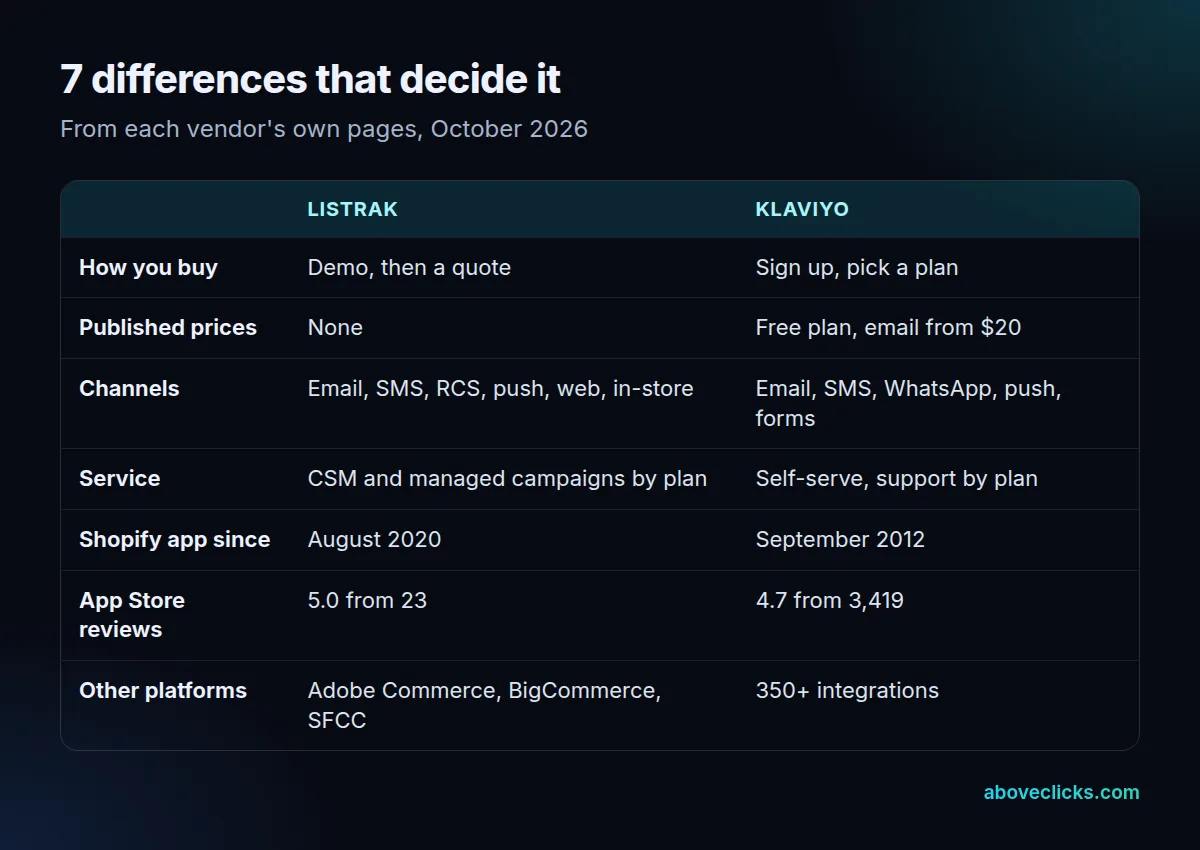
Listrak’s home page describes one customer profile behind email, SMS, app push, web, in-store and RCS messages, and every call to action is a demo or a talk with an expert, as of October 2026. Its services pages describe a team that plans and even runs campaigns for you.
Klaviyo’s pricing starts with a free plan and a calculator, and most stores set it up themselves. Its profiles also fill up with orders, product views and started checkouts, so a segment like “bought twice, not in the last 90 days” needs no export.
So the Listrak vs Klaviyo question is partly about your team. If you have 1 or 2 people running email, a managed program can do work you can’t staff. If you have a team that builds and tests flows every week, self-serve is usually faster.
What is Listrak used for?
Cross-channel retail marketing: email, SMS and MMS, RCS, app push, onsite pop-ups and in-store messages from 1 profile per shopper. It is a marketing platform with its own customer data layer, not a sales CRM.
Listrak’s email page lists a drag-and-drop composer, predictive product recommendations, send-time optimisation, a Figma-to-email tool called Listrak Studio and its own sending infrastructure with a dedicated IP, as of October 2026. Its data platform matches anonymous browsing to known contacts across devices, which Listrak calls identity resolution.
That covers most of what a Klaviyo account does for an online store. The real gaps are at the edges: Listrak lists in-store and RCS messages, while Klaviyo lists WhatsApp, app push and its own helpdesk. If your plan for the next 12 months includes shop-floor sign-ups or RCS, check those rows of the Listrak vs Klaviyo table first.
Also ask who will run the program day to day. Listrak’s services page lists weekly program reviews, quarterly growth roadmaps and managed campaign execution, with the depth set by your service plan. On Klaviyo, that work falls to your own team, a freelancer or an agency, so put that time and cost into any Listrak vs Klaviyo comparison before you look at the licence fee.
How does Listrak pricing compare with Klaviyo’s?
There is no public Listrak pricing to compare. As of October 2026, Listrak publishes no price list and sells through a demo, while Klaviyo publishes a free plan and entry prices for email and SMS.
Listrak’s Shopify App Store listing says the app is free to install and that external charges are billed by Listrak, not on your Shopify invoice, as of October 2026. Listrak pricing is therefore whatever your contract says, and it can bundle service hours that Klaviyo would bill separately or not offer.
Klaviyo’s Shopify listing shows, as of October 2026, a free plan for 250 active profiles and 500 emails a month, email from $20 a month for 251 to 500 contacts, and SMS from $15 a month. Klaviyo’s active profile guide explains that any profile you can email counts, including someone who gave an email at checkout without opting in, unless you suppress it.
Listrak vs Klaviyo: what to ask for in a quote
A Listrak pricing quote only compares with a published Klaviyo plan when it counts the same things. Ask Listrak to put 6 points in writing:
- the contact count it is priced on, and whether checkout-only customers count
- which channels are included: email, SMS, RCS, push, web pop-ups
- the service level: client success manager, weekly reviews, managed campaigns
- message limits, and what each extra text message costs
- contract term, renewal date and notice period
- setup and onboarding fees
Then price the same contact count on Klaviyo vs Listrak, add any agency or freelance help you would need to run it, and compare the yearly totals. Klaviyo’s billing guide adds that your plan must cover your active profiles at the end of each billing cycle, or it moves you up a plan.
Does Listrak work with Shopify?
Yes. Listrak is a Shopify Plus Partner with a Shopify app that syncs customers, orders, products and browsing in real time. Klaviyo’s Shopify app has the longer history and far more reviews.
Listrak’s integrations page also lists native integrations with Adobe Commerce (Magento), BigCommerce and Salesforce Commerce Cloud, as of October 2026, which matters if you run more than 1 store platform. On Shopify alone, Listrak vs Klaviyo is close: both sync customers, orders, products and browsing. Its Shopify app launched on August 26, 2020; Klaviyo’s launched on September 20, 2012, and its listing mentions 350+ integrations.
Klaviyo’s Shopify guide notes that, depending on your Shopify privacy settings, onsite tracking may not record visitors in 4 regions (the EU, EEA, UK and Switzerland) without consent. Consent starts in Shopify for both platforms: Shopify’s subscriber guide says to send promotional email only to customers who agreed to receive it.
How does Listrak SMS compare with Klaviyo SMS?
Both send SMS and MMS from the same profile as email. Listrak adds RCS and leans on compliance services; Klaviyo publishes its SMS price and bills texts as credits.
Listrak’s mobile page lists direct Tier 1 aggregator partnerships for carrier approval, quiet hours, frequency caps, known litigator blocking, double opt-in and age-gated sign-ups, as of October 2026, plus a mobile compliance team. For a brand that has had a texting complaint, that service can be worth more than the platform.
Klaviyo’s Shopify listing shows SMS from $15 a month for up to 1,250 SMS and MMS credits, carrier fees included, as of October 2026, and its billing guide keeps mobile messages as a separate part of the bill from email. In Klaviyo vs Listrak terms, ask Listrak for its per-message rate so the two can be set side by side.
Is Listrak legit, and what do reviews say?
Yes, Listrak is an established vendor, based in Lititz, Pennsylvania. On the Shopify App Store it rates 5.0 from 23 reviews, against Klaviyo’s 4.7 from 3,419 reviews, as of October 2026.
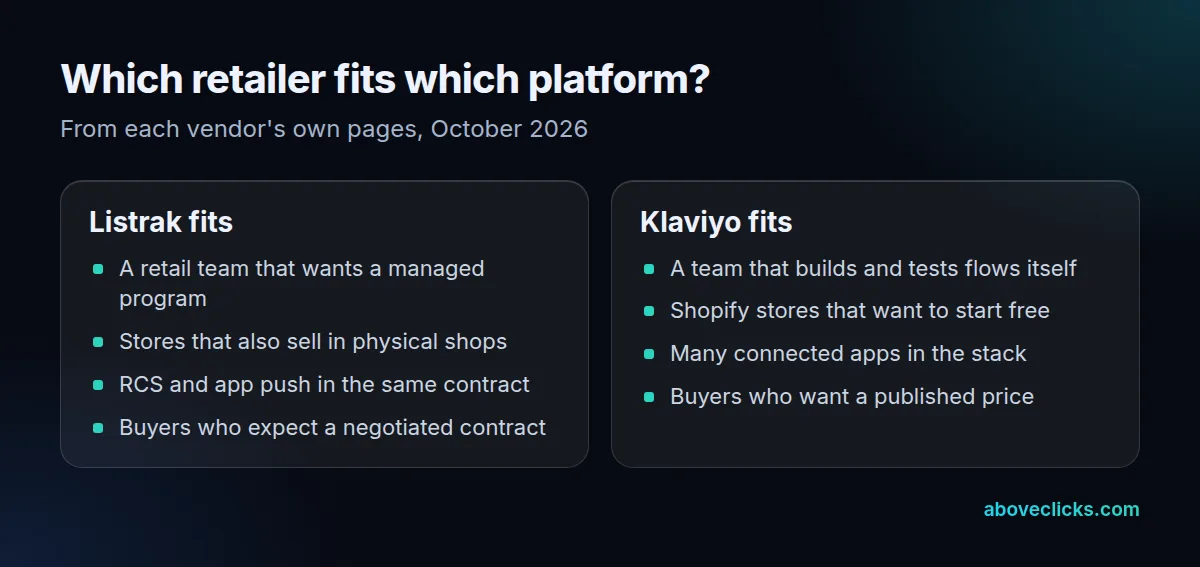
Read the Klaviyo vs Listrak review numbers with the sample size in mind. Listrak sells mainly to larger retailers through its own sales team, so its listing has few reviews. Klaviyo’s thousands of reviews include many small stores, and the low ones include complaints about bills rising with the active profile count.
Deliverability isn’t the tie-breaker either way. Google’s sender guidelines require anyone sending more than 5,000 messages a day to Gmail accounts to set up SPF, DKIM and DMARC, keep the spam rate below 0.3% and support one-click unsubscribe, as of October 2026. That applies on both platforms, and our email deliverability service checks the setup on either. For other options, see our Klaviyo alternatives and Klaviyo vs HubSpot guides.
How do you move from Listrak to Klaviyo?
By CSV, in a fixed order: suppressions first, then subscribers, then flows rebuilt and switched off, then Listrak disconnected from Shopify before Klaviyo connects.
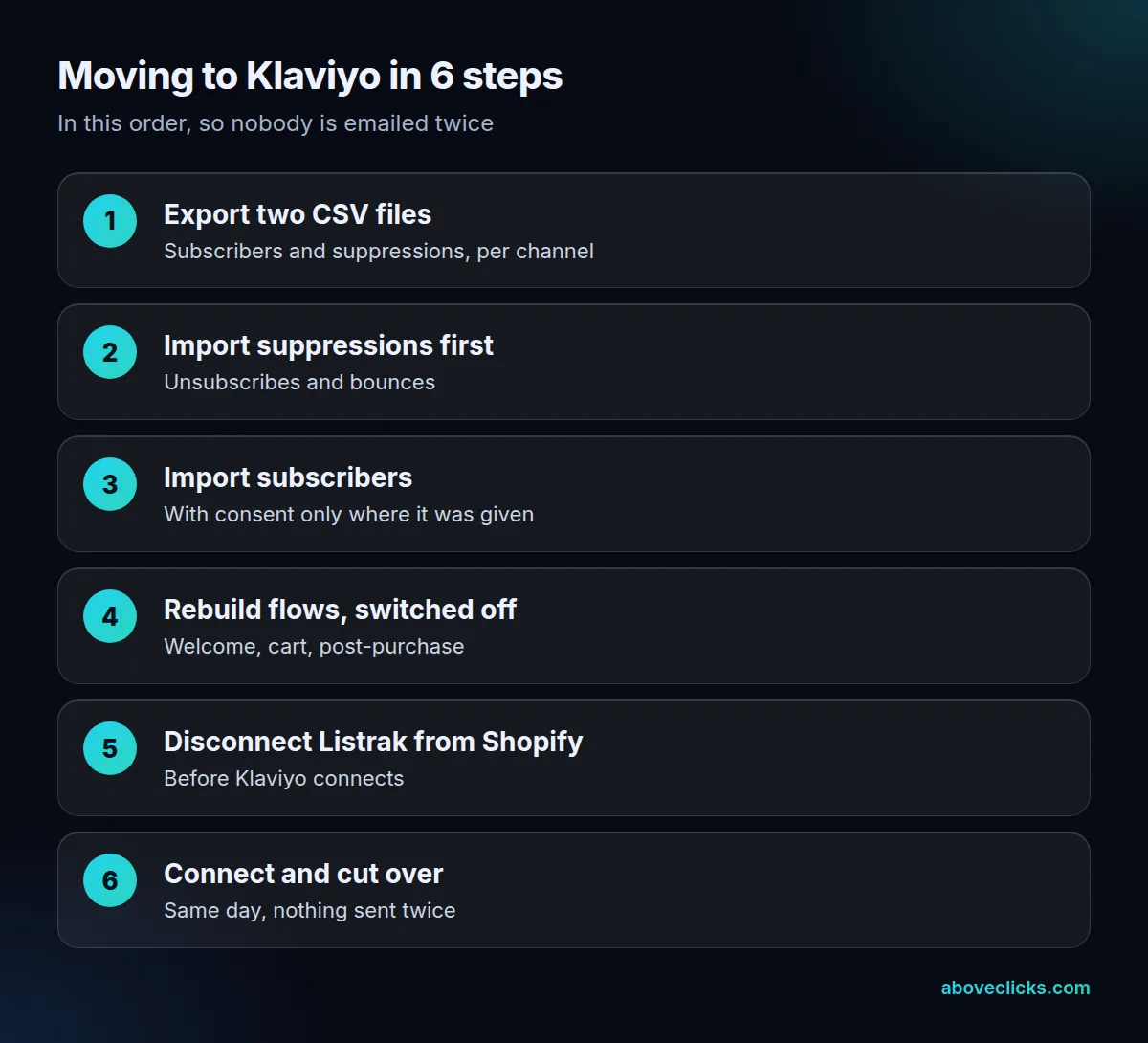
Klaviyo’s migration article lists built-in importers for 3 tools, Mailchimp, Campaign Monitor and Salesforce Marketing Cloud, as of October 2026; Listrak isn’t one of them, so contacts come in from CSV files. Export unsubscribes and bounces separately and import them as suppressions before the first send. Export SMS consent in its own file too, because consent is kept per channel. The FTC’s CAN-SPAM guide says you must honour an opt-out within 10 business days, so an unsubscribe lost in a move is a legal problem, not just a bad email. After the suppressions are in, Klaviyo’s billing guide notes the billed profile count can take up to 72 hours to refresh.
The Shopify step matters most. Klaviyo’s Shopify guide warns that leaving a prior email app connected can send double opt-in emails to your existing subscribers. Rebuild the welcome, cart and post-purchase flows in Klaviyo while they’re switched off, then turn them on and Listrak’s off on the same day. Check your Listrak contract’s notice period before you set the date: in a Listrak vs Klaviyo switch, the contract usually sets the timeline, not the data.
When we move a store, our Klaviyo migration starts with a free audit: a PDF plan within 2 workdays of what moves, what gets rebuilt and what to leave behind, then suppressions and consent, lists, flows and forms, and a cut-over with nothing sent twice. If you’re already on Klaviyo and unsure it’s set up well, our Klaviyo email marketing team can review it, or start with the free audit. More comparisons are in buying guides.