Facebook jewelry ads are paid Meta ads that send likely buyers and past visitors to a jewelry store’s product pages, usually as catalog or single-image ads. Set them up by the tier of your pieces, because a low-cost piece and a high-end one need different first steps.
This guide covers the set-up by tier, what good examples share, the weekly budget Meta’s learning phase asks for, the claims to avoid and how to read results. It is written for stores that sell online and want Facebook jewelry ads to pay back, not just collect clicks.
What are Facebook jewelry ads?
They are ads in Facebook and Instagram feeds, Stories and Reels that show a piece of jewelry and link to its page in your store. Jewelry facebook ads can be built from your product catalog, a single image or a short video.
Behind the ads sits the Meta Pixel, which reports shopper actions to Meta. Its reference lists 17 standard events, and only a few of them matter for a jewelry store at the start.
Most stores use two kinds. Catalog ads pull the pieces from your product feed and can show past visitors the exact items they viewed. Single-image or video ads carry one message, such as a gift angle or a close-up of a stone.
Our jewelry ads guide compares all channels, including Google Shopping. This guide stays on Facebook and explains how to structure the account and budget it. Meta ads for jewelry work best when the structure is settled before the first ad goes live.
How are Facebook jewelry ads different from selling on Marketplace?
Marketplace is a free listing space for one-off sales between people; ads are a paid system that finds buyers for a whole catalog and reports the results. They need different skills.
Autocomplete shows how often people mix the two up, with searches like “can you sell jewelry on facebook marketplace” appearing next to ad searches. Listing a ring on Marketplace puts it in front of people browsing the marketplace. An ad puts it in front of people chosen by Meta’s delivery system or by your targeting.
The paid route has one extra step that Marketplace never needs: learning. Meta says an ad set usually leaves the learning phase after about 50 results in the week after its last significant edit. Until then, delivery is less stable and the cost per result is usually higher, so early numbers are a poor guide.
How should you set up Facebook ads for jewelry?
Start from the price of the piece: low price pieces can optimize for purchases at once, while high price pieces often need an earlier step, such as product views or adds to cart, first.
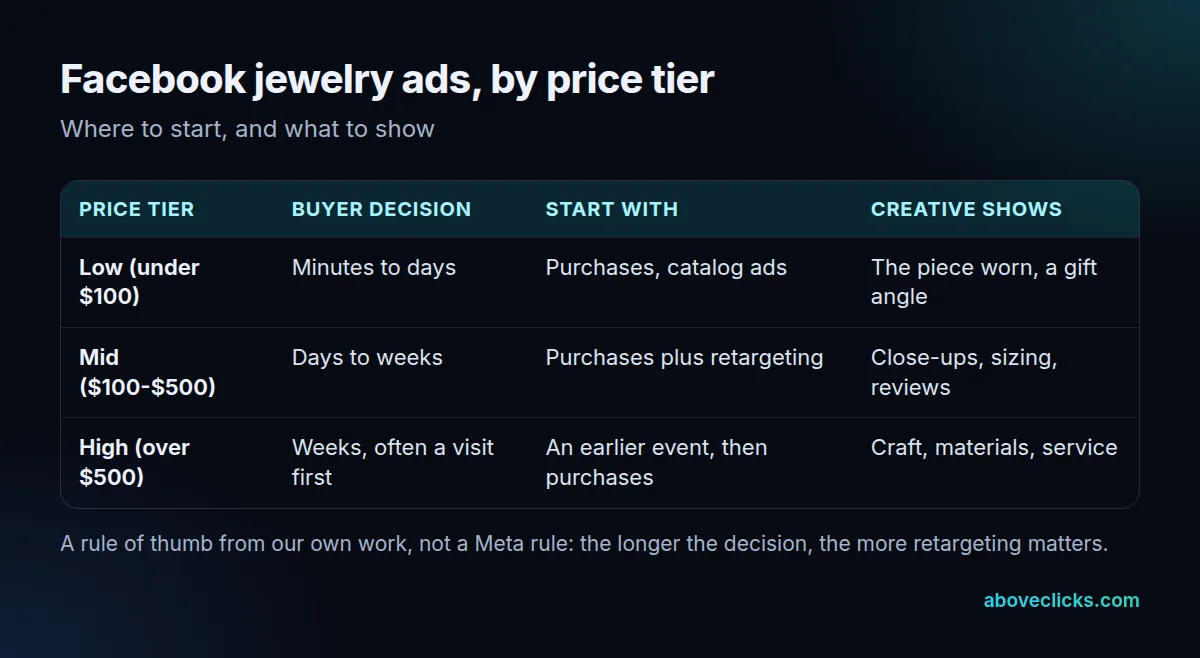
The table is our rule of thumb, not a Meta rule. The reasoning is simple. Someone buying a $40 earring decides in a session. Someone buying a $2,000 ring may visit three times over a month, so the ad set that wins is the one that keeps the store in front of them. That is why facebook ads for jewelry above a few hundred dollars lean on retargeting. For facebook ads for jewelry at the high end, the first goal is often more qualified visits, not more orders.
Follow four steps in this order.
- Fix the pixel events. Meta’s pixel reference lists 3 events that must carry product details for Advantage+ catalog ads: ViewContent, AddToCart and Purchase need
content_idsorcontents. Purchase also needscurrencyandvalue. - Build the catalog. Titles, images and prices must match the site, because a mismatch between ad and product page loses the shopper at once. Split it into product sets by category and margin.
- Choose the audiences. Meta’s detailed targeting reaches people by interests, behaviors and demographics. Meta also reports that Advantage+ audience cut cost per result by 7.2% under the Sales objective, but says it is not recommended for retargeting. Keep past visitors in their own ad set.
- Set the target. Work out your break-even ROAS before launch, so you know what a good week looks like.
Our Meta ads service follows the same order, and the jewelry industry page shows how we apply it to stores like yours.
What do good jewelry Facebook ads examples have in common?
Each one has a single job and one clear image. Looking at jewelry facebook ads examples, the strong ones tell the viewer one thing in the first second, whether that is the gift, the stone or the price tier.
Here are 4 ads, each with one job. These are formats to build, not real ads to copy.
- The worn close-up: a piece on a hand or neck, so people judge size. Job: cut returns.
- The gift moment: a box being opened, with a line about delivery dates. Job: convert in seasonal weeks.
- The craft clip: a short video of casting, setting or polishing. Job: justify a high price piece.
- The reminder: a catalog carousel of the pieces someone viewed. Job: bring back visitors.
A strong set of jewelry facebook ads examples also keeps the offer simple. One piece, one reason to click and one landing page beat a collage of twenty items, because the shopper never has to decide what the ad is about.
The same job-first rule is how you plan tests. Change one element at a time, as in our creative testing guide, so you know which change moved results.
How much budget do Facebook ads for jewelry need?
Enough for about 50 results a week per ad set, so weekly budget is roughly your cost per result times 50. At $40 per purchase that is $2,000 a week for one ad set.
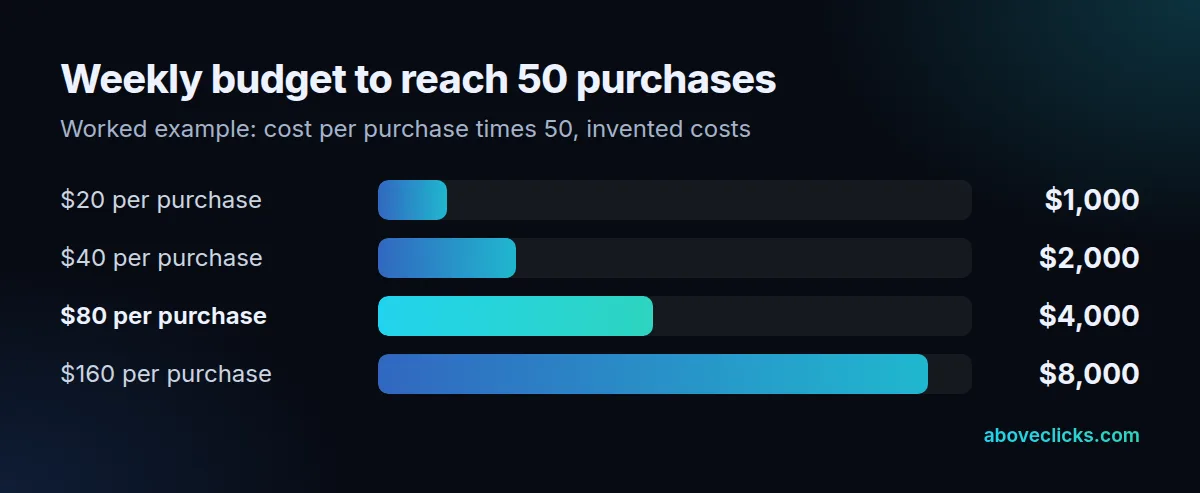
This is a worked example with invented costs, not a market rate. It follows Meta’s guidance that ad sets exit the learning phase after about 50 results in a week. For Shops ads the page asks for a minimum of 17 purchases on your website and 5 through Meta.
That is why price tier matters for budget. A store with a $160 cost per purchase would need $8,000 a week to feed purchase learning. A smaller budget fits an earlier event, such as AddToCart, which happens far more often. Treat it as a stepping stone and judge it against orders, not clicks. Many facebook jewelry ads accounts start this way and move to purchase optimization once volume allows.
Meta also advises realistic budgets, fewer ads and ad sets, and fewer edits during learning. Every significant edit can reset it, so changing budget daily wastes spend. Our Meta ads cost guide covers the costs beyond the learning phase.
Which claims can Meta ads for jewelry make?
Only claims you can prove, in words and pictures alike. The FTC’s Jewelry Guides apply to advertising and other marketing, whether a claim is direct or implied.
The text of 16 CFR 23.0 says the guides cover claims made through words, symbols, illustrations and depictions. For Facebook that means a video that shows a stone as natural while the caption stays silent can still raise an issue. Check the video as closely as the headline, since facebook jewelry ads are judged on the whole picture.
Our jewelry ad guide lists the claim words that need proof, from vermeil to handmade. Read the ad’s picture, caption and landing page together before you submit it, because the shopper does.
What mistakes make Facebook jewelry ads cost more?
The costly ones are mistakes in structure, not in wording: too many ad sets, constant edits, mixed audiences and judging by clicks. Each one starves the learning phase of the results it needs.
Meta’s learning page names several of them directly. These are the ones we see most often in jewelry accounts:
- Too many ad sets for the budget. Meta says that creating many ads and ad sets teaches the delivery system less about each one, and that combining similar ad sets also combines their learnings. A small store with 6 ad sets rarely reaches 50 results in any of them.
- Editing during learning. Changing audience, budget or creative inside the first week can reset it. Make a list of changes and apply them together, after the ad set has settled.
- Mixing prospects and past visitors. The two groups behave differently, and one blended ad set hides which is paying.
- Judging by clicks. A cheap click on a ring photo says little about orders. Judge the account on purchases and on revenue against break-even.
- Pushing a high-end piece straight to purchase. At a high cost per purchase, the ad set may never collect enough results, so give it an earlier event first.
None of these needs a bigger budget to fix. They need fewer moving parts, which is also what makes meta ads for jewelry easier to read.
How do you know the ads are working?
Compare orders in your store with what Ads Manager reports, after the ad set has left learning. Meta’s own view of results is a guide; your order data is the check.
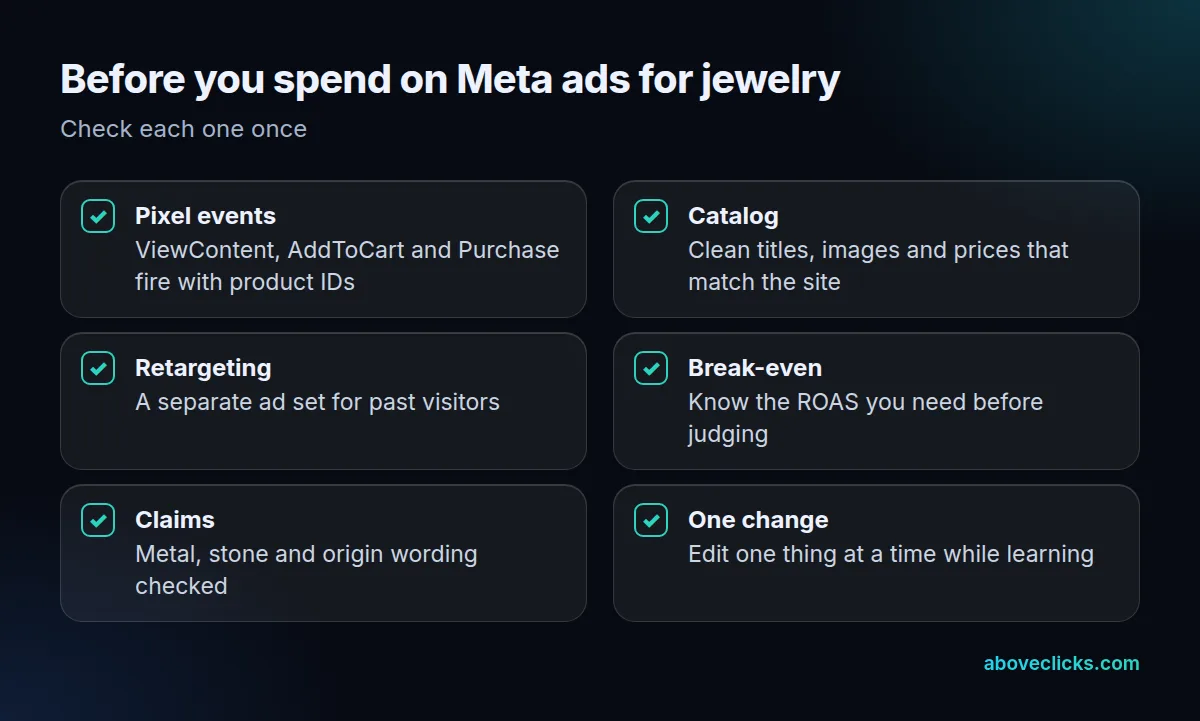
Use the checklist before launch, then review weekly. Add the “last significant edit” column in Ads Manager, as Meta’s learning page suggests, so you can see how many results came after the last change. Meta measures learning over the 7 days after that edit, so treat any week with a fresh edit as a learning week and compare it only with other learning weeks.
Then compare revenue with your break-even target, and read more setups in our Meta ads guides. Write the result down each week: spend, orders, revenue and the date of the last edit. After 4 weekly entries, the pattern in your facebook jewelry ads is far easier to read than any single day. If you want a second opinion on the account, our free audit reviews it with read-only access.