How much do Meta ads cost? There is no fixed rate: you choose a budget, and an auction decides what each click, view or purchase costs, so the useful answer is the budget you need for the result you want.
This guide answers how much do Meta ads cost by explaining what the Meta ads cost depends on, how Meta charges you, how to size a budget from your own numbers, and what help adds on top. All Meta rules below were read on Meta’s own pages in November 2026.
How much do Meta ads cost per month?
For a month, how much do Meta ads cost? Whatever monthly budget you set, plus anything you pay someone to run the account. Meta does not publish a standard rate, so the cost of Facebook advertising is your choice of budget and the results it buys.
Be wary of any single average when you ask how much do Meta ads cost. Cost per result changes with your product, country, season, audience and ad quality, and a number from another account says little about yours. We do not quote market averages here for that reason.
What you can rely on is Meta’s own rule for how a budget behaves, as of November 2026. A daily budget is an average over the week, not a hard cap, and a lifetime budget is the hard cap. That difference matters more than any benchmark when you plan a month: a lifetime budget is a hard limit, so a 30 days campaign cannot pass it, while a daily budget can run over on busy days inside the weekly limit of 7 times the daily budget.
How much do Meta ads cost per day?
Your daily budget is the average you are willing to spend each day, and Meta may spend more on some days and less on others. Meta says it may spend up to 75% over the daily budget on a day with better opportunities.
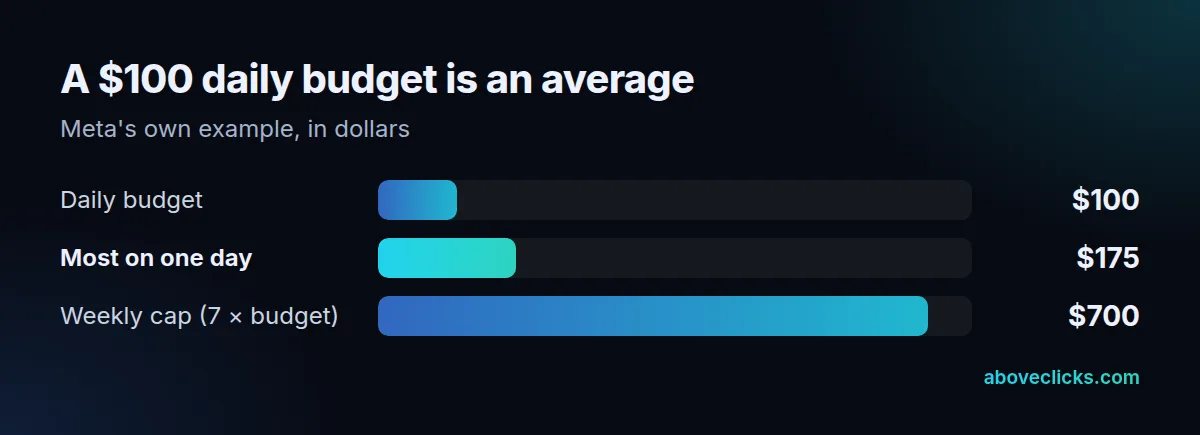
The weekly limit is firm. On Meta’s budget help page, a $100 daily budget can reach $175 on one day, but the calendar week (Sunday to Saturday) should not pass $700. For a campaign shorter than 7 days, the total should not pass the daily budget times the number of days.
So a day that looks like an overspend in your Meta ads cost report is usually normal. Judge your Meta ads cost over full weeks, and set the budget you can afford to spend 7 times over, not the figure you can afford once.
What decides the cost of Facebook advertising?
The ad auction sets most of the cost of Facebook advertising. Each time someone could see an ad, Meta runs an auction, and the winner is the ad with the highest total value, not the highest bid.
Meta’s ad auction page says total value combines 3 factors:
- Bid: what you are willing to pay for your desired outcome.
- Estimated action rates: how likely this person is to engage with or convert from your ad.
- Ad quality: feedback from people and checks for things like withheld information or engagement bait.
The cost of Facebook advertising therefore moves with relevance as well as competition. An ad that is more relevant can win against ads with higher bids, so better creative and a clearer offer can lower what each result costs. Meta says billions of auctions run every day, and your Meta ads cost is set by the ones your audience falls into. Each auction has 1 winning ad, and the other ads that were eligible pay nothing. Meta’s page names 3 inputs and no fixed rate per 1,000 impressions, so two stores selling the same product can pay very different amounts. Meta also says its adjustments will not make it charge you more than your bid.
If you know Google Ads, the idea is familiar: Google’s help page on actual CPC says you are often charged less than your maximum bid. The two systems differ in detail, so do not carry numbers from one to the other.
How do Meta’s advertising charges work?
Facebook advertising charges follow the event your ad set is billed on: most often impressions, and for some goals link clicks. Which one applies is set by your campaign goal, not chosen freely.
Meta’s developer documentation on billing events says the billing event defines what you pay for, such as impressions, clicks or actions, and that billing depends on the size of your audience and your budget. Billing events come in 3 kinds for auction campaigns in the documentation’s table (impressions, link clicks and a few special cases), and valid events depend on the optimization goal, so an ad set optimized for purchases is not billed the same way as one optimized for link clicks. Whatever the event, the amount you see is spread over 1,000 impressions or per click only as a reporting figure; your real Facebook advertising charges are the sum of what the auction took.
Your bid strategy then shapes how Meta spends, and it changes your Facebook advertising charges in 3 ways. In the bid strategy documentation:
- Lowest cost lets Meta bid to get the most results from your budget.
- Cost cap aims for an average cost per action you set, but Meta says Meta does not promise it will hold the cap.
- Bid cap sets the highest bid in each auction, so it limits delivery if set too low.
Which billing event applies is shown in Ads Manager for each ad set, so check it before you launch. For a new account, lowest cost is the usual start because you do not yet know what a result costs. Caps help once you do.
How much budget do you need to get results?
Enough to buy the results you need each week at the cost you can afford, because the Meta ads cost per result decides everything else. Start from your target cost per result, not from a round budget number.
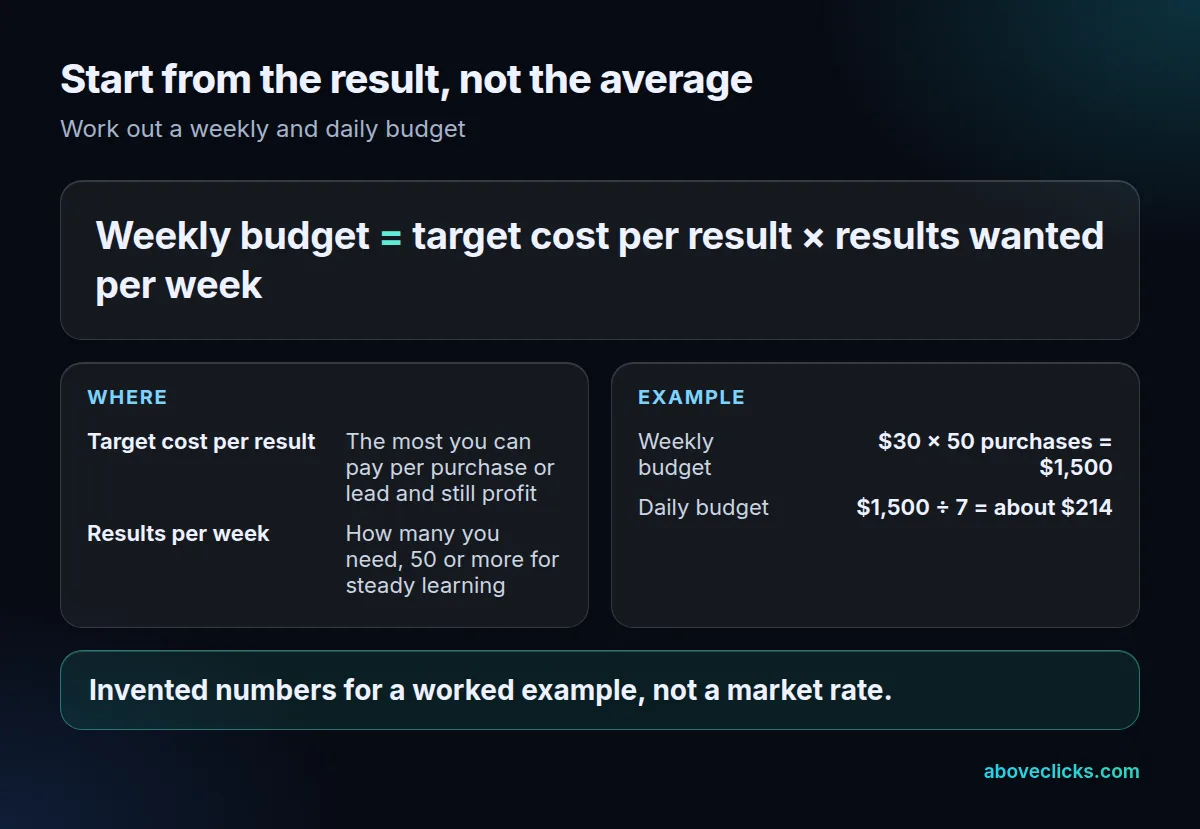
Meta’s bid strategy help recommends 50 to 100 or more conversions a week for best performance with goal-based bidding. In the invented example above, a store that can pay $30 per purchase and wants 50 purchases a week needs about $1,500 a week, or about $214 a day. That is a planning figure, not a promise of 50 purchases, and a month of it is about $6,500 (52 weeks divided by 12 months, times $1,500). Compare that with your margin before you commit, because Meta ads cost real money whether or not the first weeks work.
If that number is beyond you, there are 3 honest options:
- Optimize for an earlier step, such as add to cart, where results are more frequent.
- Narrow the plan to one product or one audience, so the budget is not split thin.
- Wait until the budget supports the plan, and fix tracking and the site first.
A simple way to spend the first month is to split it in 3 parts. Spend the first 7 days on a steady budget with no changes, so the account can gather results. Use days 8 to 21 to compare ads and audiences on cost per result, and pause only the clear losers. Use the last days to decide whether to raise the budget, keep it or stop. Changing the daily budget every 2 days makes the cost per result hard to read, because Meta’s weekly limit works on the whole calendar week, as the budget help page explains with its own examples of mid-week changes.
Track the same 3 numbers each week: ad spend, results and cost per result. If tracking is weak, the cost per result is a guess, which is why a Meta ads cost review should start with the pixel and the Conversions API before any budget change.
Our Facebook ads conversion rate guide shows how the site side changes your target cost per result, and the Meta ads for ecommerce guide covers how a store structures its spend.
What does it cost to have someone run your Meta ads?
A separate cost from ad spend, and the second half of how much do Meta ads cost. Ad spend goes to Meta from your own account; a management fee goes to whoever runs it, and a quote should keep the two apart.
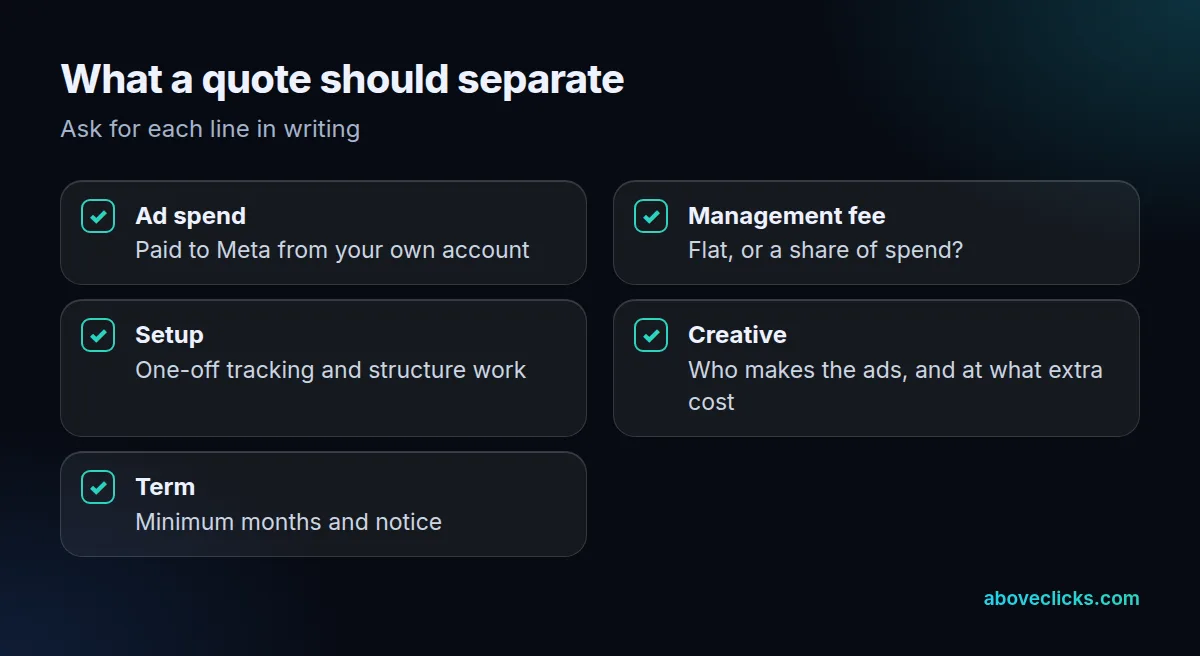
As of November 2026, our Meta ads management starts at $500 a month plus ad spend, with a one-off account setup from $400 when the account needs it. There is no percentage of ad spend and no minimum term, per the live service page. Other providers bill differently, and the pricing models guide explains flat fees, percentage of spend and retainers so you can compare like with like. Our PPC pricing guide covers the same question for paid search.
Are Meta ads worth it?
When the profit on what they sell exceeds what they cost, and you can measure both. Worth is a calculation on your numbers, not a verdict on the channel.
Check these 4 costly mistakes before you decide:
- Budgeting from an average: an average from another business hides your margin, so size the budget from your own target cost per result.
- Judging single days: daily spend swings by up to 75%, so read full weeks.
- Ignoring the weekly cap: plan for 7 times the daily budget, not once.
- Mixing fees with ad spend: if you cannot see what you pay Meta and what you pay for help, you cannot see the real cost per result.
In short, how much do Meta ads cost? It is the budget you set, billed through an auction, plus any help you hire. If you want your numbers checked against your account, our free audit reads your setup and gives you a budget you can test. More guides are in Meta ads.