Jewelry ads are paid ads for rings, necklaces and other pieces, shown on Meta, Google Shopping and Google Search. They work when the product feed is complete, the claims match the FTC Guides and spend stays above break-even ROAS.
This guide covers the main kinds of jewelry ads, the product data Google needs, creative that holds up, the wording rules, a break-even example and the timing of gifting peaks.
What are jewelry ads, and which kinds do online stores run?
Jewelry ads are paid placements that show a piece to shoppers who are searching for jewelry or scrolling a social feed. Online stores mostly run catalog ads on Meta and product ads on Google.
Meta’s Advantage+ catalog ads come in 3 formats: carousel, collection, or a single image or video. They need a product catalog and a Meta Pixel or app SDK to track what people do with each product.
Google’s Performance Max serves 6 channels from one campaign, including YouTube, Display, Search, Discover, Gmail and Maps, using the feeds, images and bidding goals you provide.
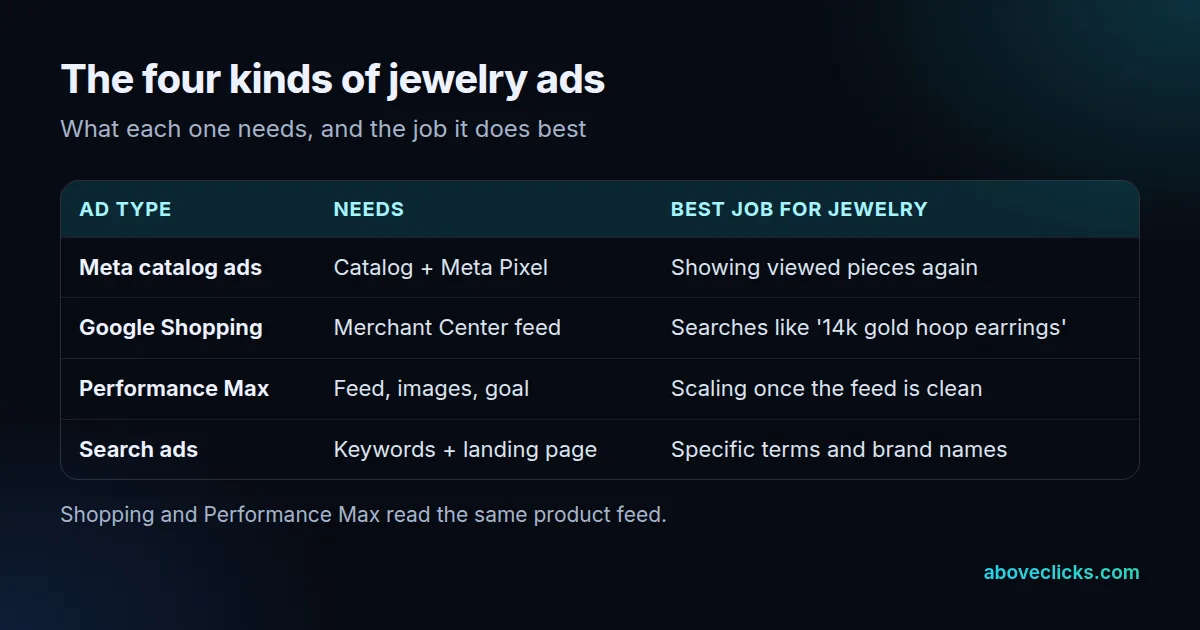
Ads for jewelry on Shopping and Performance Max read the same feed, so fixing the feed once improves both. A catalog of 400 pieces means 400 feed rows to get right, and each row is a chance to qualify or disqualify a search. Search ads sit apart: they use keywords you choose, such as a specific stone or metal, and they send people to a page you pick.
Which ads for jewelry work on Facebook and Instagram?
Jewelry ads on Facebook and Instagram share one Ads Manager account and one catalog. The setup that works is catalog ads built from a clean feed, shown first to people who already viewed a piece, with close-up and on-hand creative behind them. That is where our jewelry marketing work starts.
Meta’s setup guide gives 2 audience paths. For retargeting, choose a catalog custom audience, such as people who recently viewed products. For prospecting, use detailed targeting like age, gender or interests. Meta also recommends excluding recent purchasers unless you are cross-selling.
For a store with 400 pieces, one product set for everything wastes the format. Split the catalog into sets by category and margin, such as rings, earrings, necklaces and gifts, so each carousel shows pieces that belong together.
Measure the result against your store’s own orders, not only Meta’s report, because a catalog campaign that shows 3.0 ROAS in Ads Manager can still miss break-even once returns are taken out. Then test creative in a controlled way. Start with 3 concepts: a close-up on a hand, a gift-unboxing clip and a styled shot on a model. Change one element per test, as our creative testing guide explains, and our Meta ads service covers the account setup behind it.
How do Google Shopping ads work for jewelry?
Google reads your product feed, matches pieces to searches and shows the image, title and price. A complete feed decides which searches you can enter.
Ads for jewelry depend on a few feed fields that generic advice skips. All limits below come from Google’s product data specification:
- Title: up to 150 characters. Put metal, stone and product type first, as in “14k yellow gold hoop earrings, 20 mm”.
- Material: one primary material plus up to 2 secondary ones, separated by “/”, such as “gold/diamond”. The field takes up to 200 characters.
- Images: the main image plus up to 10 additional ones. These can include staging and the piece in use, such as worn on a hand.
- Brand: you may enter your own brand name if you make the pieces or sell customized jewelry.
- Identifiers: if a piece has no GTIN and no MPN plus brand, set identifier exists to “no”. A made-to-order ring usually falls here.
- Cost of goods sold: optional, but it lets Google report gross margin next to your ad revenue.
Feed titles are ads too, so the wording rules in the claims section apply to them. A lab-grown stone listed as “diamond hoop earrings” breaks the rule, while “laboratory-grown diamond hoop earrings” does not. Missing material or color values keep a listing out of searches such as “14k gold hoop earrings”. Our Google Shopping feed guide shows a worked title rewrite, and the Google Ads service page covers how we set up the campaigns on top.
What makes jewelry ads that work?
Ads that show the real piece at its real size, from several angles, with a claim a buyer can check. Prettier photos help less than accurate ones.
Size is the first trap. The FTC Guides say an illustration that shows a diamond or other gemstone larger than actual size may mislead consumers unless the true size is disclosed. A macro shot is fine when a hand or a ruler beside it shows the real scale.
Then use the 10 extra feed images well, because jewelry ads draw on the same pictures as the product page. A workable set is 1 white-background shot, 1 on a hand or neck, 1 detail of the clasp or setting, 1 packaging shot and 1 size reference. Jewelry ads that work usually answer the questions a buyer cannot ask: how big is it, what is it made of, will it arrive as a gift.
Jewelry ads that work also earn trust before the click: a clear return policy, a metal and stone description and real reviews on the landing page. The ad promises, and the page proves. That is the difference between jewelry ads that work and ones that only get clicks.
Video does the same job. A 6-second clip of a ring catching light on a hand shows more than a still. Keep claims in the text, not in the clip, so they can be checked and edited.
Which claims can a jewelry ad make?
Any claim you can prove, with the right qualifier. Jewelry ads and feed titles fall under the same rules. The FTC Jewelry Guides apply to advertising and all other marketing, at every level of trade, including retailers, according to 16 CFR 23.0.
The Guides are the FTC’s current thinking, not a statute. The agency can still act under the FTC Act if a claim is inconsistent with them. See the FTC’s rule page for the full set, and read the text yourself because this list is a summary, not legal advice.
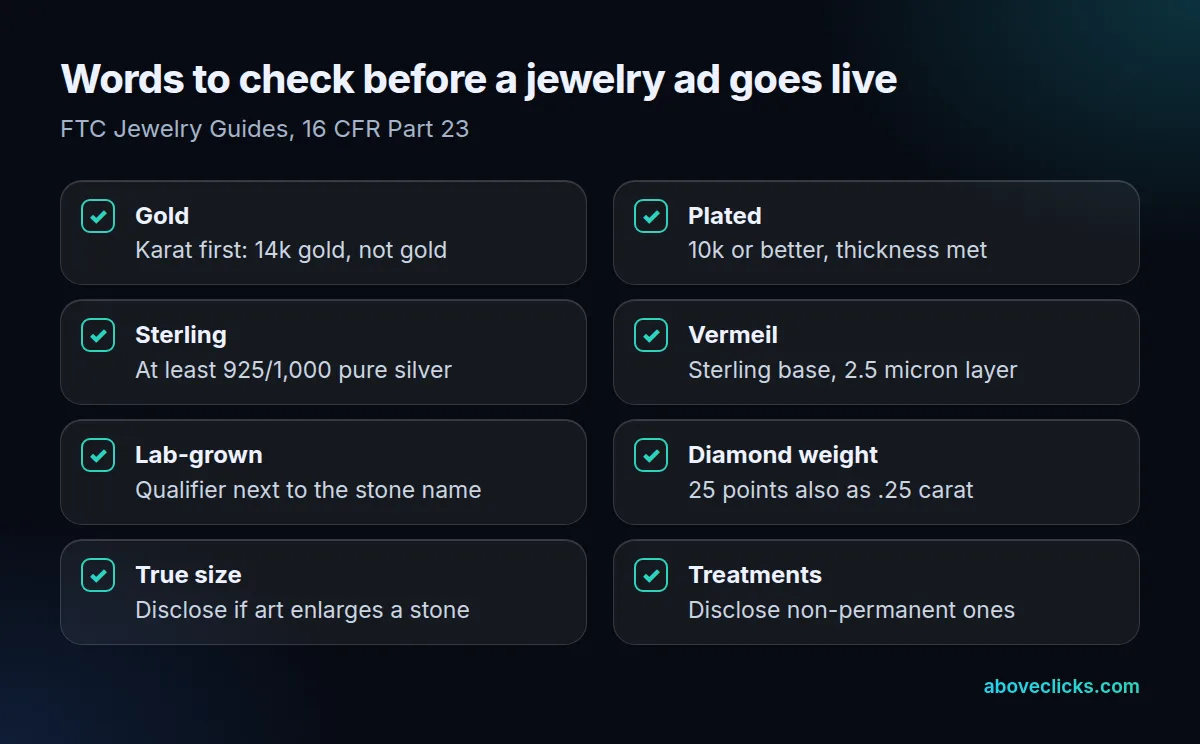
The checks that catch most ad copy and feed titles:
- Gold: under §23.3, unqualified “gold” means 24 karat, so a 14k piece is “14k gold”. “Gold plated” needs an alloy of at least 10 karat, and an electroplate needs at least 0.175 microns of gold.
- Sterling and vermeil: sterling means at least 925/1,000 pure silver. Vermeil means a sterling base with a gold layer of at least 2.5 microns.
- Lab-grown stones: §23.12 and §23.25 require a clear qualifier such as “laboratory-grown” next to the stone name, as visible as the name. “Faux” does not count.
- Weight: a weight in points must also appear as decimal carats, such as 25 points or .25 carat.
How much should a jewelry store spend on ads?
As much as your margin allows at a ROAS above break-even, so spend on jewelry ads follows margin, not a round number. Work that number out first, then set daily budgets from it.
Break-even ROAS is 1 divided by gross margin, and it sets the ceiling for every jewelry ads budget. Our break-even ROAS entry explains the formula, and the worked example below uses an invented store.
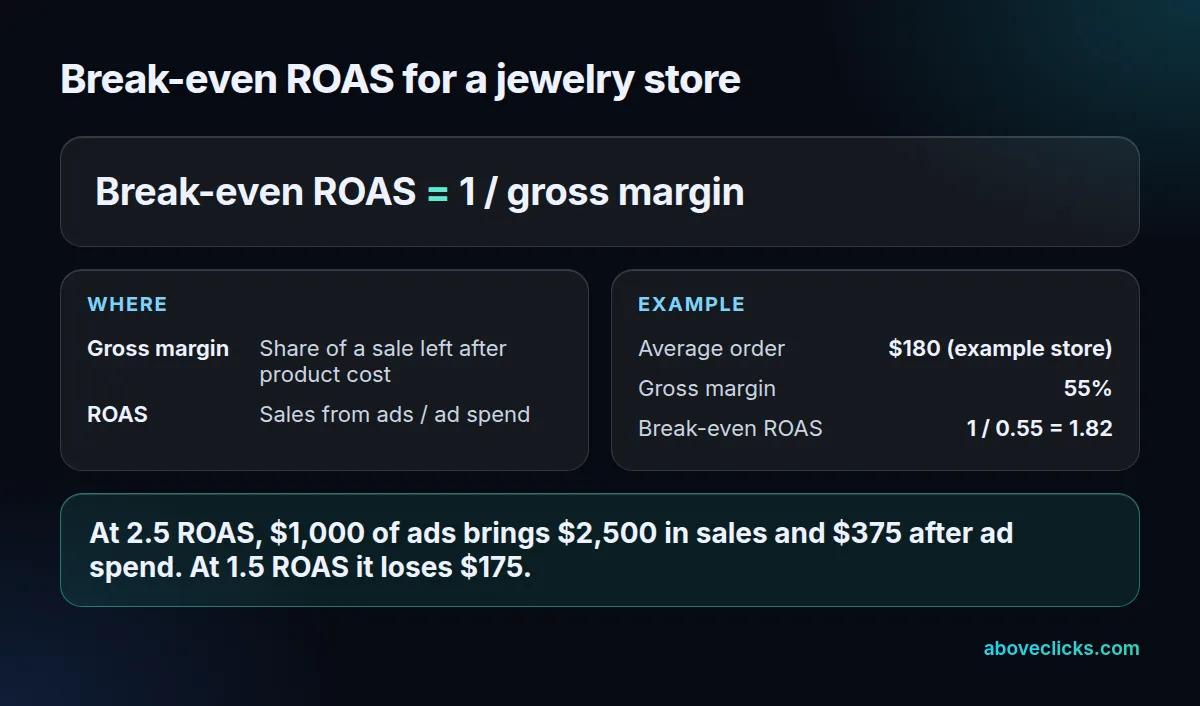
In the example, an average order of $180 at a 55% margin gives a break-even ROAS of 1.82. A second example store sells earrings at a 60% margin (break-even 1.67) and fine pieces at a 40% margin (break-even 2.5), so one 2.0 target would overspend on the second range. Every $1,000 of ads must bring back at least $1,820 in sales just to cover the ads and product cost. That margin counts product cost only; shipping, payment processing and returns lower it, so use your own figure.
Jewelry margins differ by category, so one store-wide target hides losers. Our practice, as listed on the jewelry industry page, is to set break-even ROAS by category and use custom labels for margin and best sellers. A target ROAS bidding strategy then works from numbers that are real.
When should a jewelry store advertise?
Before each gifting peak, with the feed and creative ready weeks earlier. Google’s guidance on seasonality adjustments sets the limits for short events.
Google says seasonality adjustments suit events of 1 to 7 days and may work less well beyond 14 days. Smart Bidding already manages seasonal events, so use an adjustment only for a major change in conversion rate. In Google’s example, a 3-day sale expected to raise conversion rates by 50% gets a matching adjustment for those 3 days.
Plan ads for jewelry around your own sales history. Pull your own order dates for the last 2 years, by week, and mark the peaks. Those dates, not a generic calendar, tell you when to start. After each peak, review the jewelry ads by category and keep only the product sets that cleared break-even. For a sale or a launch, fix the product sets, stock status and landing pages at least 2 weeks ahead.
Five checks before you spend a dollar
Run these 5 checks on your jewelry ads in order, before a first test budget of even $500. Each one removes a reason to waste the money.
- Tracking: purchases reach Meta and Google with the right value, so ROAS is real.
- Feed: titles, material, images and identifiers are complete for every piece you advertise.
- Creative: true size and scale are shown, with 3 concepts ready to test.
- Claims: gold, silver, stones and weights match the checklist above.
- Break-even: you know the ROAS each category needs (1.82 in the example above) before any budget is set.
Want a second opinion on jewelry ads that are already running? Our free audit reads your store and ads and sends a report within 2 workdays. More guides are in industry guides.