In Facebook ads vs Amazon PPC, Facebook ads reach people who were not searching, while Amazon PPC pays for a click when shoppers search Amazon to buy. Choose by where your buyer is and where the sale is recorded.
This guide compares Facebook ads vs Amazon PPC (and Amazon PPC vs Facebook ads from the other side) on billing, budgets, fit and measurement, then lists the five mistakes that waste money when both run together.
What is the difference in Facebook ads vs Amazon PPC?
Amazon PPC shows your product to shoppers who are already searching a store; Facebook ads show an offer to people scrolling a feed who may not know you exist. That one difference explains most of the rest.
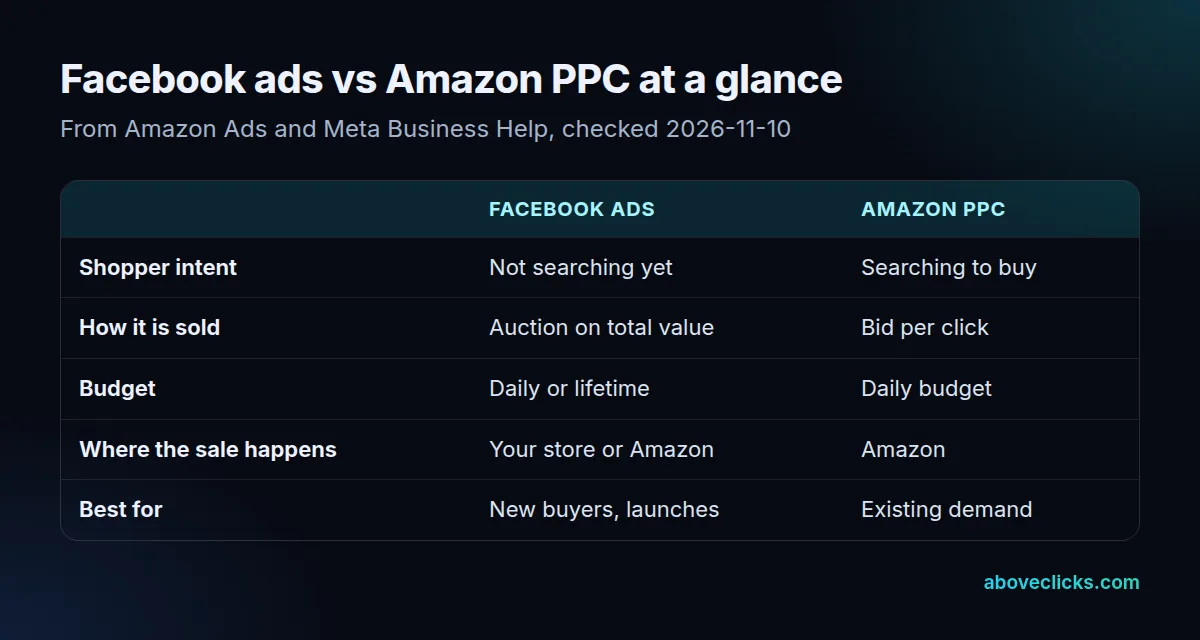
On Amazon, Sponsored Products are cost-per-click ads for individual listings. You choose keywords to target or let Amazon’s systems pick them, and your ad can appear at the top of, alongside or within shopping results and on product pages, and Amazon says shoppers can reach the product page and buy in 1 to 2 clicks. Sponsored Brands adds a brand-level placement with video, image or collections.
On Facebook, each ad opportunity runs an auction. Meta’s ad auction guide says the winner is the ad with the highest total value, built from 3 factors: your bid, the estimated action rate and ad quality. A more relevant ad can win against a higher bid, and in Meta’s own example 1 person can sit in the target audiences of 2 advertisers at once, so both ads enter the same auction.
The result is a clear split in Facebook ads vs Amazon PPC: Amazon PPC is a search-style channel and Facebook ads are a discovery channel. Many sellers compare Facebook ads vs Amazon ads as if one replaces the other; they feed different parts of the buying path. Treat Facebook ads vs Amazon PPC as a question of jobs, not of winners. Our Amazon Ads and Meta Ads services are separate for that reason.
How does each platform charge you?
Amazon charges per click against a daily budget; Meta runs an auction and bills against a budget you choose. Both let you cap spend, but the caps behave differently.
Amazon says Sponsored Products campaigns have no monthly or upfront fees, and you bid the maximum you will pay for a click. The daily budget is not paced through the day. Amazon’s own example: a $100 daily budget can bring up to $3,100 of clicks in a 31-day month, and a small budget can run out early in the day. Our Amazon advertising cost guide covers what typical clicks cost.
Meta’s budget guide says a daily budget is an average, not a hard cap. On days with better opportunities, Meta may spend up to 75% over the daily budget, and over a week it will not spend more than 7 times the daily amount. A lifetime budget is a hard cap. If you use a cost per result or ROAS goal for people on iOS 14.5 or later, Meta advises running the ad set for at least 3 full days.
What this means in practice:
- On Amazon, a budget that is too small ends the day early and you lose the afternoon shoppers.
- On Facebook, a budget that is too small gives the system too little data to learn from.
- Both need a cap you can afford in the worst week, not the average one. That budget behaviour is the first practical difference in Facebook ads vs Amazon PPC, and it affects how fast you can learn from a test of 14 days.
Is Amazon PPC worth it compared with Facebook ads?
On the question of Amazon PPC vs Facebook ads, Amazon PPC is worth it when shoppers already search for your product type and your margin covers the click. Facebook ads are worth it when you need to create demand or send people to a store you own.
Amazon PPC has two limits. Ads only appear when the advertised item is in stock, and the product must be eligible for the Featured Offer. If the listing is out of stock or loses that position, the spend stops working. Facebook ads have no such rule, but they depend on the offer and the creative being strong enough to stop a scroll.
A simple test on a worked example, with illustrative figures. Take 3 product groups and run both for 14 days. Amazon PPC: tight keyword groups on the 3 best sellers. Facebook ads: one prospecting audience per product. Then compare cost per sale, with margin included, per product group. Give each platform at least 14 days before you judge it, and do not compare a Facebook ads result from week 1 with an Amazon PPC result from week 4. A product with strong repeat demand tends to show up on Amazon first; a new product with no search volume tends to need Facebook to build it.
Our Amazon PPC guide covers how to structure campaigns, and the Facebook ads conversion rate guide shows what to expect once people click.
Can Facebook ads send traffic to Amazon listings?
Yes. Facebook ads can link straight to an Amazon listing, but Meta’s reports will not show the sale because it happens on Amazon.
That is the main trap of Facebook ads vs Amazon PPC for a seller who uses both. A listing link gives you clicks but no sale data. Amazon Attribution is a free measurement tool that shows the effect of non-Amazon channels, including social, search, display, video and email, on Amazon sales. Reports use a 14-day attribution window and include engagement and conversion metrics.
The set-up for Facebook ads vs Amazon PPC tracking is short:
- Create an Attribution tag for each product you advertise.
- Use one tag per tactic, such as one for a Facebook prospecting ad and one for retargeting, so you can read results by tactic.
- Paste the tagged link into the Facebook ad as its destination.
- Check the console weekly for detail views, add-to-cart and purchases.
Eligibility matters: Attribution is open to professional sellers enrolled in Brand Registry, vendors, KDP authors and agencies that work with them. If you are not eligible, send the traffic to a page of your own with analytics instead.
How do you measure Facebook ads vs Amazon PPC together?
Give every click a source you control, and read both on one sheet with the same period and the same sales window. Each platform reports its own numbers, and they will not add up.
Facebook ads vs Amazon PPC: why the reports disagree
The mismatch comes from three places. Meta counts the actions it can see, Amazon counts sales inside its store, and the two use different windows. Put them side by side only after you match the period, then add your own sales total as a check.
This is where Facebook ads vs Amazon PPC reporting usually breaks, so keep it simple: use the same 14-day window that Amazon Attribution uses on both channels. A weekly sheet needs 5 columns per product: spend on Amazon PPC, spend on Facebook ads, tagged sales from Attribution, Amazon-reported ad sales and your total units sold. If total units rise while neither platform claims the growth, look at organic rank and promotions before you cut budgets.
Read cost goals on Facebook only after a 3-day minimum run, as above, and do not change Amazon bids on the same day you change the Facebook budget. Two changes at once make a result unreadable. The SEO vs paid ads guide shows the same rule for organic work.
Which should you start with: Facebook ads or Amazon PPC?
When you weigh Facebook ads vs Amazon PPC for a first test, start with Amazon PPC if you sell on Amazon and shoppers already search for your product type. Start with Facebook ads if you have your own store, a new product category, or little search volume.
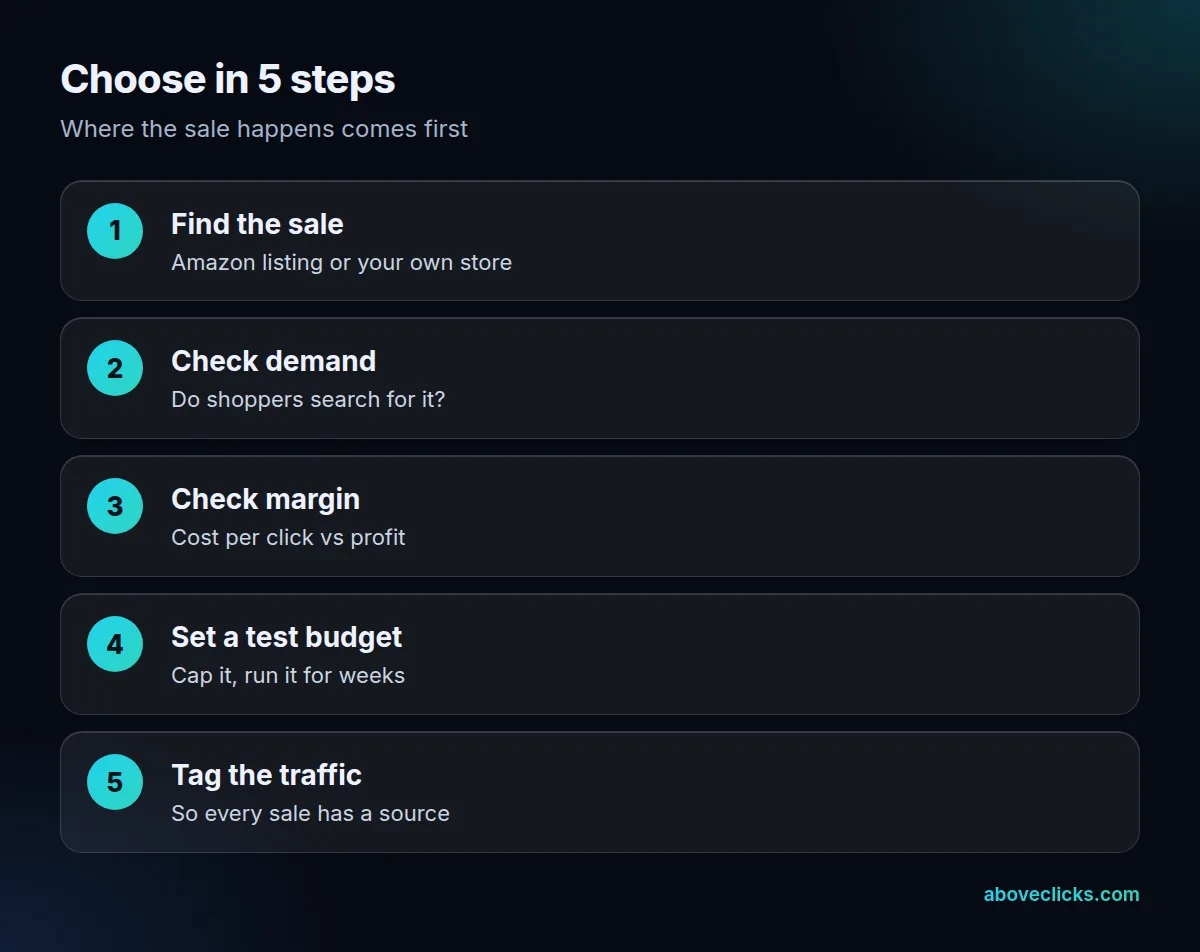
The steps above put the sale first. If the sale happens on Amazon and people search for it, Amazon PPC is nearer the money. If you need people to learn the product exists, Facebook ads do that job, and the tagged link brings the sales back into view.
Here is an illustrative split for a $3,000 month for a seller with a live Amazon listing and some search demand. It is a worked example, not a client result or a benchmark.
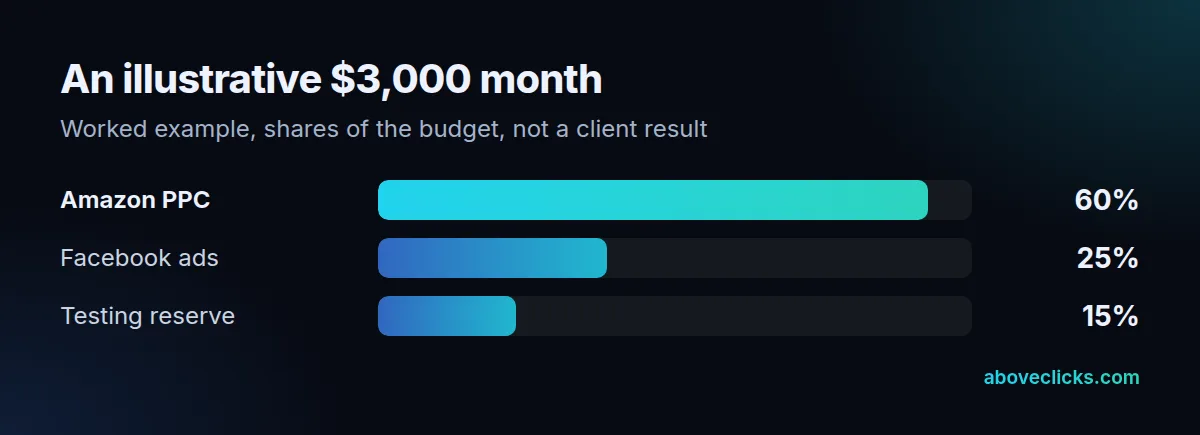
The 15% reserve is deliberate, and it is the part of Facebook ads vs Amazon PPC planning that people skip. It funds the one thing that looked promising in week two, so you do not have to take it out of a campaign that is working.
Should you run Facebook ads and Amazon PPC at the same time?
Yes, once each channel can be measured on its own. Facebook ads vs Amazon PPC stops being an either-or choice at that point. Running both too early hides which one is working.
The case for running Facebook ads vs Amazon PPC side by side is that they support each other. Facebook ads can lift the searches that Amazon PPC then captures. Retargeting people who visited a listing also works on Facebook. But five mistakes waste the most money, and each can cost 2 to 4 weeks of data:
- Launching both on the same day. You cannot tell which one caused the change.
- Skipping the tags. Facebook clicks that end on Amazon show as nothing in Meta.
- Judging Facebook ads on Amazon’s last-click view. Discovery rarely gets the last click.
- Advertising out-of-stock listings. Amazon stops showing them, and Facebook keeps spending.
- Using average margin. A product with a thin margin can lose money at a cost per sale that looks fine overall.
If you are still unsure about Facebook ads vs Amazon PPC for your catalogue, or want a second opinion on an account that already runs one of the two, our free audit reads the set-up and tracking with read-only access. More guides are in Meta Ads.