Drip email marketing real estate teams use is a set of automatic emails sent to a lead after a trigger, such as an open house sign-in. The main decision is the trigger, because each lead source is at a different point in its decision.
This guide on drip email marketing real estate teams can run matches 5 lead sources to their own drip, shows what to send after month one, lists the sender checks that keep each real estate drip email out of spam, and compares sources by appointments.
What is drip email marketing real estate agents can automate?
Emails written once and sent to each person on their own clock, starting from something they did or a date on their record. A lead who signs in on Saturday starts a new drip on Saturday, whatever stage the other 400 leads on your list are at.
Most real estate email drip campaigns fail for a simple reason: all leads get the same drip, sent at the same pace. A person who signed a sheet at an open house knows you, while someone who filled in a portal form knows only the listing. One drip cannot speak to both, which is why this guide builds each real estate drip email around its source.
For the wider picture, our guides to real estate email marketing and marketing automation for real estate agents cover newsletters and the rest of the stack. This one stays on triggers, sending and tracking.
Which real estate email drip campaigns should each lead source start?
One drip per lead source, each with its own trigger, first email and review date. Five sources cover most teams: open house, website form, portal enquiry, past client and referral.
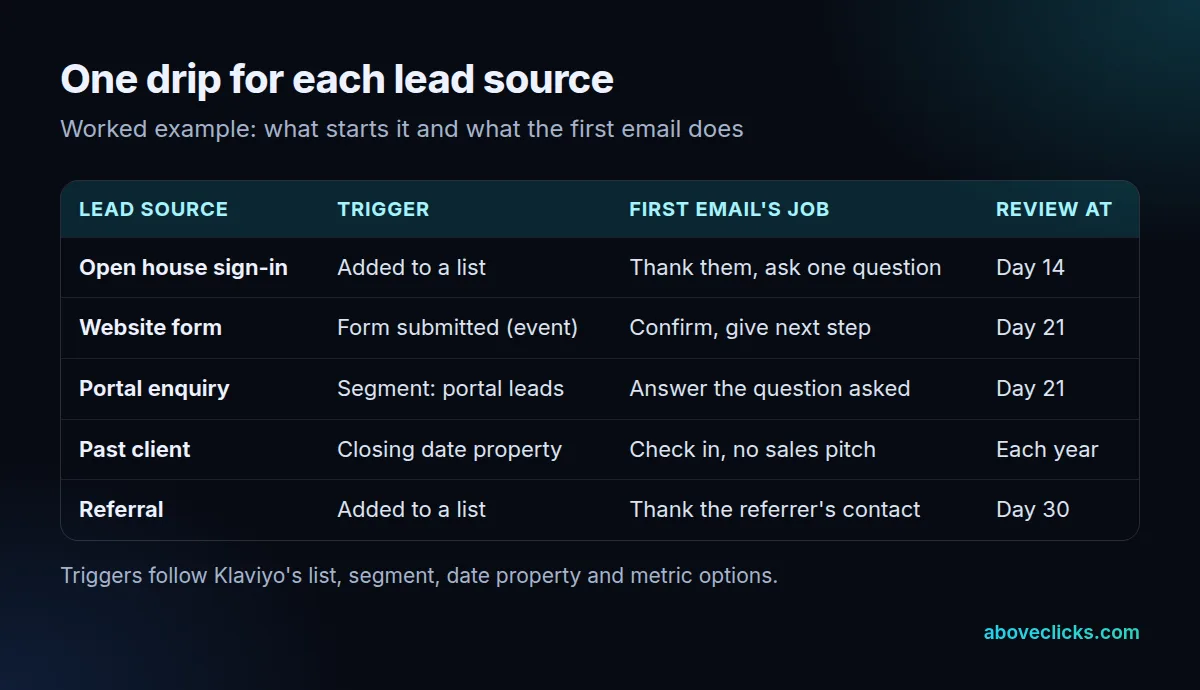
Klaviyo’s help page names 4 ways to start a flow: a list, a segment, a date property or a tracked event. Pick the trigger that matches what you actually know. A sign-in sheet typed into a list is a list trigger. A website form sent through an integration is an event. A closing date saved on a profile is a date property, so the past-client drip can start on each anniversary.
The same help page notes that list, segment and date property flows have no event data, so you cannot pull a form answer or a listing into those emails. Put the detail you need into the profile when the lead is created, or use an event trigger for the website form.
Portal leads need the most care. They often enquire on 3 or 4 listings at once and may hear from several agents the same day, so the first email should answer the exact question they asked and nothing else. Open house leads can take a warmer tone, because they met you in person. Referrals sit between the two: name the person who referred them in the first line, if that person agreed, and keep the drip short.
We build each flow with one job per email. The first message in a real estate drip email series confirms what the person did and asks one question, such as their budget range or the areas they like. That single answer lets you write the next 4 or 5 emails for that person instead of for everyone.
Set a gap between emails with a time delay. Klaviyo’s guide to adding a time delay lets you wait minutes, hours or days. For a real estate drip email, a good starting pattern is day 0, day 1 and day 4, then widen the gaps to a week or more. Test the real gap with a dummy lead before the first real lead enters.
What do real estate drip campaign ideas look like after month one?
One useful email a month, each with a single idea, for people who are not ready yet. A slow drip keeps you known for 12 months without sounding like marketing.
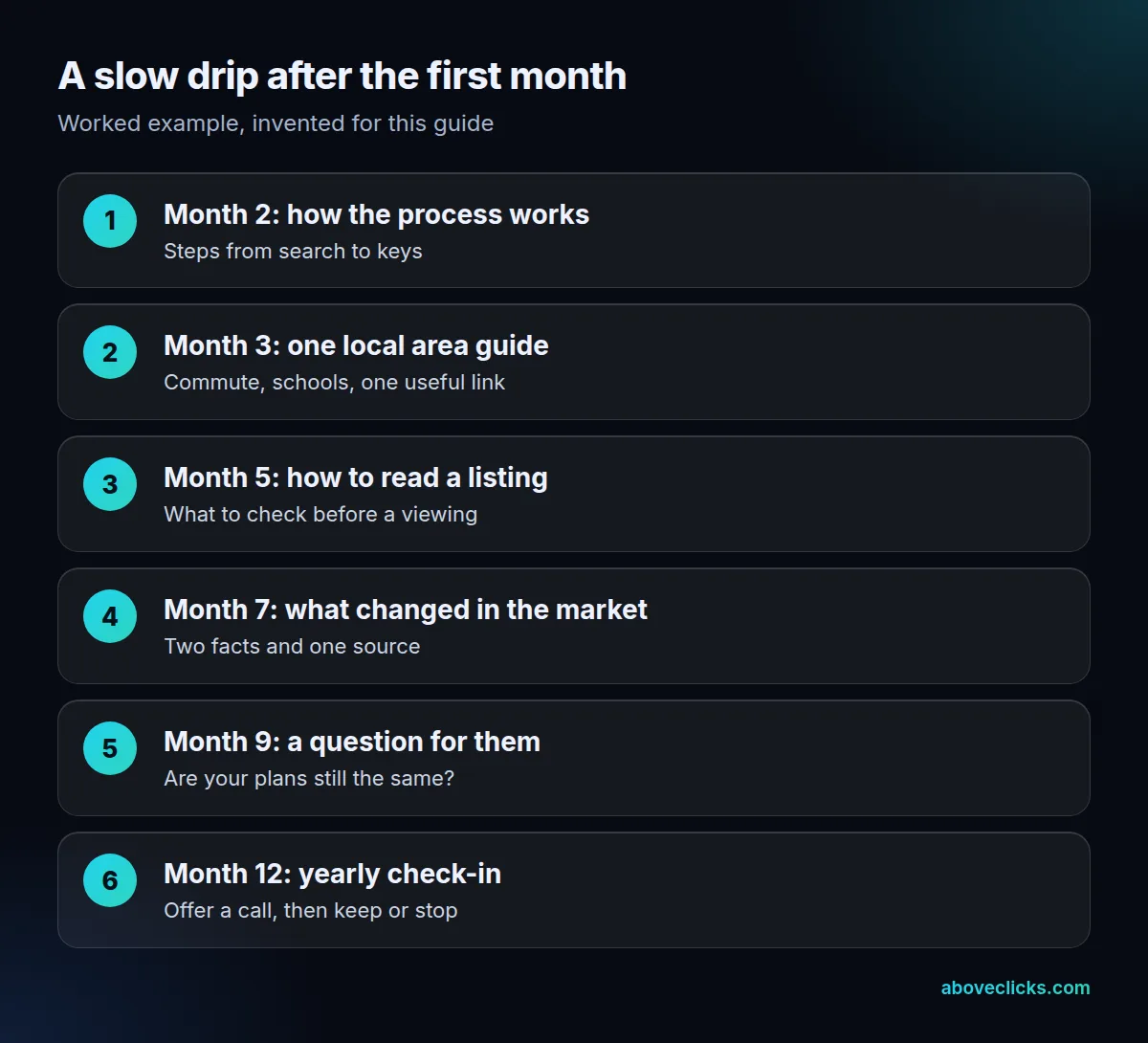
The calendar above, one of many real estate drip campaign ideas, is an invented example, not a benchmark: 6 emails across months 2 to 12. Notice that none of them says “buy now”. Each explains a step, answers a worry or asks whether plans have changed. A person who replies “we start looking in spring” is a better lead than one who opened 10 emails in silence.
Write the subject line as a plain description of what is inside, such as “Your viewing checklist for Saturday”. Avoid capital letters and exclamation marks, and keep the preview text to one short sentence. Keep each real estate drip email under 150 words, which is about 1 screen on a phone. The month 9 question is the most valuable email in the plan, because it asks for a reply and tells you who to call. Use the answer: move people who reply with a date into a short, faster drip, and leave the rest on the slow calendar.
As a rule of thumb, review each slow drip every 90 days. Check which emails got replies, delete any that got none in 2 quarters, and write one new idea to replace it. Good real estate drip campaign ideas come from the questions leads actually ask you on calls and at showings, not from a template library.
How do you keep a real estate drip email out of spam?
Authenticate the sending domain and make leaving easy. Gmail’s rules start at SPF or DKIM for every sender, then add DMARC and one-click unsubscribe above 5,000 messages a day.
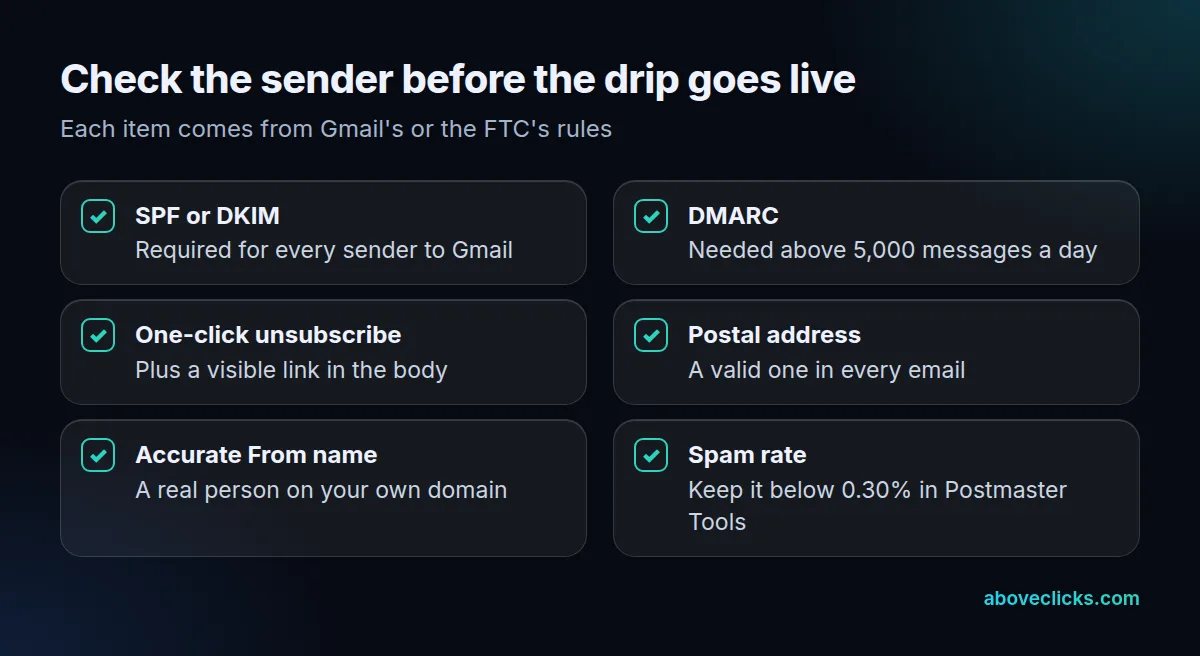
Gmail’s sender guidelines list three tiers. All senders must set up SPF or DKIM, and sending to personal Gmail accounts needs a DKIM key of 1024 bits or longer, with 2048 bits recommended. Senders of more than 5,000 messages a day to Gmail must also set up DMARC, support one-click unsubscribe on marketing messages and keep their spam rate below 0.30% in Postmaster Tools.
A single agent usually sends far fewer than 5,000 a day, so the strict tier rarely applies, though a brokerage mailing a list of 20,000 on one day could cross it. SPF or DKIM still does, and your email platform should handle both once you add its DNS records to your domain. Check that its records are published before the first lead enters the drip.
The FTC’s CAN-SPAM guide adds rules for every commercial email: accurate From, To and Reply-To details, a valid physical postal address, and a clear opt-out. You must honor an opt-out within 10 business days, and the opt-out method must keep working for at least 30 days after the email is sent. The FTC lists penalties of up to $53,088 for each violating email, as of November 2026.
How do you know which real estate drip campaign works?
Compare lead sources by appointments, not by opens, whichever real estate email drip campaigns you run. Tag every link so your analytics shows which drip sent the visit, then divide appointments by leads for each source.
Analytics Help’s campaign URL guide lists three parameters: utm_source, utm_medium and utm_campaign. It also warns that values are case-sensitive, so “Meta” and “meta” count as different values, and recommends lowercase. Pick one naming rule, for example utm_source=drip, utm_medium=email and utm_campaign=open-house-day-14, and use it in all 5 drips.
The formula is simple: appointments divided by leads, for each source. Here is an invented example for one quarter:
| Lead source | Leads | Appointments | Rate |
|---|---|---|---|
| Open house | 120 | 12 | 10.0% |
| Website form | 80 | 6 | 7.5% |
In this example the open house drip converts better, so you would test a stronger first question on the website drip before adding more emails. With only 6 appointments, though, the gap could be chance, so wait for another quarter before moving budget. Record each appointment in your CRM with its source, because the email platform can’t see who actually met you. Do this for all real estate email drip campaigns, not only the busiest one, and review the table every quarter. A drip with 60 leads and no appointments after 2 quarters needs a new first question, not more emails.
Which drip mistakes cost leads?
Five mistakes cause most of the damage in drip email marketing real estate teams set up, and every one is cheap to fix before launch. Run a test lead through the whole sequence first.
- One drip for every source. An open house sign-in and a portal enquiry need different first emails.
- No question in email 1. Without an answer you cannot write email 2 for that person.
- No stop rule. A reply or booking should end the drip, so the lead is not emailed after they have already answered.
- Unauthenticated sending. Without SPF or DKIM, the first 100 emails can land in spam and you will not see why.
- No source tag. Without
utm_sourceand a CRM field, you cannot tell which drip earned an appointment.
Good drip email marketing real estate teams rely on comes down to a clear trigger, a safe sender and honest tracking. If you want help building the flows, our Klaviyo email marketing service sets up and tests them, and the real estate digital marketing page shows where drip email sits in a wider plan. To have a setup reviewed first, request a free audit. More industry guides are in the industries section.