Real estate marketing post cards are mailed or handed-out cards that put a listing or an agent in front of nearby owners and buyers. Pick the size and route from the postal rules, check the words, and tag a link so you can count the replies.
This guide covers the four kinds of real estate marketing post cards worth sending, the size limits, the cost of the main mailing route, the housing-ad rules and a worked count of what a mailing earns.
What are real estate marketing post cards?
Real estate marketing post cards are printed cards, usually mailed, that carry one message about a property or the agent. People also search for them as real estate postcards or mail out cards; Google’s autocomplete returns 8 suggestions for “real estate post cards”.
A card works because it needs no click to be seen. It lands in a mailbox, sits on a counter and gets read in about 10 seconds. That short read sets the design rule for real estate post card marketing: one message, one photo, one next step.
The same short read is why real estate marketing post cards fail. A card that tries to list a house, promote you and invite people to an open house does none of them well. Treat each card as a small test with one job and one number to check it by.
If you are still deciding how cards fit your yearly spend, our real estate marketing plan shows how a budget splits across channels. The agent marketing plan guide covers the weekly hours.
Which real estate post cards should an agent send?
Four types of real estate marketing post cards cover most needs: just listed, just sold, a market update and an open house invitation. Start these real estate post card marketing runs with just listed and just sold, because they carry a fact a neighbor already wants to know.
- Just listed: one photo, the address, the price band in words if your rules allow it, and a link to the listing page.
- Just sold: the street, the number of days it took and a link to a short note on what the sale means for nearby homes. Check with your broker first on what you may state about a sale.
- Market update: two numbers for the neighborhood and a link to a page that explains them.
- Open house: the date, the time and one map link.
Each card has one number to check it by: visits to its own page per 100 cards sent. That is the figure the count in a later section uses.
Do not send all four real estate marketing post cards at once. Add one type at a time, and keep each type on the same route for three mailings, so you can tell the card from the street.
What size should real estate postcards be?
To be mailed at card rates, a postcard must be at least 3.5 by 5 inches and no more than 6 by 9 inches. Anything outside that range is priced as a letter or a flat.
The USPS Domestic Mail Manual sets the limits for cards at card rates: at least 3.5 inches high, 5 inches long and 0.007 inch thick, and at most 6 inches high, 9 inches long and 0.016 inch thick. A card over 4.25 by 6 inches must be at least 0.009 inch thick, and its length divided by its height must fall between 1.3 and 2.5.
Those numbers explain why the common 4 by 6 and 5 by 7 sizes are popular for real estate marketing post cards, and why a square card is risky. A 6 by 6 card has a ratio of 1.0, which is outside the allowed range.
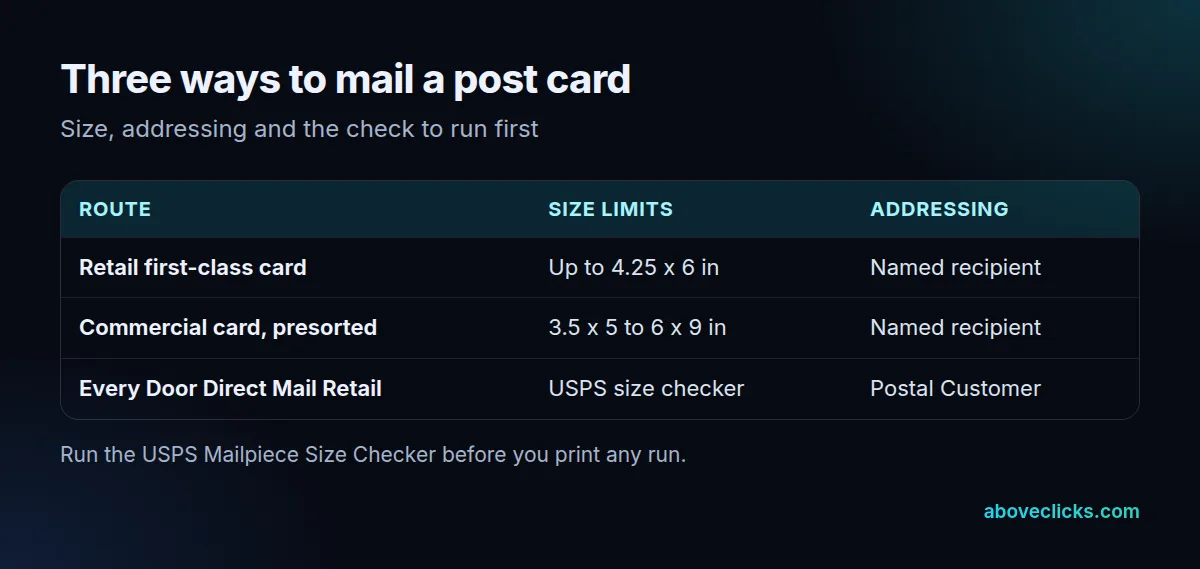
The table compares the three routes. The retail first-class card has the smallest size ceiling, so check the limit for the route before you order a large run. A print shop can usually tell you which sizes it trims.
How do you mail real estate post card marketing?
Choose between addressed real estate marketing post cards, for a list you already hold, and Every Door Direct Mail, for every address on a route. Both are normal real estate post card marketing routes, and USPS lists realtors among the businesses the second one suits.
As of November 2026, the USPS Every Door Direct Mail page lists EDDM Retail at $0.26 per piece for flats up to 3.3 ounces. It allows 200 to 5,000 pieces per day per ZIP Code, needs no mailing permit, and takes cards addressed to “Postal Customer”, so no names are needed. Each piece carries a postage indicia above and to the right of the address block.
Example, with invented figures: an agent mails 500 just-listed real estate marketing post cards to the routes around a new listing. Postage is 500 × $0.26 = $130. If printing costs an invented $0.20 a card, that is another $100, for $230 in all. You must rerun the sums with your own printing quote.
Addressed cards suit a list you already hold, such as past clients, owners near a recent sale or open house guests who agreed to be contacted. They let you write a name on the card, but the postage and list work are yours to price with USPS.
What must a real estate post card say and show?
Words and pictures that treat every buyer the same. The federal text on housing advertising names printed notices, so real estate marketing post cards get the same check as an ad.
The Fair Housing rule at 24 CFR 100.75 makes it unlawful to print or publish an advertisement for the sale or rental of a dwelling that shows a preference or limit because of race, color, religion, sex, handicap, familial status or national origin. That is 7 protected groups for your real estate marketing post cards to respect. Written notices include flyers, brochures, signs, banners, posters and billboards, and any documents used with a sale.
The rule also covers words, phrases, photographs, illustrations and symbols that suggest a home is or is not open to a group. It covers the choice of media or locations that keep some people from hearing about housing, so the route you pick is part of the check.
If you later boost a listing to people who scanned a card, the platform rules apply. In the US, Meta’s special ad category page says age, gender, ZIP code, exclusion targeting, lookalike audiences and saved audiences are limited or unavailable for housing ads. Google Ads bars age, gender, marital status, parental status and ZIP code targeting for housing ads in the US and Canada.
If your scan page asks for an email address and you send marketing email to it, the FTC’s CAN-SPAM guide requires a valid postal address and a clear way to opt out. Our email marketing guide covers the follow-up. State and brokerage ad rules add more; we do not cover them here, so ask your broker.
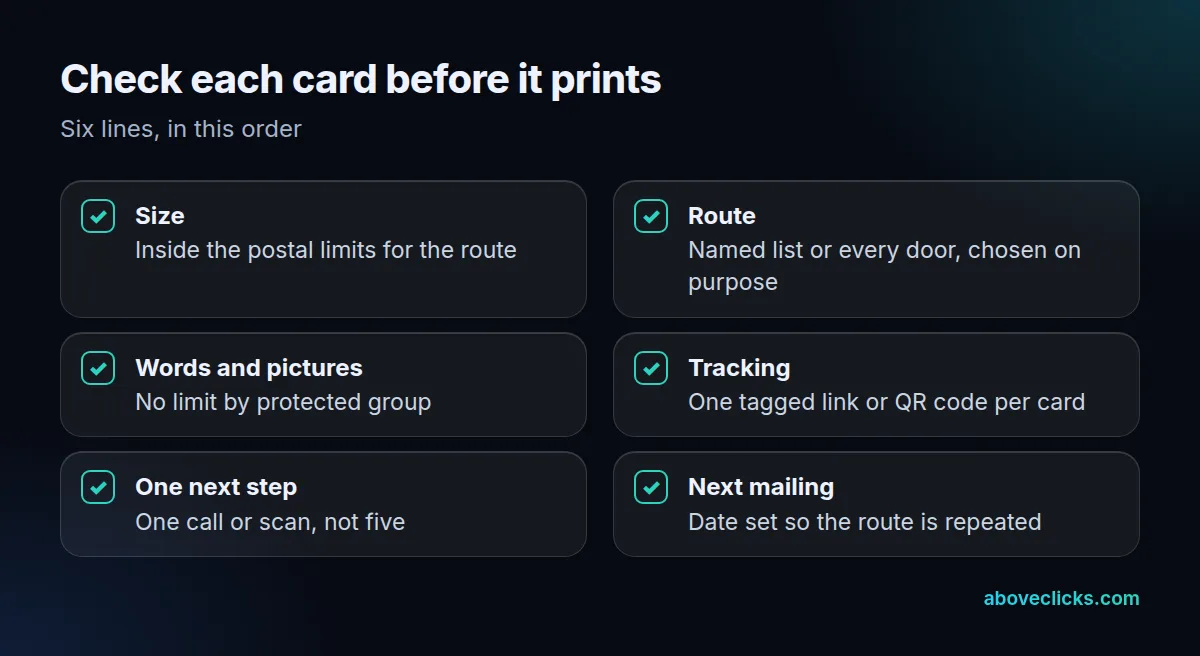
Do real estate postcards work, and how do you count the replies?
They can, but you only know for your area by counting. Give each card its own tagged link or QR code, then compare visits per 100 real estate marketing post cards over at least three mailings.
Google Analytics Help says to always use three parameters in a campaign link: utm_source, utm_medium and utm_campaign. It adds that utm_content tells similar creatives apart and that names are case-sensitive, so use lowercase. Its own example of a source is “billboard”, so offline pieces are a normal use.
A naming sheet for real estate marketing post cards could use:
- Source:
postcard. - Medium:
printorqr. - Campaign: the listing or the month, such as
elm-street-sold, in lowercase with hyphens. - Content: the card type or version, such as
justsoldorblue.

Example: an invented agent sends 500 cards of each type over three months. The tagged pages show 17, 12, 8 and 6 visits, which is 3.4, 2.4, 1.6 and 1.2 per 100 cards. Just sold leads. For the just-listed run, 12 visits and 5 calls or form replies on a $230 run come to $46 per reply.
Your numbers will differ. What carries over to any real estate marketing post cards run is the method: keep the route, change one thing, and compare per 100. Our real estate service page describes how we check landing pages and lead quality and send a PDF report within 2 workdays; the wider channel mix is on our real estate digital marketing page.
What are the 6 traps that make post cards cost more than they earn?
Six mistakes account for most wasted runs of real estate marketing post cards: thin stock, a wrong label, route limits, unchecked wording, no tag and judging after one mailing. Each can be fixed before printing.
- Stock too thin. A card over 4.25 by 6 inches and under 0.009 inch thick is treated as a nonmachinable letter, which costs more to mail, according to the Domestic Mail Manual.
- The wrong label. A card that does not meet the card standards must not bear the words “Postcard” or “Double Postcard”.
- Route limits. EDDM Retail needs at least 200 pieces and allows at most 5,000 per day per ZIP Code, so a run of 150 or 6,000 needs a different plan.
- Unchecked wording. A photo or phrase that signals who a home is for breaks the rule in 24 CFR 100.75, however good the design.
- No tag. A card without its own link or code gives you nothing to count, so the next run repeats the guess.
- One mailing. A single run of 500 cards cannot separate the card from the street, the season and chance. Plan three.
If you want a second opinion on the pages your codes lead to, our free audit is a place to start, and more guides are in industries.