Real estate investor marketing is the work of reaching three audiences, sellers, buyers and lenders, and costing the result per deal. Judge it by what each deal costs to find, not by how many leads arrive.
This guide covers who to reach, where leads come from online, the ad, call, text and email rules, a worked cost-per-deal example and a 90-day order of work. It is general information, not legal advice.
What is real estate investor marketing?
It is every effort an investor makes to get found by the people a deal depends on. Real estate investor marketing differs from an agent’s marketing: an agent markets to buyers and sellers of homes, while an investor markets to sellers, to buyers of the deals, and to people who fund them.
That changes what you measure. An agent counts leads and listings; real estate investor marketing is closer to sourcing, where one closed deal has to pay for all the marketing that did not close. Our real estate marketing plan guide covers the agent side, and commercial real estate marketing covers larger properties.
Take the invented example used later in this guide: $3,000 of ads brings 40 leads and only 1 closed deal. The other 39 leads still cost money, so the one deal has to carry them all. That is why real estate investor marketing starts from the deal and works backwards.
Who does real estate investor marketing need to reach?
Three audiences: sellers who bring you deals, buyers who take them, and lenders or partners who fund them. Marketing for real estate investors goes wrong when one message and one channel are used for all three.
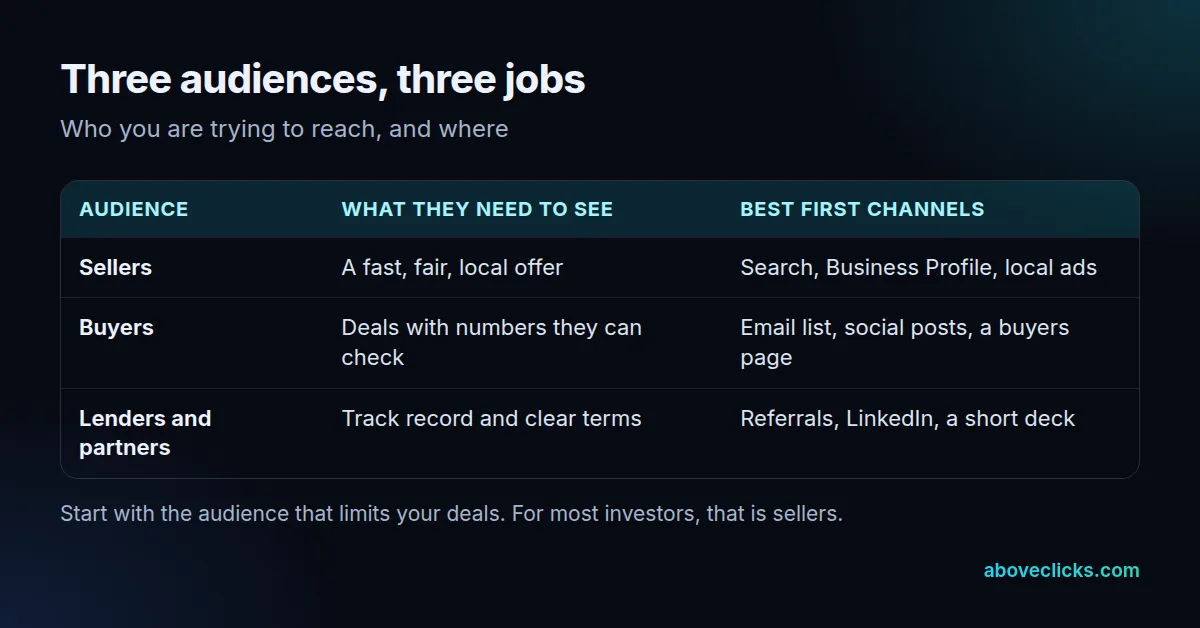
Sellers want speed, certainty and a local name they can check. Buyers want numbers: price, repairs, likely resale or rent. Lenders and partners want a track record and clear terms. A single page cannot say all of that, so give each group its own page and its own call to action, and aim to reply to a seller within 24 hours.
Most investors starting real estate investor marketing should begin with sellers, because without deals the other two audiences have nothing to look at. Once deals arrive, build a buyers list, then a short summary of past deals for lenders.
How do investors find leads online?
Mostly through search, a Google Business Profile, paid ads and a website that answers the questions sellers type. Digital marketing for real estate investors works best when these four reinforce one another, because a seller often checks you on search before replying to an ad.
- Search and your website: a page per area you buy in, a short form, a phone number and one clear next step. See how we structure this in our real estate digital marketing work.
- Google Business Profile: if you meet people at their homes and have no storefront, Google’s guidelines say to use one service-area profile and hide your address. A virtual office is allowed only if it is staffed during business hours. As of November 2026, that is the rule to check before you set one up.
- Paid ads: Google and Meta both limit targeting for housing-type ads. Google says that in the United States and Canada you can’t target housing ads by age, gender, parental status, marital status or ZIP code, though radius targeting of at least 1 kilometre (about 0.6 miles) is allowed (Google Ads policy, as of November 2026). Meta’s Special Ad Category limits age, gender, ZIP code, exclusions, lookalike and saved audiences, and city targeting gets an expanded radius.
- Email and social: best for buyers and lenders, where you already have a relationship. Our real estate email marketing guide covers the flows.
Whether a particular “we buy houses” ad counts as housing is decided by each platform’s definition, which we have not verified for that case. Read the definition, and if you are unsure, ask platform support in writing before you spend.
Which rules apply to real estate investor marketing?
Rules for ad categories, calls, texts, emails and profiles, each set by a different body. The costly traps in real estate investor marketing are mostly here, not in the ads themselves.
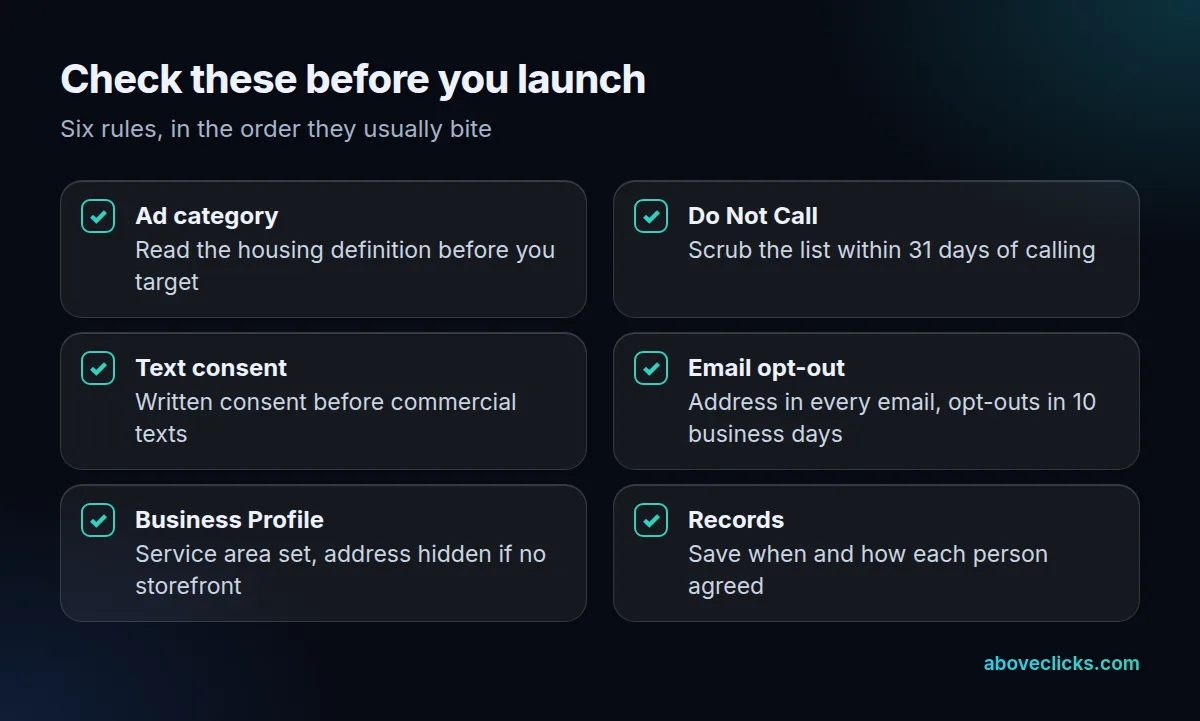
Check them in this order:
- Ad category: pick the Special Ad Category on Meta when the offer fits, and expect fewer targeting options. Meta says that using one may limit your audience options.
- Do Not Call: the FTC says it is against the law to call a number on the registry unless the seller has an established business relationship or written agreement, and a seller must access the registry no more than 31 days before calling (FTC Q&A, as of November 2026). Most calls to a business to solicit sales are exempt.
- Texts and recorded calls: the FCC requires prior written consent for prerecorded telemarketing calls, and consent before an autodialed call or text to a wireless number. Commercial texts need written consent (FCC guide, as of November 2026).
- Email: the FTC’s CAN-SPAM guide says the law covers business-to-business email too. You need a valid postal address, a clear opt-out that you honor within 10 business days, and you cannot hand off responsibility to the company that sends for you.
- Profile eligibility: use the service-area setup above.
- Records: keep the date, source and wording of every consent.
State laws may add rules, such as extra hours or registration, so ask a lawyer who knows your state before you start calling or texting at scale.
How do you work out the marketing cost of one deal?
Divide total marketing spend by deals closed. That number, not cost per lead, tells you whether real estate investor marketing is paying for itself.

The example is invented, to show the arithmetic. If $3,000 buys 40 leads, a lead costs $75. If 8 of those are qualified, 2 become offers and 1 reaches closing, the deal cost $3,000 to find. If the deal earns more than that after repairs, holding and fees, the channel works; if not, fix the step where most leads drop out.
Use the same sums for every channel, then compare. A channel with cheap leads and no deals is more expensive than one with dear leads and a closing. Track four numbers per channel each month: spend, leads, offers and closings. Our sample report shows how we lay a monthly report out.
Which mistakes make a deal cost more to find?
Five mistakes cause most of the waste in real estate investor marketing: counting leads instead of deals, slow replies, one message for three audiences, calling lists that were never checked and texting without a record of consent. Each is cheap to fix before launch and expensive to fix after.
- Counting leads, not deals. A channel with 100 leads and no closings is worse than one with 10 leads and a closing, as the formula above shows.
- Slow replies. A seller who filled in a form has often filled in 3 others. Decide who answers, and by when, before you pay for the first click.
- One message for everyone. A page that speaks to sellers, buyers and lenders at once persuades none of them. Use a separate page for each.
- Unchecked call lists. The registry rule is dated: the list has to be checked within 31 days before you call, so an old spreadsheet is a risk.
- No consent records. If someone complains, the date and wording of their agreement is your evidence. Store it with the lead.
A short review each month catches most of these. Our audit checks the first three on your own setup, and you can ask for one with the form at the end of this guide.
What does a 90-day real estate investor marketing plan look like?
Three blocks of 30 days: set up and answer, test one channel, then compare and widen. This order keeps real estate investor marketing from spreading across five channels before one has proved itself.
- Days 1 to 30, set up: build the seller page and form, set up the Business Profile, and write down who answers a lead and how quickly. We check lead handling before we change any ads, because slow replies waste the spend.
- Days 31 to 60, test one channel: run search or Meta ads in one area with a small budget, and log every lead by source.
- Days 61 to 90, compare and widen: work out cost per deal, drop what failed and add a buyers email list or a second area.
For most investors, a first 90 days will not produce a stable cost per deal on its own, because a handful of closings is a small sample. Treat it as a first reading of your real estate investor marketing, and keep logging.
What should digital marketing for real estate investors track?
Spend, leads, qualified leads, offers and closings, by source. Digital marketing for real estate investors is easy to start and easy to misread, so keep the numbers on one sheet and review them in the first 5 days of every month.
Add two checks to your real estate investor marketing sheet. First, response time: how long until a person replies to a new lead. Second, source quality: which channel brings leads that reach an offer. If you want a second opinion on the setup, our free audit reviews your ads, site and lead handling, and the real estate marketing service page lists what we run each month. More guides like this are in the industries section.