Luxury real estate marketing is the work of getting a high-value property in front of a small number of qualified buyers, usually with privacy. Judge it by the quality of each enquiry, not by clicks or reach.
This guide to luxury real estate marketing covers how big the buyer pool really is, which channels fit which price tier, how to launch privately, the ad rules that limit housing campaigns, what the listing page needs and a 90-day plan. It builds on our general real estate marketing plan and goes deeper on the top of the market.
What is luxury real estate marketing?
Luxury real estate marketing is marketing for homes where only a few buyers can say yes. It trades volume for fit: a sharp page, a private list, selective ads and a fast, careful reply.
The tier is local, so luxury real estate marketing starts with a definition. A home that is luxury in one city is mid-market in another, so define your tiers by your own sales. Our working rule, not an industry standard: call the top 5% of sales by value in your market the luxury tier and the top 1% ultra-luxury. Three things change as you go up the tiers of luxury real estate marketing:
- Fewer buyers: you cannot rely on broad reach, so each lead counts for more.
- More privacy: owners often do not want the address, the photos or the sale date public.
- Longer, relationship-led sales: buyers check the agent, the area and the property before they call.
Marketing luxury real estate therefore starts with the owner’s rules on privacy, then the buyer list, and only then the ads. Our real estate marketing service follows the same order. Most luxury real estate marketing that disappoints skips the first two steps and spends the budget on the third.
How many buyers are you actually trying to reach?
Often fewer than you think. A luxury listing needs one buyer, so plan around qualified enquiries and viewings, not clicks.
Take a worked example, with illustrative figures only. A $4 million home draws 12 serious enquiries in 60 days. Five become private viewings and one becomes an offer. Doubling the clicks would not have changed that, but one more qualified introduction might have.
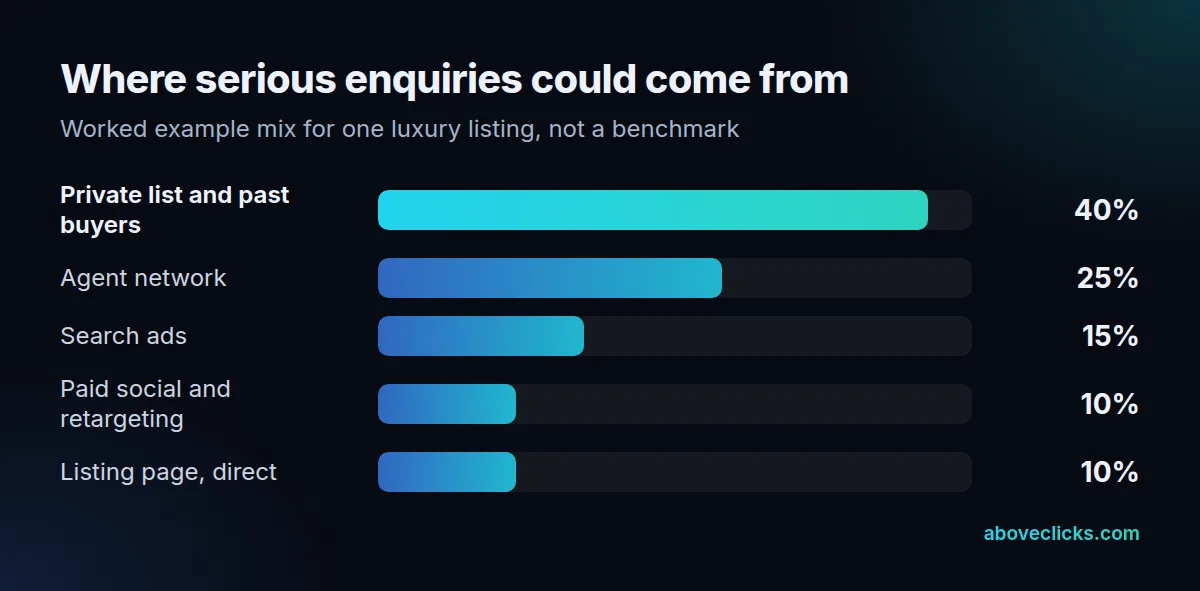
The chart is an example mix for luxury real estate marketing, not a benchmark. Its point is the habit: log the source of every serious enquiry (private list, agent network, search ads, paid social, direct) so that at day 90 you can move effort to the sources that produced viewings. Without that log, every source claims the credit.
A good source tag costs nothing. Give each channel its own tracked link, ask “how did you hear about this home?” on the enquiry form and record the answer. In a worked example, an agent who tags 100% of enquiries by source can compare 5 channels after 30 days, while one who tags half cannot. That is the difference between a decision and a guess.
Which channels fit which price tier?
Private lists and agent networks lead at the top; search and paid social lead lower down. Search ads reach people already looking, and paid social mostly builds awareness and retargets.
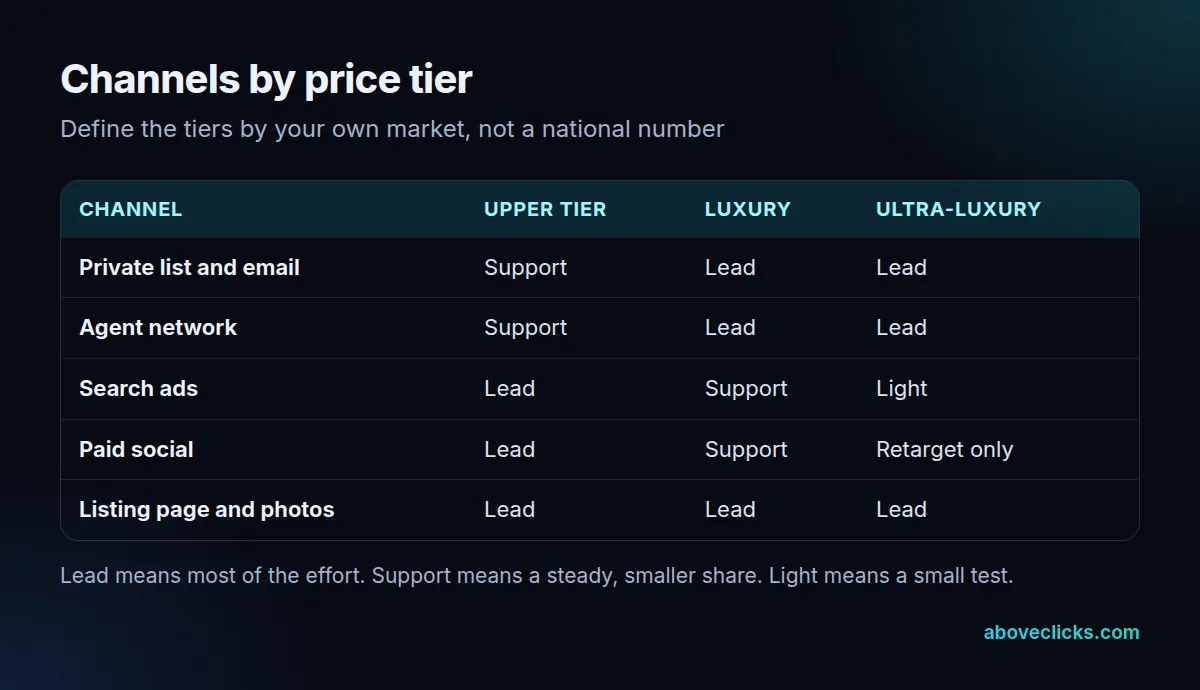
Read the table by tier:
- Upper tier: buyers compare many listings online, so search ads and a strong listing page do most of the work.
- Luxury: the private list and the agent network carry the launch, with search ads for people searching for the area or the type of home.
- Ultra-luxury: the buyer pool is so small that you can name most of it, so paid ads are a light test, and social ads only retarget people who already saw the page.
In luxury real estate marketing, one page deserves the most effort: the listing page, because every channel sends people to it. Run 3 to 5 channels at most for one listing, and in a worked example keep 15% of the budget as a test channel you can cut at day 45. More channels spread a small luxury real estate marketing budget over a small buyer pool thinner and make the source log harder to read.
How do you market luxury real estate privately?
Share in steps: a chosen list first, a teaser without the address next, and the full details only after a buyer is qualified. Set a private window, such as 14 days, before any public launch.
Private-first luxury real estate marketing works as a disclosure ladder:
- Private list: past buyers, past enquirers and agents you trust get the full details, in a personal message.
- Teaser: a page or email with the area, the size and the best photo, but no street address.
- Qualified viewing: the address goes out only after you have a name, a way to reply and a reason to believe the buyer can proceed.
- Public launch: the page and ads go live once the private window ends, or sooner if the owner agrees.
Before you start, check your brokerage and local listing-service rules on pre-marketing, because they differ by market and can limit what you may do before a public listing. Get the owner’s wishes on privacy in writing: photographs of the interior, the sale date and whether the sale amount may be mentioned. A 30-minute call with the owner about marketing luxury real estate before day 1 saves a retraction on day 12.
Keep the private list current. After each sale, add the buyers and the underbidders, with their consent, and remove anyone who asks to leave. A list of 200 people who know you beats a list of 5,000 who do not.
Which ad rules limit luxury real estate marketing?
Housing ads cannot target by ZIP code, age or gender on Meta or Google in the US. Plan for location radius, interests and your own first-party data instead.
Meta’s help page says you must specify a Special Ad Category when a campaign promotes housing. For those ads in the US, age, gender, ZIP code, exclusion targeting, lookalike audiences and saved audiences are limited or unavailable, and audiences based on a city or pin drop get an expanded radius.
Google’s housing policy says that in the United States and Canada you cannot target housing ads by gender, age, parental status, marital status or ZIP code. Radius targeting is allowed, with at least 1 km around a location. Read both pages again before each luxury real estate marketing launch, because platforms change these rules.
Location settings matter more in luxury real estate marketing, because buyers often live elsewhere. Google’s help page on advanced location options says the default includes people who have shown interest in a place. It cites internal Google data from 2022 in which advertisers in Travel, Real Estate and Education who switched from Presence to “Presence or interest” saw 5% more conversions on Search. Treat that as a reason to test, not a promise.
The rules for these campaigns are longer than one section, so read our guide to PPC for real estate before you set up search ads.
What does the listing page need?
Sharp photos with descriptive alt text, a clear enquiry path and a verified profile for the agent. Everything else on the page supports those three.
Photos carry the page in luxury real estate marketing. Google’s image guidance says high-quality photos appeal to users more than blurry ones, and that descriptive filenames and alt text help Google understand an image. Write alt text that says what the picture shows, such as “terrace and pool at dusk”, not “luxury home”.
The agent’s profile matters as much as the home. Google’s Business Profile guidelines count real estate agents as individual practitioners, so an agent can have a profile of their own. A verified profile with real reviews answers the “who is this agent?” check that buyers run before they call.
Finally, give the enquiry form 4 fields at most (name, email or phone, a time to talk and one question), and reply within 24 hours. A luxury buyer who waits 3 days for an answer has usually called another agent. Our real estate digital marketing page shows how we build the path from ad to booking.
What does a 90-day luxury real estate marketing plan look like?
Five steps: prepare, launch privately, launch publicly, retarget and review. Each step runs 10 to 30 days and ends with one number to check, so do not skip the review. Luxury real estate marketing rewards patience.
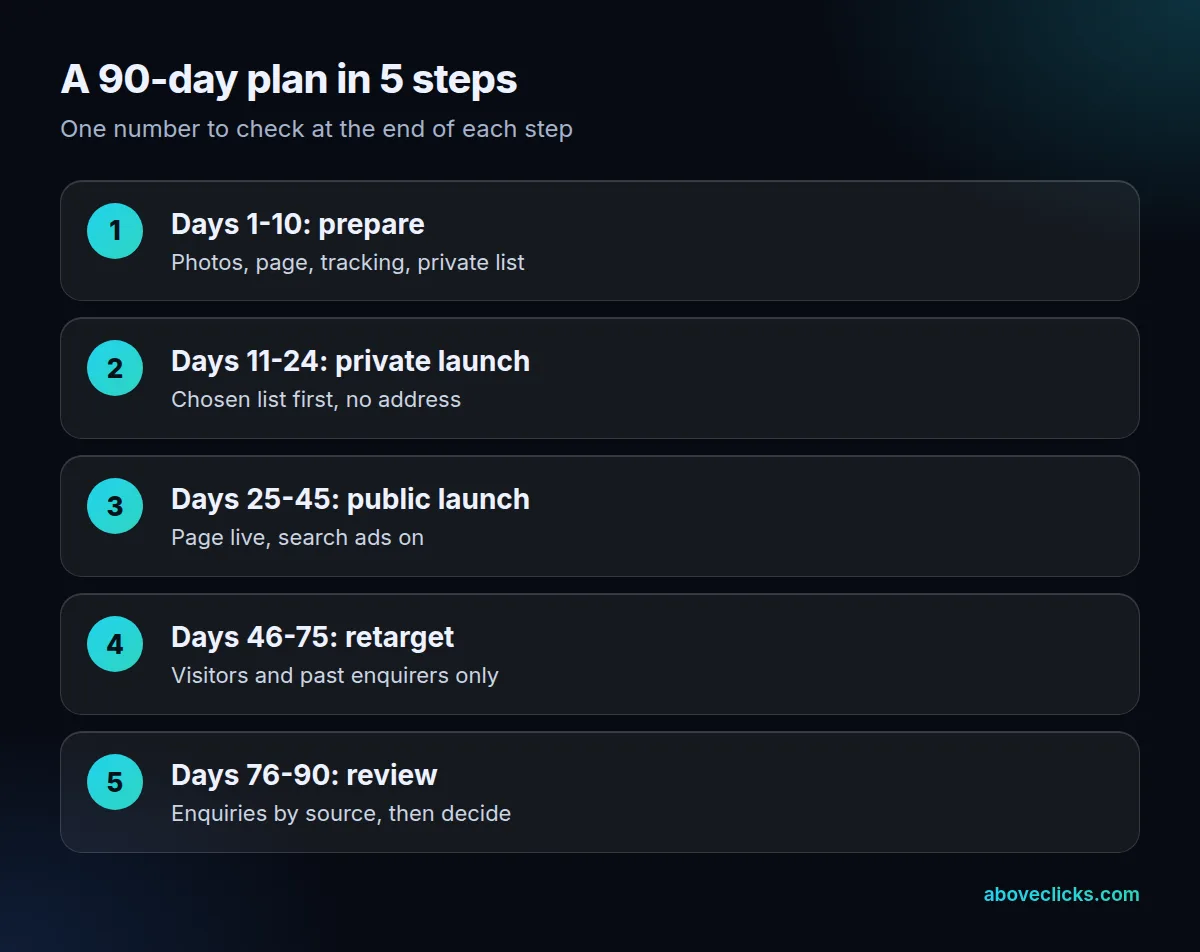
What to check at the end of each step:
- Prepare: every channel has a tracked link, and the form records the source.
- Private launch: how many list members opened the message and how many asked for details.
- Public launch: enquiries from search ads and the cost of each serious one.
- Retarget: whether people who saw the page came back and enquired.
- Review: enquiries and viewings by source, then a decision to add, cut or change.
The traps in luxury real estate marketing are predictable: a public blast before the private window, ZIP targeting that the platform will not accept, enquiries logged without a source, photos too soft to use and an address given before the buyer is qualified. If any of these sound familiar, our free audit checks your ads, pages and lead tracking and sends a PDF report within 2 workdays. More guides are in industries.