The hourly rate for social media marketing runs from about $20 to $150, as of November 2026, and experience explains most of the gap. A rate alone tells you little, so multiply it by a list of hours before you compare quotes.
This guide shows where a social media marketing hourly rate comes from, how many hours a month of work usually takes, how to convert an hourly quote into a monthly cost, and four costly mistakes that make an hourly bill drift.
What is a normal hourly rate for social media marketing?
About $20 to $150 an hour for a freelancer, depending on experience, as of November 2026. Agencies sit above the middle of that range and usually sell monthly retainers instead.
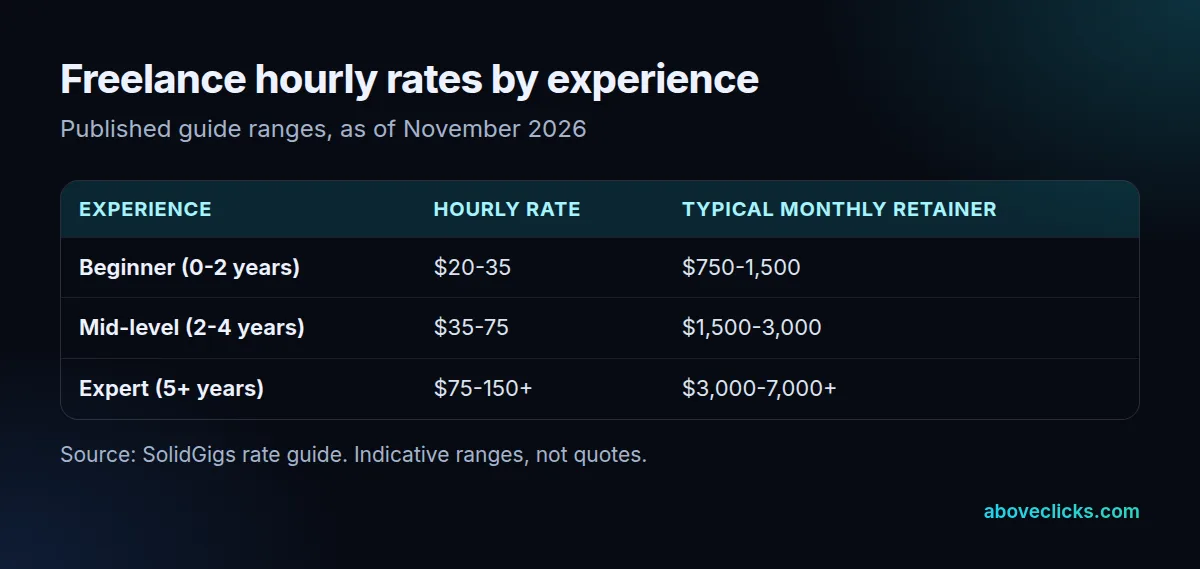
SolidGigs puts the hourly rate for social media marketing at $20 to $35 for a beginner, $35 to $75 for a mid-level freelancer and $75 to $150 or more for an expert with five or more years. Sprout Social gives the same overall range of $20 to $150 an hour. Treat both as guide ranges, not quotes: scope, country and platform mix move the number.
What moves a social media marketing hourly rate up or down is usually the same few things:
- Experience and results you can show: the three SolidGigs bands above are the biggest single driver.
- Platform mix: video-led platforms need filming and editing, which takes more hours than text posts.
- Paid social: managing ad budgets is a different skill from organic posting, and many people quote it separately.
- Strategy versus doing: planning and reporting are often quoted higher than scheduling and replies.
Our social media packages guide lines up the monthly tiers; this guide stays with the hourly rate for social media marketing and the hours behind it.
Why does a freelancer’s social media marketing hourly rate differ from a wage?
Because a freelancer pays both halves of the payroll taxes, buys their own tools and bills only part of the week. The hourly rate has to cover all three before it pays anyone.
For a wage baseline, the Bureau of Labor Statistics reports a median of $35.94 an hour, or $74,750 a year, for public relations specialists, as of May 2025; their duties include developing social media programs. Market research analysts, who read social data, had a median of $37.87 an hour. Those are employee wages, not billing rates.
The IRS sets the self-employment tax rate at 15.3%: 12.4% for social security plus 2.9% for Medicare. Here is a worked example, not a market figure, of the break-even social media marketing hourly rate for someone who wants the BLS median wage as take-home:
- Target pay: the $74,750 BLS median above.
- Add 15.3% self-employment tax, which is $11,437, giving $86,187.
- Add $2,400 for the year’s scheduling and design tools: $88,587.
- Bill 60% of 2,080 working hours, which is 1,248 hours: $88,587 ÷ 1,248 = about $71 an hour.
That break-even lands in the mid-level band, which is why a rate far below $35 either comes from a beginner or leaves the freelancer working for less than a wage.
How many hours does social media marketing take each month?
A small account on two platforms with 12 posts a month takes about 34 hours in the worked example below. The hours, not the rate, decide most of the bill.
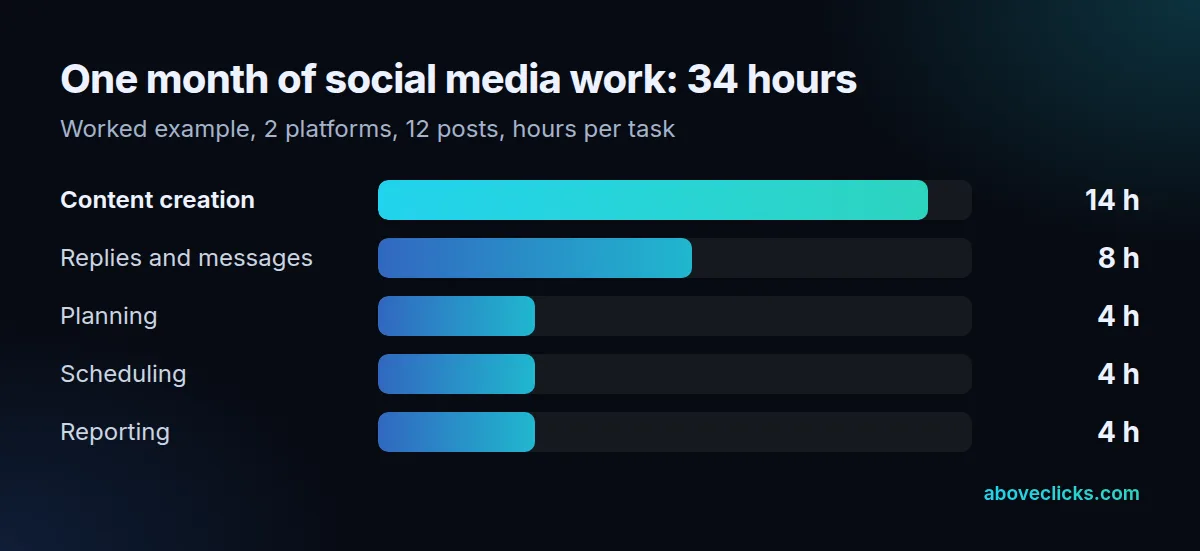
The split above is a worked example, not a benchmark. Content creation leads at 14 hours, replies and messages take 8, and planning, scheduling and reporting take 4 each. Costed at three social media marketing hourly rates, the same 34 hours cost:
| Hourly rate | Monthly cost for 34 hours |
|---|---|
| $35 | $1,190 |
| $71 | $2,414 |
| $100 | $3,400 |
Double the posts or add a third platform and the hours rise, so the cost rises with them. A lower hourly rate for social media marketing that needs 50 hours for the same output costs $1,750 at $35 an hour, which is more than the $1,700 that 20 hours would cost at $85. The hourly rate for social media marketing only compares fairly once the hours are the same.
Two things inflate hours most often. Content creation grows when each post needs a new photo or video instead of reusing an asset, and reply time grows when nobody sets agreed hours for answering comments and messages. Agree both before the first invoice.
Is an hourly rate or a monthly retainer better?
A retainer suits ongoing work and an hourly rate suits audits, one-off projects and extra requests. Divide a retainer by its hours to see the hourly rate for social media marketing you actually pay.
Most experienced freelancers prefer retainers: SolidGigs lists $750 to $1,500 a month for a basic package, $1,500 to $3,000 for a standard one and $3,000 to $7,000 or more for a premium one, as of November 2026. The effective hourly rate is the retainer divided by the hours worked. In a worked example, a $2,000 retainer for the 34-hour month above is about $59 an hour. If the same retainer quietly grows to 50 hours, it falls to $40 an hour, and the freelancer is working for less than planned. That is when quality or reply times start to slip.
Hourly billing has the opposite risk: the buyer carries the extra hours, and a social media marketing hourly rate that looks low can end up as the larger bill. Our marketing agency pricing models guide covers when hourly and project fees make sense next to retainers and ad-spend percentages.
What should an hourly quote include?
A task list, a monthly cap, a time log, a list of extras and the time for any creator disclosures. Each one stops a different kind of drift.
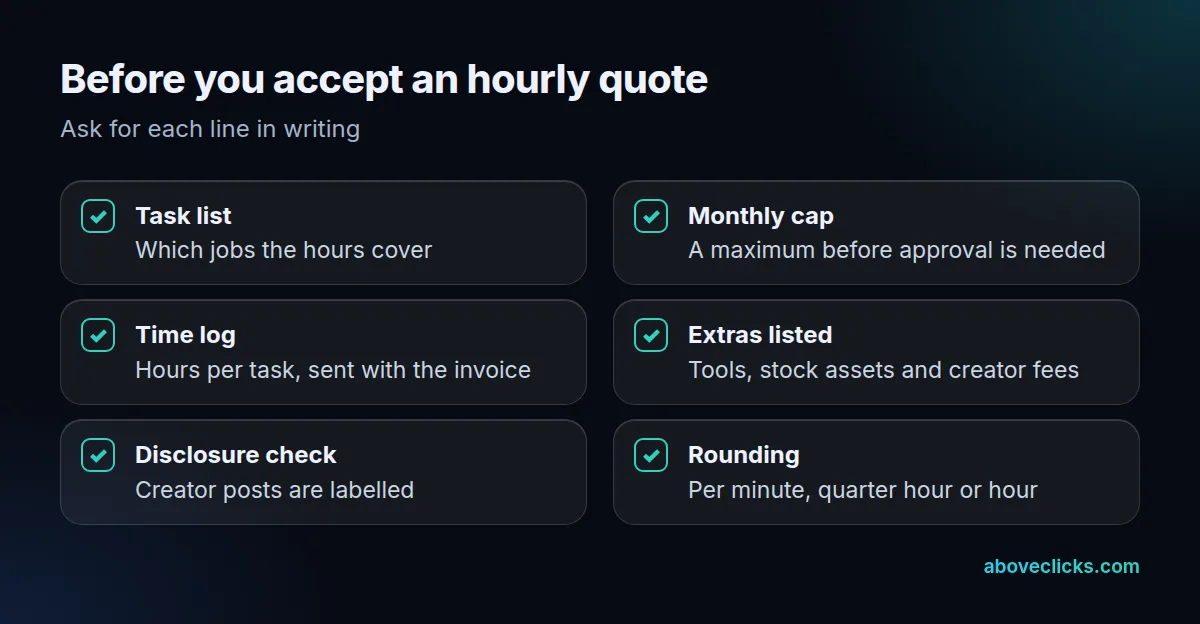
Disclosures belong in the hours. The FTC’s endorsement guidance says that a connection between an endorser and the marketer that consumers would not expect should be disclosed clearly and conspicuously. If creators or ambassadors post for you, checking their labels is a task that takes time, so it should be on the list.
Rounding is the quiet one. In a worked example, 12 replies of 10 minutes each take 2 hours, but a quote that rounds every task up to a full hour bills 12. Ask whether time is billed per minute, per quarter hour or per hour.
Also keep these out of the hourly rate and list them on their own lines: ad spend, which goes to the platform, scheduling software, stock assets and creator fees.
How do you check the hours you are billed?
Ask for a time log by task with every invoice, and compare it with the work you can see. If you cannot see 14 hours of content in a month, the log should explain why.
Here is what we publish for our own social media management: the plan in the first week, the first posts in week 2 and the first monthly report after 30 days. You see the month’s plan before it starts and each post a few days before it goes out, so hours can be matched to visible output. Whoever you hire, ask for a timeline that specific, because an hourly rate for social media marketing is easy to accept and hard to audit without one.
Keep the log even when you pay a retainer. It shows which tasks take the time, and it is the only way to tell whether a quiet month means less work or less effort. If the log shows 8 hours of replies but your inbox shows slow answers, the problem is when the replies happen, not how long they take, and that is a conversation to have before the next hourly rate for social media marketing is agreed.
A simple monthly check takes five minutes:
- Add up the hours in the log and compare them with the cap.
- Count the posts, replies and reports delivered and compare with the task list.
- Divide the invoice by the hours to get the effective rate, and compare it with the social media marketing hourly rate you agreed.
When is an hourly rate the wrong way to buy?
For steady, repeating work with a clear scope, where a retainer with listed deliverables is easier to check. An hourly rate for social media marketing fits best when the work is hard to predict.
Hourly billing does work in three cases: a one-off audit or content calendar, a short burst such as a product launch, and a trial month before you agree a retainer. In each, the scope has an end, so a cap on hours keeps the cost known. Ongoing posting, replies and reporting repeat every month, which is where a fixed list of deliverables protects both sides better than a running clock.
These are the four costly mistakes behind most hourly bills that disappoint:
- Comparing a social media marketing hourly rate without hours. A $40 rate with 50 hours costs more than a $60 rate with 30.
- Mistaking a wage for a billing rate. An employee’s $36 an hour does not cover tax, tools and unbilled time.
- No cap and no log. Without them, the first sign of drift is the invoice.
- Hourly billing for work that repeats every month. A listed-deliverable retainer is simpler to hold to account.
If you are not sure which fits, our free audit reads your accounts and shows what a month of work would need. More cost guides are in buying guides.