LLM SEO rank tracking records where your brand appears in AI answers for a fixed list of buyer prompts, because an AI answer has no ranked page to look up. Track three things each week: whether you are named, how early, and whether your page is cited.
This guide defines rank for an AI answer, gives a four-step weekly routine, shows how to set a noise band so you do not chase chance, and explains how the figure differs from Search Console position.
What is LLM SEO rank tracking?
LLM SEO rank tracking is a weekly record of how your brand shows up when the same prompts are put to AI assistants and AI search. A typical list of 15 prompts run 3 times each gives 45 answers a week, each scored by hand or by a tool, and the scores become one figure you can follow over time.
LLM SEO rank tracking borrows its name from classic rank tracking, but it measures something looser. Google’s Search Console defines position as a relative ranking of your link on Google, where 1 is the topmost position, and it is shown only for Google Search results. An AI answer is a paragraph with names in it, so there is nothing equivalent to count down from.
That is why the first job in LLM SEO rank tracking is a rule for what counts. Without one, two people reading the same answer log different results, and a trend built on them is not a trend. The next section gives the rule.
Tool choice is a separate question. Our guide to the best LLM SEO tracker covers scorecards and trials, and the AI share of voice entry has the share formula. This guide covers the part both leave open: what rank means and when a change is real.
Is there a rank inside an AI answer?
Not a fixed one. An answer can name several brands, so the useful record is how early you are named and whether a page of yours is linked, scored on a short scale you apply the same way every week.
Several brands share most answers. Pew Research Center found that 88% of Google’s AI summaries in its March 2025 sample cited three or more sources, and that 18% of the searches in the study produced a summary at all. So the question is rarely “am I first?” and more often “am I among the first few, or missing?”
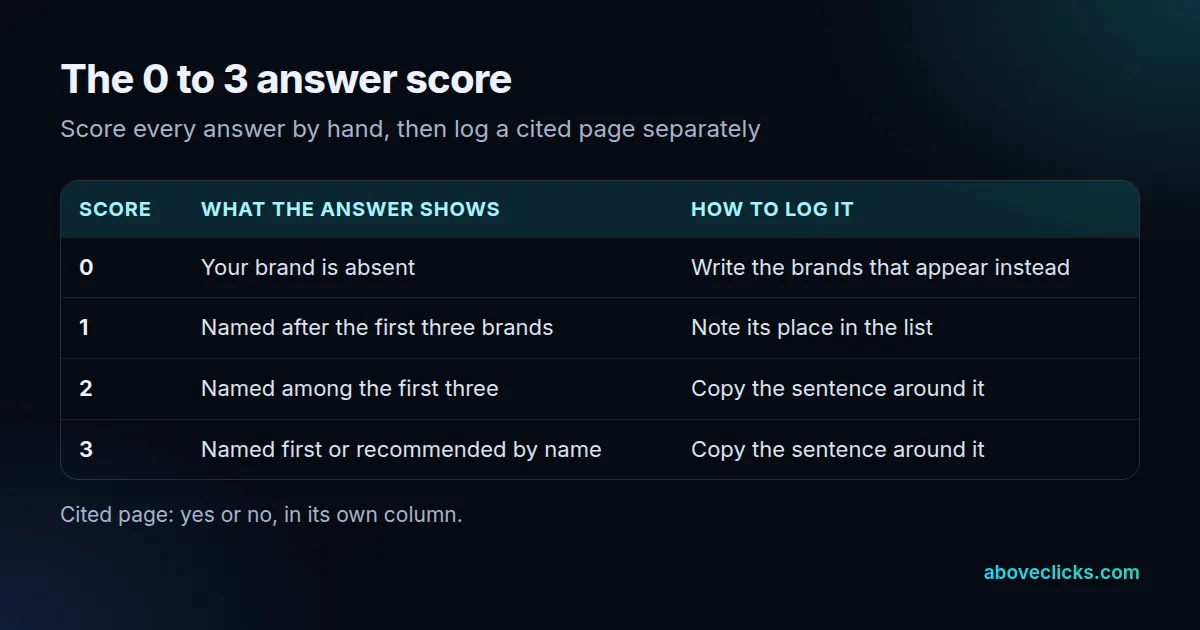
Use the 0 to 3 score above for every answer, and keep two rules fixed:
- Order means the order of first mention in the text, not the order of a list of links under it.
- A cited page is its own yes or no column. A brand can be named at score 3 and never linked, or linked while scoring 1.
In LLM SEO rank tracking the score is a record of what you read, not a number the assistant gave you. That is its weakness and its strength: it is stable because you decided how to apply it.
What does the best LLM SEO rank tracking setup look like?
A small, fixed prompt list, the same run conditions every week and raw answers saved. The best LLM SEO rank tracking setup is the one you can repeat unchanged for months, not the one with the most prompts.
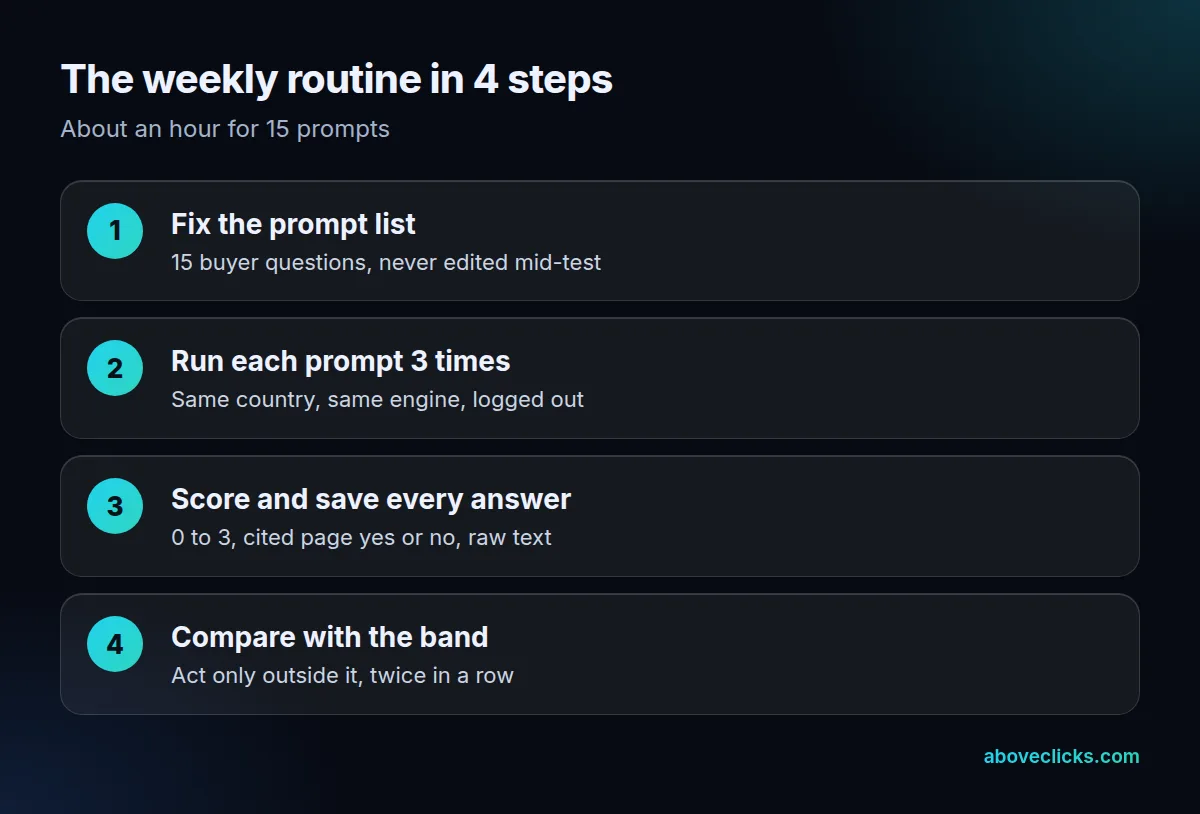
A worked setup for LLM SEO rank tracking: 15 prompts with 3 runs each gives 45 answers a week. Write the prompts the way buyers type them, with a budget, a country or a rival in them, and cover four stages: the problem, the options, comparisons and trust. If you need a buyer-question list to start from, the buyer prompt set entry shows how to build one.
Keep one row per answer with these columns:
- Date, engine and country, so a change in conditions is visible later.
- The prompt, copied exactly, never edited mid-test.
- Run number, 1 to 3.
- Score, 0 to 3, and the brands named before you.
- Cited page, yes or no, and which URL.
- The raw answer text, so a score can be re-read.
Why three runs in LLM SEO rank tracking? Google says that AI Mode and AI Overviews may use different models and techniques, so the responses and links they show vary. The same prompt can give different answers an hour apart, and three runs show how much. Google also says AI Overviews often do not trigger, as of November 2026, so a blank on that surface can be normal and not a loss.
Do not edit the prompt list once the baseline starts. If you must change it, start a new baseline and say so in the log.
How do you turn AI answers into one weekly number?
For LLM SEO rank tracking, count the share of answers that score 2 or 3, then compare it with a baseline band built from your first three quiet weeks. One figure a week is enough to follow.
The band rule has four steps:
- Run three baseline weeks before you change anything on the site.
- Take the lowest and highest weekly share. That range is your band.
- After a change, a week inside the band means nothing yet.
- Treat a move as real only when it sits outside the band for two rounds in a row.
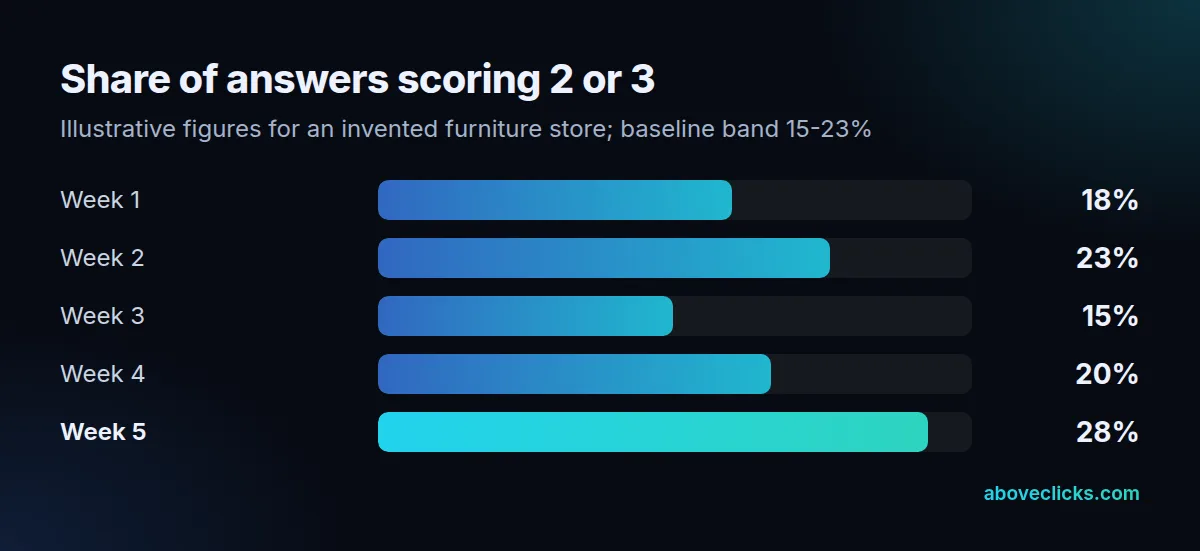
The example is illustrative: an invented furniture store with 45 answers a week. Weeks 1 to 3 gave 18%, 23% and 15%, so the band is 15% to 23%. A fix went live after week 3. Week 4 came in at 20%, still inside the band, and week 5 reached 28%, above it. That is one round outside the band, so the honest reading is “promising, wait for week 6” and not “the fix worked”.
The band rule for LLM SEO rank tracking is cautious on purpose. It will sometimes make you wait a week for something real, and it will stop you from reporting a fix that was chance. If you want a second figure, log the cited-page rate the same way, with its own band.
Report the band next to the figure every time. A line that says “28%, band 15% to 23%” gives the reader what they need to judge it; a bare 28% does not.
How does LLM SEO rank tracking differ from Search Console position?
Search Console measures links on Google with a defined position, while LLM SEO rank tracking measures your own sampled scores across assistants. They answer different questions, so keep them in separate columns.
Google says sites that appear in AI features are counted in the Performance report, within the Web search type, as of November 2026. That means AI clicks and impressions sit mixed with ordinary results and are not split out as an AI rank. The Help page also notes that position is tied to an impression: a link that was never shown gets no recorded position.
Use the two together, with LLM SEO rank tracking weekly and Search Console on a slower clock:
- Weekly: your answer scores and cited-page rate from the log.
- Monthly: Search Console clicks and impressions for the pages that were cited.
- Quarterly: both against the same weeks a year earlier. Google recommends setting the Performance report to the last 16 months so a yearly pattern shows.
If scores from LLM SEO rank tracking rise and Search Console does not move, that is not a contradiction. The log measures being named; Search Console measures people clicking on Google.
What can LLM SEO rank tracking not tell you?
Whether a person acted on an answer, what a logged-in user saw, and whether the answer was right. It tells you how often you were named in sampled public answers, and nothing more.
Three limits of LLM SEO rank tracking to state in every report:
- Sampling: 45 answers a week are a sample of what people ask, not all of it. The band shows how much that sample moves.
- Accuracy: OpenAI says that search results and citations in ChatGPT can be incomplete, outdated or incorrect (OpenAI Help, checked November 2026). A high score on a wrong answer is not a win until you have read it.
- Traffic: a score is not a visit. Visits come from your analytics and server logs, which no answer log can see.
A fourth limit of LLM SEO rank tracking is easy to miss: the log says nothing about why. If you want to know whether crawlers can reach and quote your pages, run the checks in our LLM SEO check first, then start LLM SEO rank tracking. More measurement guides are in the measurement section.
What should you do when your rank drops?
Check the band, re-read 15 answers by hand, then check access and content in that order. A drop inside the band is noise; a drop outside it for two rounds is worth a fix.
Work through this list:
- Is the week inside your band? If yes, do nothing and log it.
- Re-run the 5 prompts that fell most and read all 15 answers in full. Did a new brand replace you, or did the answer change shape?
- Did the conditions change: country, engine, a new model version?
- Did your own pages change, or did a crawler start being blocked?
- Only then edit content, one change at a time, so you can read the effect.
If you would rather have this set up and read for you, our AI search optimization service starts from the same prompt log, so LLM SEO rank tracking is where that work begins, and a free audit shows what is limiting your pages first.