Amazon search engine advertising costs are what you pay per click on sponsored ads in Amazon’s shopping results, set by an auction and capped by your daily budget. This guide covers click pricing, the Google comparison and a first test budget.
What are Amazon search engine advertising costs?
Pay-per-click charges for ads that appear in Amazon’s search results and on product pages. Sponsored Products are cost-per-click ads for single listings: you choose bids and a budget, and you pay only for clicks.
Amazon works like a search engine for products, so amazon search engine advertising costs have the same shape as other search advertising. You bid on shopping searches, an auction decides who shows, and nothing is charged until someone clicks. As of November 2026, Amazon says new sellers can earn up to $1,000 in ad credits when they launch and spend within 30 days of their first campaign, in select marketplaces.
What is different is where the click goes. Amazon sends the shopper to your product detail page, so your price, photos and reviews decide whether the click becomes an order. It helps to read amazon search engine advertising costs in three layers. The first is the price of a click. The second is the price of an order, which is the click price divided by your conversion rate. The third is the price of the page itself, because photos, reviews and copy move the conversion rate and so the second layer. Most owners look only at the first layer and are surprised by the other two.
That is why we link ad cost to listing work on our Amazon SEO page. For minimums and formats, see our Amazon advertising cost guide.
How does Amazon set the price of a click?
By auction. Amazon’s CPC guide says the final click cost comes from your adjusted bid plus other factors, and that busier keywords and more visible placements cost more.
Your bid is the most you would pay for a click before adjustments, and Amazon’s bidding help page says the amount you pay will not exceed your maximum effective bid. Each click is taken from your daily budget. So nobody can quote your amazon ppc cost in advance; they can only show a range from past auctions. Any average you read online is a starting point, not your number.
Amazon helps with a suggested bid. It is calculated from bids on similar ads that won impressions over the past 7 days, and it updates daily. Start at the suggested bid, then judge it against your profit, not against the suggestion. Your amazon ppc cost per click only matters next to your margin.
Which searches trigger your ad also moves the bill. Amazon’s match types page lists three manual options, broad, phrase and exact, and says you cannot change a match type after the campaign is created. Broad reaches more searches, including synonyms; exact is narrower and usually cheaper to control.
Automatic campaigns skip match types. In Sponsored Products, Amazon uses 4 targeting groups instead: close match, loose match, substitutes and complements. Substitutes and complements show your ad on the product pages of similar or related items, so your amazon search engine advertising costs can include clicks that come from product pages, not only from searches.
How do Amazon and Google search ad costs differ?
Both charge per click, set by an auction. The differences are in what feeds the price and where the click lands. For example, with a $1.00 maximum bid on Google you might be charged $0.70 if that is what it takes to beat the advertiser below you.
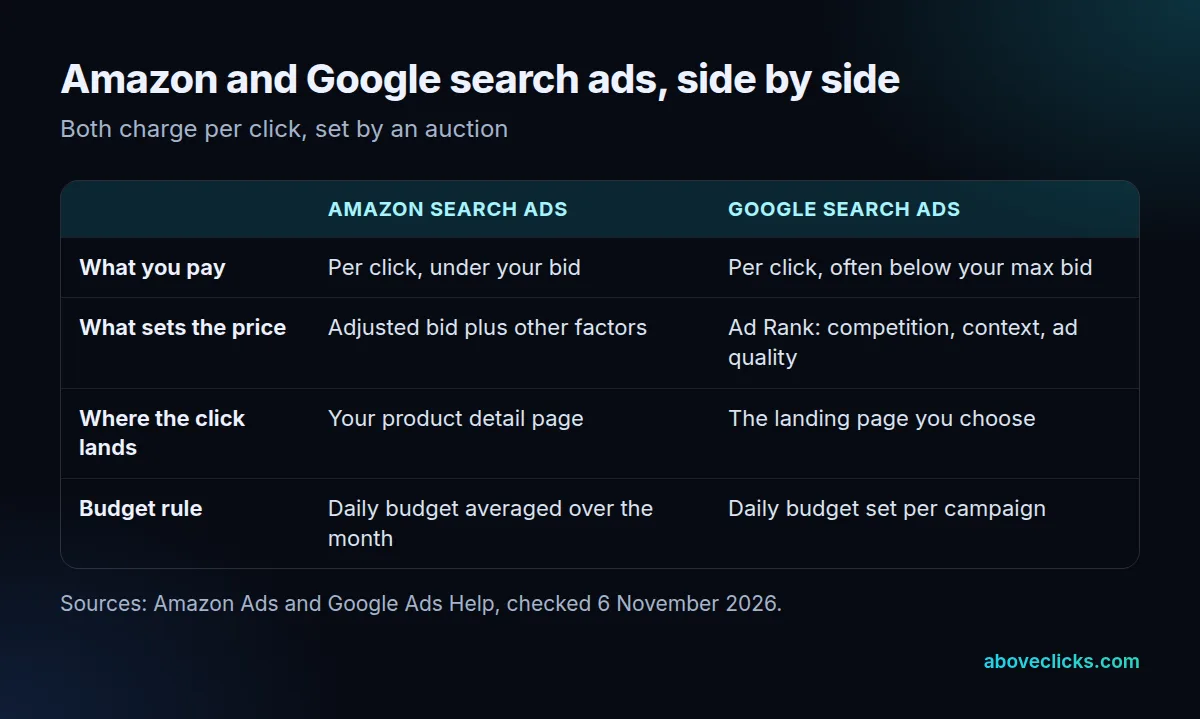
Google’s actual CPC page says you are often charged less than your maximum bid, because you pay what is needed to beat the Ad Rank of the advertiser below you. Its Ad Rank page says Ad Rank is built from competition, the context of the search and your ad quality. Amazon describes the same idea in broader words: an adjusted bid plus other factors.
The practical gap is the landing step. On Google you choose and build the page, so a weak page is your fix to make. On Amazon the page is your listing, which also changes how many shoppers buy. A store with a strong listing can afford a higher click than a rival with the same bid and a weak one. Our free audit reviews listings before ad spend goes up.
How much do Amazon search ads cost per month?
As much as your daily budget allows, and no more over a month. Amazon’s budget guide says the daily budget is averaged over the calendar month, so a single day can run up to 25% over.
Amazon’s own example: with a $10 daily budget, one day may spend $12.50, but the month still comes to $300. For many advertisers it recommends at least $10 a day per campaign, and it says to choose a budget you are able to pay.
Two things follow for the amazon search ads cost you plan, and for your wider amazon search engine advertising costs. First, a small budget can run out in minutes if many shoppers click, and the ad then stops until the budget resets at midnight. Second, the number to compare is monthly: multiply the daily budget by the days in the month, add each extra campaign, and treat the total as the ceiling. If an agency manages it, the fee is a second bill; our Amazon PPC management cost guide covers it.
How much should a first test cost?
Enough to buy the clicks that produce about 10 orders. Divide your target orders by your conversion rate to get the clicks, then multiply by your cost per click.
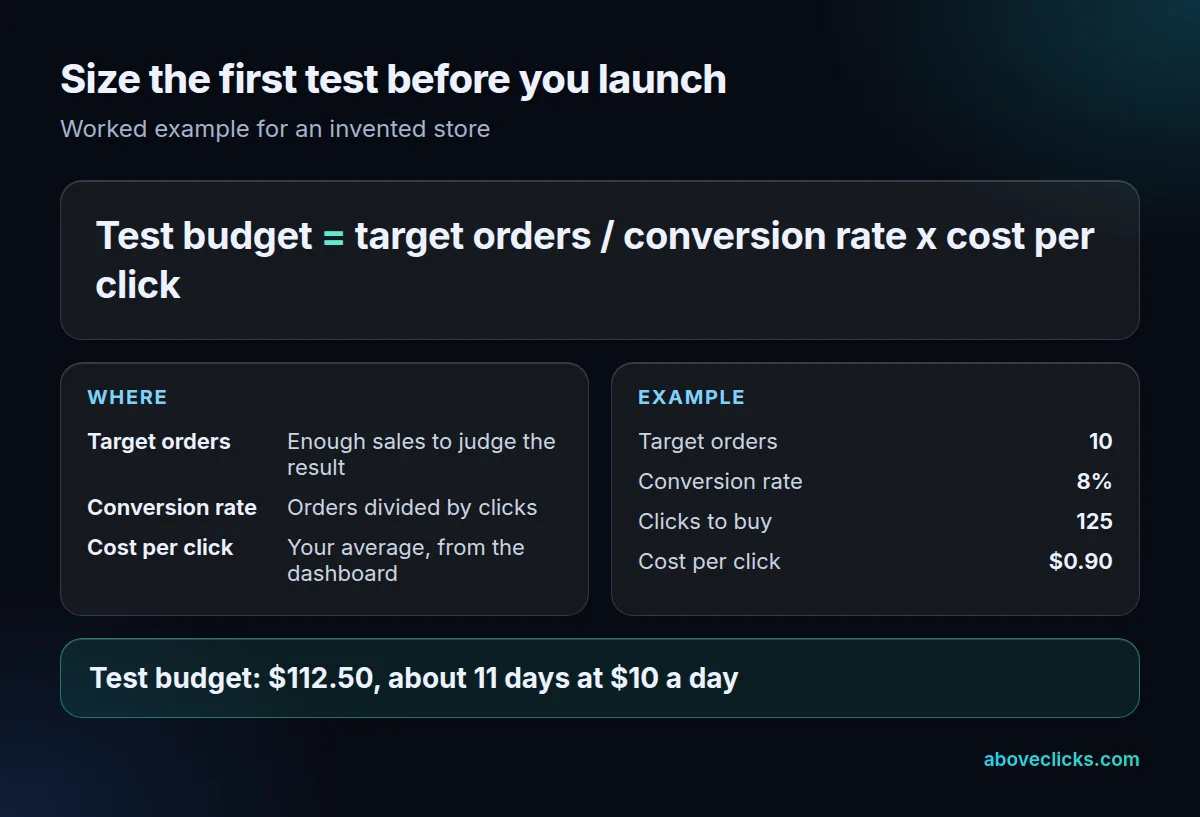
Example: an invented store sells a $30 product with $12 of profit before ads. It expects an 8% conversion rate and a $0.90 click. Ten orders need 125 clicks, so the test costs $112.50. At $10 a day that is about 11 days.
The same sums work for any budget. A store with a lower conversion rate needs more clicks for the same 10 orders, so its amazon search engine advertising costs for the test are higher even at the same click price. At a 4% conversion rate, the example store would need 250 clicks and $225 to reach the same 10 orders.
Now check it against profit. One order costs $0.90 divided by 8%, or $11.25 in ads, which leaves $0.75 of the $12. Amazon’s metrics page defines ROAS as sales divided by total cost, so this test returns $30 / $11.25, or 2.67. Break-even ROAS is $30 / $12, or 2.5. The test clears it, but only just. Try the same sums in our break-even ROAS calculator.
This is how we stage a first test for a store, and the plan below follows it. Start with one automatic campaign so Amazon finds the searches. Then build manual keywords from the search terms that sold, and move the budget only after the data is in. Keep a simple log: one row per week with spend, clicks, orders and ROAS, so the amazon ppc cost per order is visible at a glance.
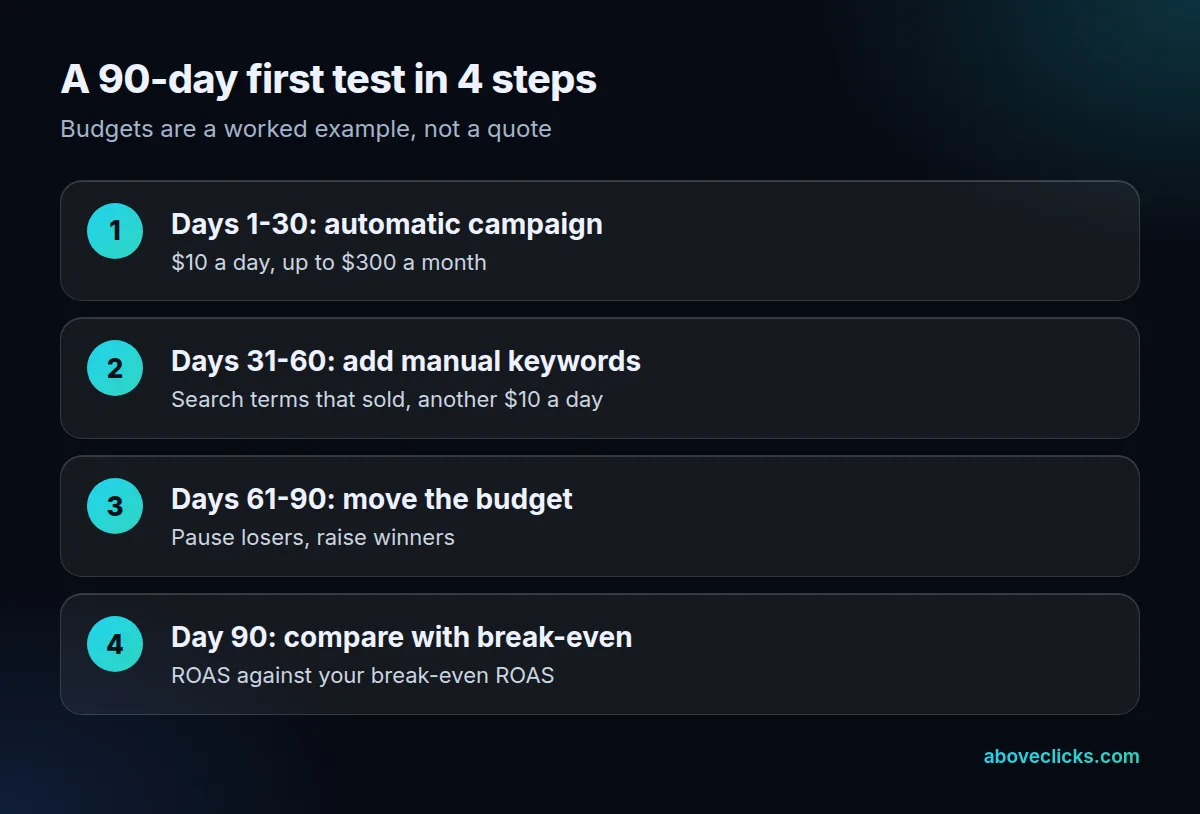
The budgets in the plan are a worked example: $300, then up to $600, then up to $600, so up to $1,500 across 90 days at $10 a day per campaign. Your numbers will differ with your margin and category, and so will your amazon search ads cost.
When do Amazon search ad costs jump?
Around big shopping events, and when a budget is set too small. Amazon’s bidding page says higher CPCs typically occur in the weeks leading up to and during Prime Day, Black Friday and Cyber Monday.
These are the 3 traps that push costs over plan:
- Event weeks. If your click price jumps in November, a flat daily budget buys fewer clicks. Decide in advance whether to raise the budget or let it run out.
- Reading cost too soon. Amazon says the cost column is an estimate that can change until 3 days after the click, and sales data can take up to 48 hours. A bad Monday may look better by Thursday.
- Broad keywords left alone. A broad match keyword can match synonyms and related terms, so cost drifts to searches you never meant to pay for. Review search terms weekly and add the poor ones as negative keywords.
A short run of high amazon search engine advertising costs does not mean the plan is wrong. Compare a full week with the same week last month before you change a bid. If the amazon ppc cost stays high for 4 weeks in a row, look at the listing before the bid, because a weak page raises the cost of every order.
When is paid help worth it?
When the sums above say the channel can pay, but you do not have the weekly time to run it. Search term review, negative keywords and budget moves are the repeating jobs.
The cost of Amazon search ads includes your own time, and that is the real price of doing it yourself. Paid help is worth considering if you sell many listings, if your conversion rate is low and the page needs work, or if events keep surprising your budget. It is less useful if you have not yet tested one campaign, because you have no numbers to hold anyone to.
Ask any provider about amazon search engine advertising costs in writing, and for the same things every time: how they will stage the first 90 days, which metric they report against (ROAS compared with your break-even), and who owns the ad account. Our Amazon Ads service page explains how we run it, and more cost guides are in buying guides.