Amazon PPC AI is software that uses machine learning or language models to suggest or make changes to Amazon pay-per-click ads. There is no official definition, so split it into three kinds: AI Amazon builds in, an AI agent you connect yourself, and third-party tools.
Each kind needs different checks, and none of them removes your job of setting the limits. This guide maps the three kinds, gives five checks to run before any of them touches your budget, and ends with a 28-day test you can run on one campaign. It is written for sellers who already run, or are about to run, Sponsored Products, and it sits in our buying guides because the real question is what to pay for and what to trust. We use “Amazon PPC AI” as shorthand for all of it.
What is Amazon PPC AI?
It is any tool that decides, or recommends, what to change in your Amazon ads: a bid, a budget, a target or a report. The label covers very different things, so always ask which of the three kinds is meant.
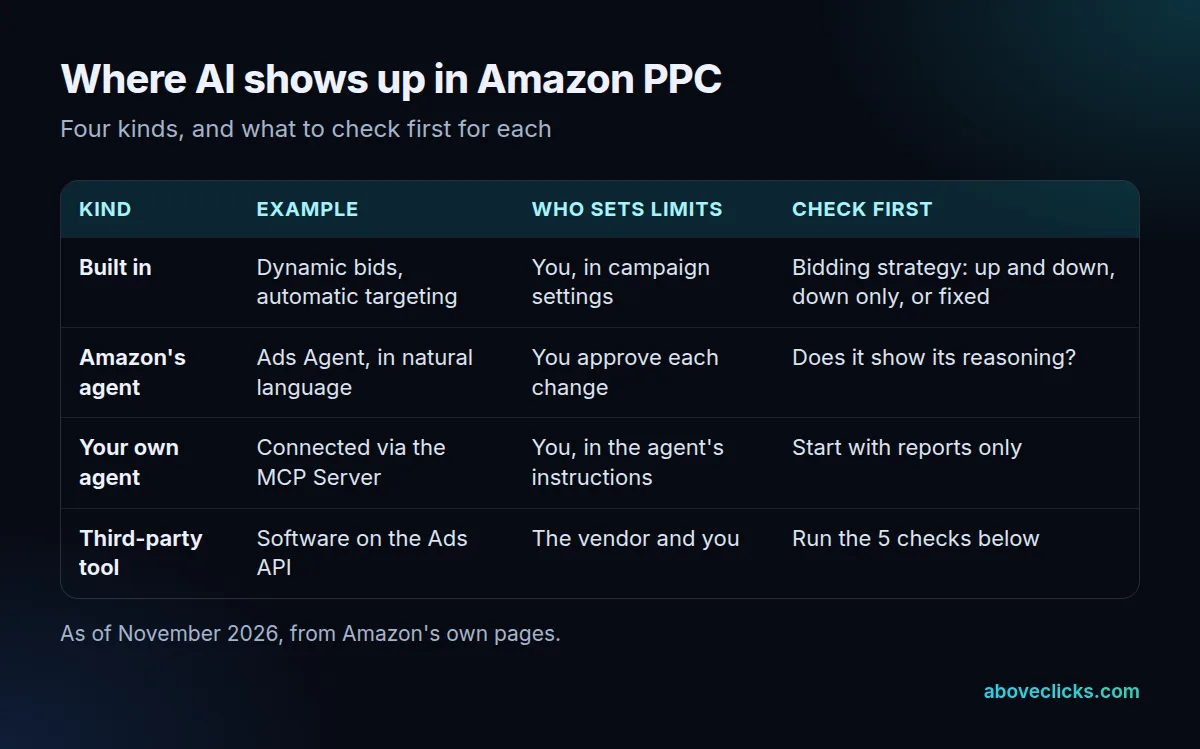
The map above is a working definition of ours, built from how Amazon describes its own features. Amazon PPC AI is not a separate ad type. The ads are still Sponsored Products and the other formats, billed per click. Only the thing that tunes them changes. Amazon’s FAQ says the minimum daily budget for Sponsored Products is $1.00, so even a small test can run on the real system.
That matters when a vendor says its Amazon PPC AI “optimizes” your account. Optimizes what, within which limits, and who checks? The rest of this guide gives you a way to answer those three questions, whichever Amazon PPC AI you are looking at.
What AI does Amazon build into its own ads?
Mostly bidding and targeting. In Sponsored Products you can let Amazon match ads to keywords and products, and you can let it move your bids using live signals. Both are settings, not extra software.
Amazon’s best-practices guide says automatic targeting is the easiest and quickest way to get started, because Amazon matches your ads to keywords and products. It also lists bidding strategies: “dynamic bids – up and down”, “dynamic bids – down only” and “fixed bids”, which uses the exact bid you enter.
Two limits are worth knowing. Your final cost per click never exceeds your maximum adjusted bid, according to the same guide. And placement adjustments can go as high as 900%, so a careless adjustment on top of a dynamic bid can raise costs fast.
Amazon also now runs its ad console inside the Amazon Ads Agent, which, as of November 2026, it describes as a platform where you plan, create, optimize and measure campaigns in natural language. Amazon says the AI “shows its reasoning” and that you make the decisions. Take it at its word and read the reasoning before you approve anything it suggests. Amazon PPC AI that explains itself is easier to trust than one that doesn’t. For the cost side of these ads, see our guide to CPC on Amazon.
Can AI for Amazon PPC run through your own agent?
Yes, in principle. Amazon says its MCP Server lets you connect your own AI agents to the Ads Agent, and that connected agents can create, update and optimize campaigns and run performance reports.
That is Amazon’s description on its FAQ page, as of November 2026. MCP is the Model Context Protocol, an open standard for how AI systems talk to outside tools. Amazon adds that one integration replaces dozens of manual API calls.
Read that as a capability, not a recommendation. Using AI for Amazon PPC this way is new, and Amazon may change the details. An agent that can create campaigns can also overspend, so use a ladder with three rungs:
- Reports only. The agent reads performance and explains it. It changes nothing.
- Suggestions. It proposes bid or budget changes, and you apply them by hand.
- Capped changes. It applies changes inside limits you set, such as a maximum bid and a daily budget.
Start the agent on a campaign with a daily budget of $10 or less. Stay on each rung until its output has been right for 4 weeks. Most sellers never need rung 3 on every campaign, and the best AI for Amazon PPC is the one whose changes you can read. Rung 1 costs nothing but time. If you would rather hand the work to a specialist, our Amazon Ads service covers management, and the agency fees guide explains what that costs.
What do third-party Amazon PPC AI tools add?
Usually speed and a nicer interface on the same data. Tools read your campaigns and reports through Amazon’s API, then show recommendations or apply changes for you.
Amazon’s developer overview says developers can use the Amazon Ads API and Amazon Marketing Stream to access performance metrics, with the API handling asynchronous report requests and the Stream giving near real-time metrics. So the data an Amazon PPC AI tool sees is the data you already own.
We don’t name tools here, because we can’t verify any vendor’s claims from a primary source. What a tool really adds is judgment about which change to make, and that is the part you have to test. A tool that edits a bid every hour makes 24 changes a day on each target, so a wrong assumption compounds quickly. Ask how often it acts and what it does when it has little data. The next section gives you five checks for that.
How do you check an Amazon PPC AI claim?
Ask five questions, in writing, before you connect anything. A vendor that can’t answer them has told you what you needed to know. The same five checks work on Amazon’s own tools and on an agent you build, so they apply to every kind of Amazon PPC AI.
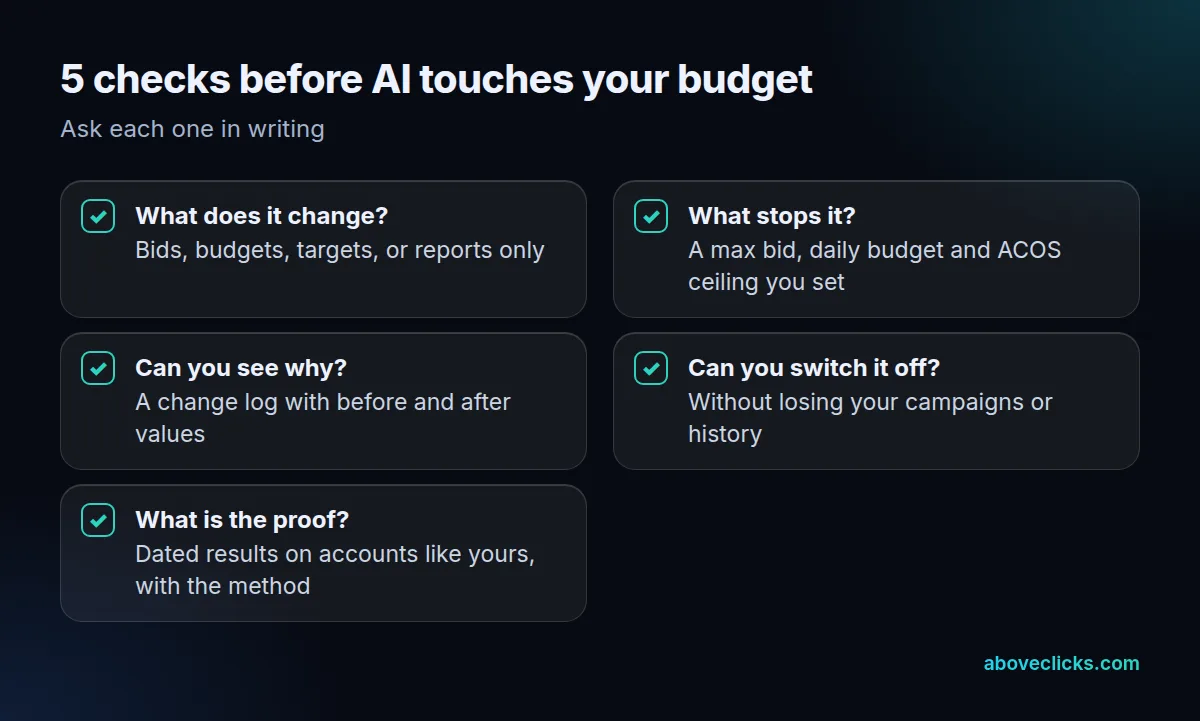
- What does it change? Bids, budgets, targets, or reports only. Anything beyond reports needs limits.
- What stops it? A maximum bid, a daily budget and an ACOS ceiling that you set, not defaults.
- Can you see why? A change log with the before and after value of every edit.
- Can you switch it off? And keep your campaigns, targets and history when you do.
- What is the proof? Dated results on accounts like yours, with the method. A screenshot of one good week is not a method.
The second check needs a number, and Amazon gives you the rule. Its ACOS guide defines ACOS as ad spend divided by ad revenue, times 100, and says your ACOS needs to be lower than your profit margin to keep a profit. That margin-linked figure is your break-even ACOS, and it belongs in the AI’s settings as a ceiling.
How should you test Amazon PPC AI on a small budget?
On one campaign, for 28 days, against a similar campaign you leave alone. Set the stop rule before you start, so a bad run ends on a number instead of on a feeling.
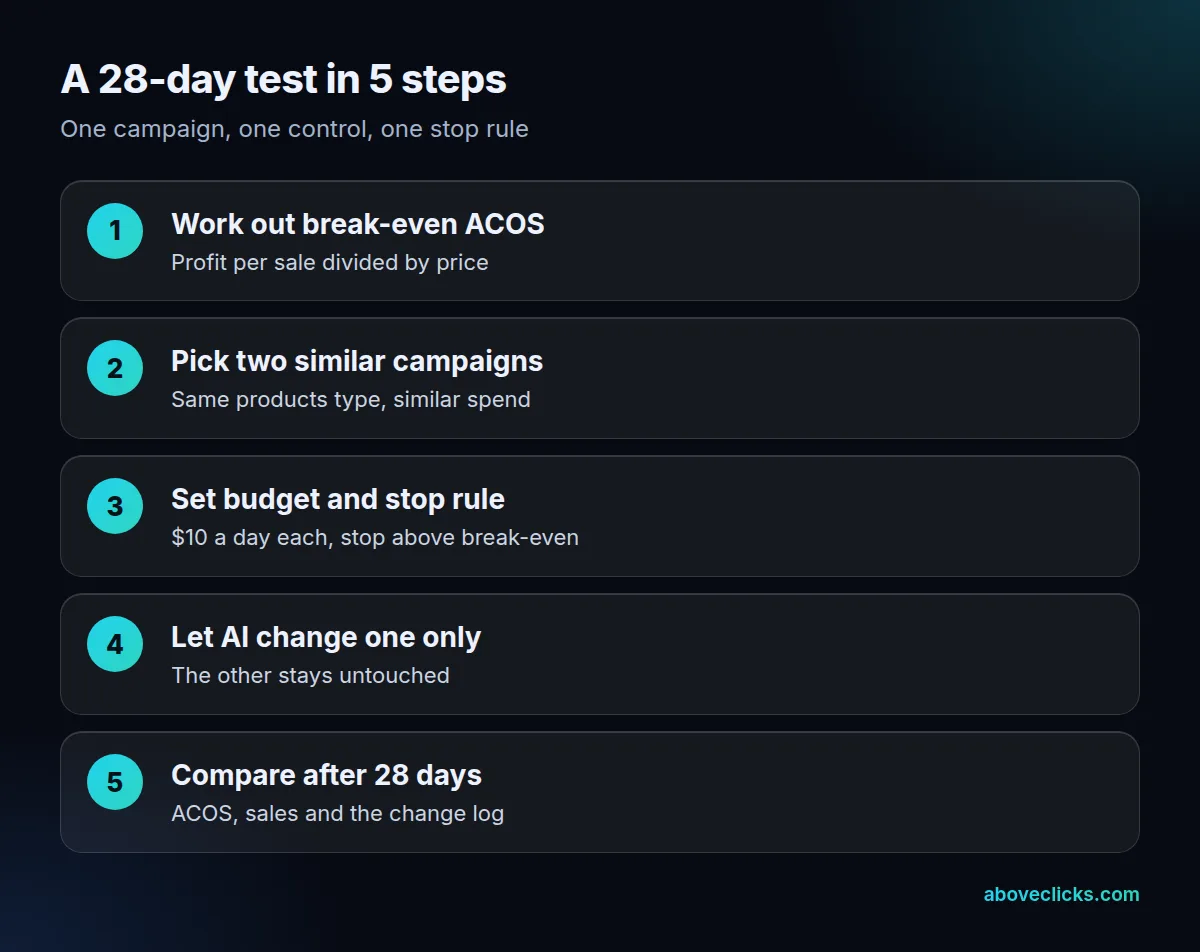
Here is a worked example with invented numbers. A store sells a product for $40 and keeps $14 per sale after product cost and Amazon fees, before ads. Break-even ACOS is $14 divided by $40, or 35%. A target of 25% would leave 10 points of profit.
Amazon’s best-practices guide suggests a starting daily budget of $10 and explains the maths: a $100 daily budget may bring up to $3,000 of clicks in a 30-day month. So the monthly total is what a budget really caps. At $10 a day for 28 days, each test campaign is capped at roughly $280.
The stop rule for this example: switch the AI off if its campaign’s ACOS is above 35% after $280 of spend, while the control campaign sits below it. At break-even, $280 buys about $800 of sales, or 20 orders of $40. That is a small sample, so use the test to catch obvious harm, not to prove a big gain.
Amazon also advises watching your metrics at least twice a week in the first week. Do the same here, and keep the change log open. Compare the two campaigns on ACOS and on the number of orders, not on ACOS alone, because a campaign can lower its ACOS simply by spending less. If the Amazon PPC AI campaign wins on both measures, extend it to a second campaign and run the same test again.
When is a person still needed?
For every decision the AI can’t see: your margin, which products deserve ad spend, stock levels and whether a result is real. The AI can read an ad report. It can’t read your cost sheet. That is true of Amazon PPC AI built by Amazon, by you or by a vendor.
A person should own three things, and should look at the change log twice a week for the first 4 weeks:
- The ceiling. Break-even ACOS comes from your costs, and costs change when a supplier or fee changes.
- The product list. Which products get budget is a business choice, not a bid choice.
- The review. A weekly look at the change log, because a rule can be wrong for weeks before the totals show it.
If that sounds like a job, it is, and it is the same job with or without Amazon PPC AI. Our Amazon SEO service looks at the listing side of the same account, since a weak listing wastes clicks whatever tunes the bids. To see how your current account reads, request a free audit.