The Model Context Protocol (MCP) is an open-source standard for connecting AI applications such as Claude or ChatGPT to outside data, tools and workflows through one common interface. Anthropic open-sourced it in November 2024, and Shopify now uses it for shopping agents.
The Model Context Protocol (MCP) is an open-source standard for connecting AI applications such as Claude or ChatGPT to outside data, tools and workflows through one common interface. Anthropic open-sourced it on 25 November 2024, and Shopify now uses it for shopping agents.
How does the Model Context Protocol work?
An AI app connects to MCP servers and calls the tools they describe. The MCP documentation calls it “an open-source standard for connecting AI applications to external systems”, and Anthropic’s launch post described “a new standard for connecting AI assistants to the systems where data lives” (Anthropic).

The architecture overview splits it into a host (the AI app), one client per connection and the servers. Messages use JSON-RPC 2.0 and travel over 2 transports: stdio for local servers and Streamable HTTP for remote ones.
What is an MCP server?
A program that offers an AI app things to use, in a standard shape. Each MCP server exposes up to 3 kinds of primitive: tools the AI can call (search a catalog, create a cart), resources it can read for context, and prompts, which are reusable templates.
Because every server describes itself the same way, one integration works in any compatible app. The MCP site lists Claude, ChatGPT, Visual Studio Code and Cursor among the clients that support it.
Servers can be small. At launch, Anthropic shared pre-built servers for Google Drive, Slack, GitHub, Git, Postgres and Puppeteer, and an open-source repository of more. A store-side example is a tool that looks up stock for a product ID: 1 tool, 1 input and 1 answer, described once for every AI app. As of October 2026, the latest specification version on the MCP site is dated 2026-07-28.
Does a Shopify store have an MCP server?
Yes, for shopping agents. All 18 Shopify stores whose Universal Commerce Protocol profile we fetched on 17 October 2026 declared an mcp transport at https://<store>.myshopify.com/api/ucp/mcp. We couldn’t call those endpoints from our test machine, so this is what the profiles declare, not tested tool output.
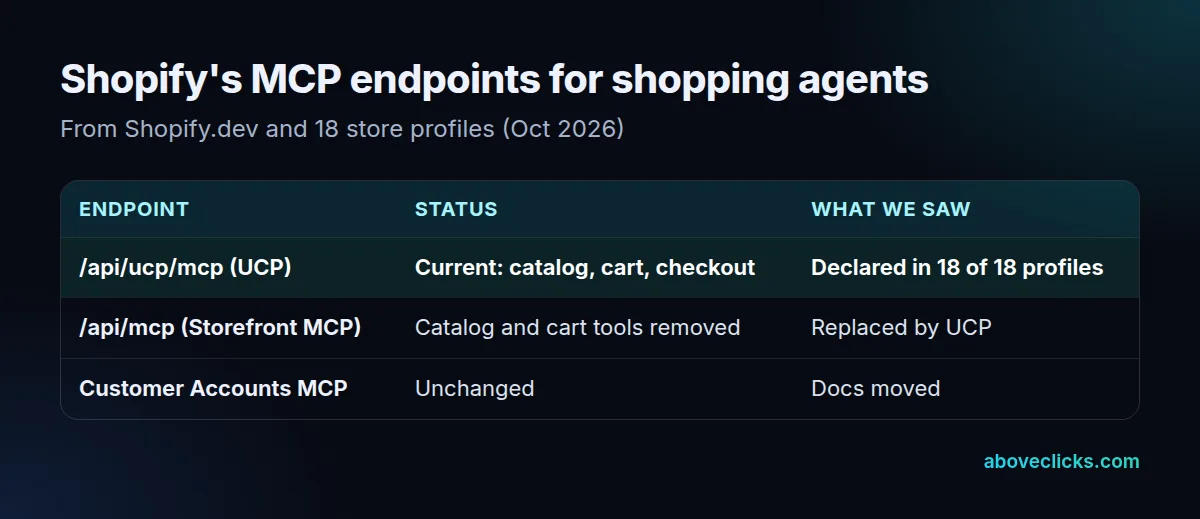
That endpoint replaced an older one. Shopify’s developer docs say the catalog and cart tools on /api/mcp were removed and “UCP now provides these capabilities at” /api/ucp/mcp, with 3 catalog tools: search_catalog, lookup_catalog and get_product (Shopify.dev). Agents must include an agent profile in every request.
Does a store need to build one?
Usually not for selling through AI agents: the shopify mcp endpoint already exists in all 18 store profiles we checked, and what agents find there is your product data. Building an MCP server makes sense when your own team wants an AI assistant to reach internal data, such as stock, orders or a supplier sheet. Scope it like any integration: which tools, which data, who may call them, and how each call is logged, because an MCP tool acts with whatever access you give it.

The Universal Commerce Protocol page covers the shopping side in more detail. Our custom Shopify apps team builds internal model context protocol tools, our AI shopping channels service covers agent access, and the AI for e-commerce hub covers the rest.