The Agentic Commerce Protocol (ACP) is an open standard, first developed by OpenAI and Stripe, that defines how an AI agent such as ChatGPT reads a merchant's catalog and runs a checkout for the buyer, while the merchant stays the merchant of record.
The Agentic Commerce Protocol (ACP) is an open standard, first developed by OpenAI and Stripe, that defines how an AI agent such as ChatGPT reads a merchant’s catalog and runs a checkout for the buyer. The merchant stays the merchant of record throughout.
What does the Agentic Commerce Protocol do?
It gives agents and stores a shared API for product data, carts and checkout. OpenAI describes ACP as “the connective layer between merchants and ChatGPT users” that lets ChatGPT “ingest structured catalog data” (OpenAI Developers).
- License: open source under Apache 2.0, so any agent or payment provider can implement it.
- Control: businesses “maintain their customer relationships as the merchant of record” and decide which products can be sold (agenticcommerce.dev).
- Payments: any compatible payment provider; Stripe was the first, with its Shared Payment Token.
- Integration: REST and MCP compatible.
Who maintains ACP?
OpenAI and Stripe started it, and the project’s maintainers file now lists Meta as a third lead maintainer. The ACP repository README still names only OpenAI and Stripe as maintainers and says the spec is “currently in beta“.
The first release is dated 29 September 2025, and there have been 5 dated releases since then, the latest on 17 April 2026, which marked the 30 January 2026 version as deprecated. For anyone building against acp openai docs, that pace means pinning a version and re-checking it each quarter.
What does a merchant have to build for ACP?
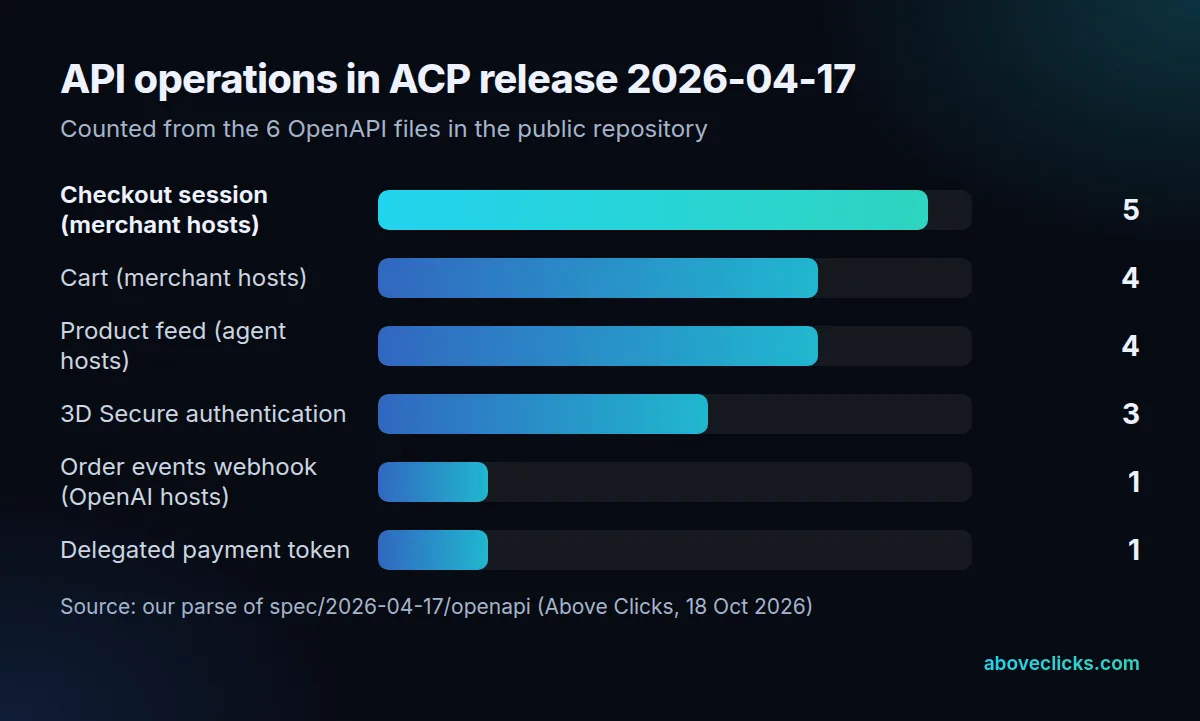
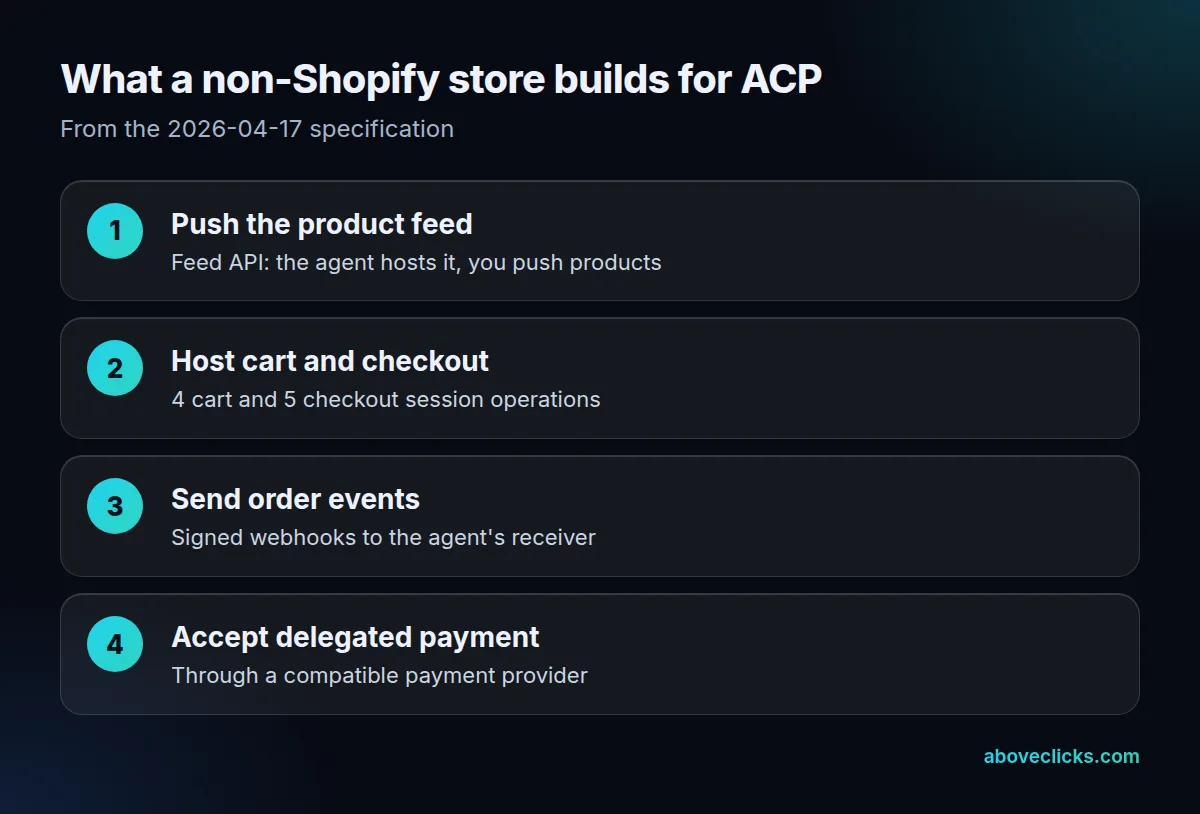
A store that implements it itself hosts the cart and checkout endpoints and pushes its products to the agent. We parsed the 6 OpenAPI files of the 2026-04-17 release on 18 October 2026 and counted 18 API operations: 5 for the checkout session, 4 for carts, 4 for the product feed, 3 for 3D Secure authentication, 1 order-events webhook and 1 delegated payment token.
The feed works the other way round from a crawler. The release notes call it “a push model”: merchants push product records to a feed the agent hosts. Order updates go back as signed webhooks to a receiver OpenAI hosts: each request carries an HMAC-SHA256 signature in a Merchant-Signature header, and the receiver rejects it with a 401 if the signature or timestamp fails the check. So this chatgpt checkout api is a real development project for a custom store, not a setting.
How is ACP different from UCP?
Different backers, same goal. The Universal Commerce Protocol comes from Google with Shopify and large retailers, and stores announce it in a file at /.well-known/ucp, which 18 of 30 stores served in our 17 October 2026 check. The Agentic Commerce Protocol has no such file yet; its site says discovery mechanisms are still being worked on.
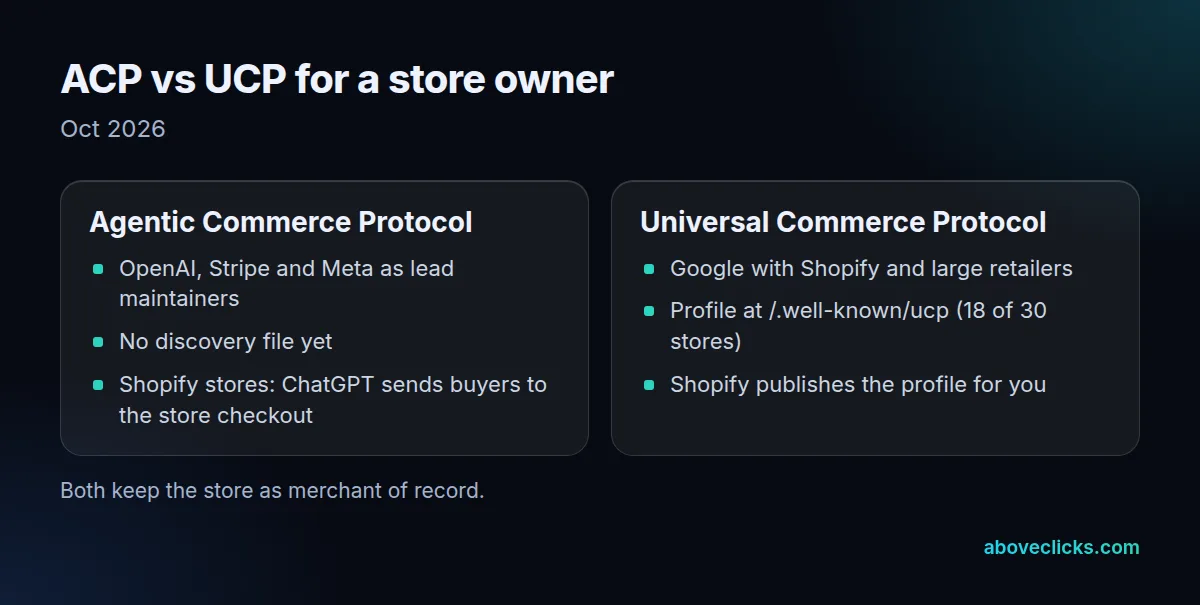
For Shopify stores the question mostly goes away. Shopify says ChatGPT users “complete their purchase on your online store checkout in a ChatGPT in-app browser” (Shopify Help Center), so there’s no agentic commerce protocol work for the store to do. Off Shopify, our AI shopping channels service scopes the build, the AI commerce readiness check shows what your catalog lacks, and the AI for e-commerce hub covers the rest.