An AI agent is software in which a language model decides which steps to take and which tools to use to reach a goal, instead of following a script written in advance. It can look things up, call other systems and act on the results.
An AI agent is software in which a language model decides which steps to take and which tools to use to reach a goal, instead of following a script written in advance. It can look things up, call other systems and act on the results.
What is an AI agent in simple terms?
A model with hands: an AI agent. It reads a goal, picks a tool, looks at what came back, and decides the next step, repeating until the job is done or it needs a person.
Anthropic’s guide to building effective agents splits these systems in two. Workflows run a model through predefined code paths. Agents “are systems where LLMs dynamically direct their own processes and tool usage, maintaining control over how they accomplish tasks.” Both start from the same block: a model given 3 extras, retrieval, tools and memory.
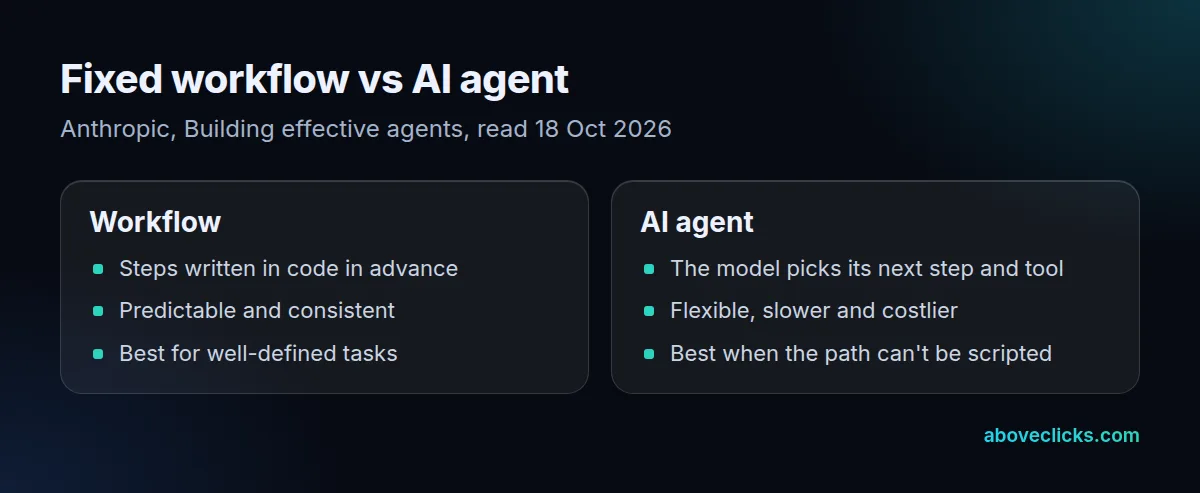
The same guide gives the honest advice: find the simplest solution that works, because agentic systems trade speed and cost for better results on hard tasks. Many store jobs are better as a fixed workflow, such as a Shopify Flow rule. The two also mix: 2 of Shopify’s 10 official Flow code examples exist to read answers from an LLM or an MCP server, so a fixed workflow can call a model for one step and stay in control of the rest.
How is an agent different from a chatbot?
A chatbot answers. An AI agent acts: it can call tools, read systems and change things, such as a cart or a ticket, and it chooses those actions itself rather than replying turn by turn.
Microsoft’s Foundry Agent Service overview shows how vendors package this, with 3 agent types: prompt agents defined by instructions and tools, voice-based prompt agents for spoken conversations, and hosted agents running your own code. The label “agentic AI” usually covers the whole family. The practical gap shows in the plumbing: a chatbot’s reply is text, while an agent’s step is a tool call with data in and out. Shopify’s own Flow example for parsing an LLM chat reply runs 2,884 characters of code just to turn that text into fields a workflow can use. In shopping, the same idea gives an AI shopping agent that compares and buys for a person.
Can agents shop on Shopify stores?
Yes. Shopify publishes agent endpoints for its stores, and on 18 October 2026 all 21 stores we tested listed the same 13 agent tools, covering catalogue search, carts, checkout and orders.
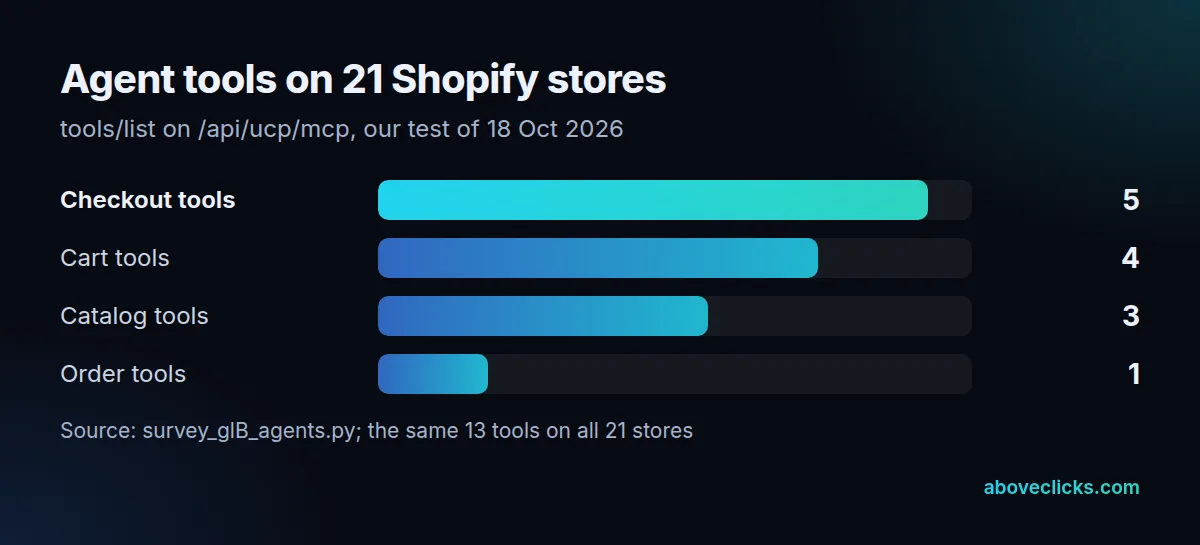
Shopify’s agent docs describe these as MCP servers built on the Universal Commerce Protocol, part of agentic commerce. The Storefront Catalog page gives the address, /api/ucp/mcp on each store, and says every request must carry an agent profile. In our test the list of tools came back in a median 2.97 seconds, and it came back without a profile too. We only asked for the list, so we can’t say what the tools allow without one.
Example (a hypothetical coffee store): its support AI agent reads the order and tracking, checks the returns policy, drafts the reply, and passes any refund or discount to a person to approve. The agent saves the looking up; the person keeps the decisions that cost money. At 300 tickets a month and about 4 minutes of looking up each, the AI agent takes on roughly 20 hours of work, while every refund still has a person’s name against it.

Our AI consulting team scopes where AI agents for ecommerce pay off, and our business automation service builds the fixed workflows around them.