An API (application programming interface) is a set of rules that lets one program ask another for data or actions. When a review app reads your orders or a warehouse system updates stock, it uses an API instead of a person clicking through admin screens.
An API (application programming interface) is a set of rules that lets one program ask another for data or actions. When a review app reads your orders or a warehouse system updates stock, it uses an API instead of a person clicking through admin screens.
What is an API in simple terms?
A menu for software. It lists what a program can be asked for, how to ask, and what comes back, so another program can order from it without knowing how the kitchen works.
MDN’s glossary defines it as features and rules inside a program that allow interaction through software rather than a human interface, adding: “The API can be seen as a simple contract (the interface) between the application offering it and other items, such as third-party software or hardware.” On the web that contract is usually a set of URLs, methods and events.
A Shopify store has several. The Admin API reads and writes orders, products and stock for apps you install, and the Storefront API feeds product data to custom sites and mobile apps. A webhook works the other way round, sending data out when something happens. Shopify ships a new version of these interfaces every 3 months, so any integration built on them needs regular upkeep.
REST vs GraphQL: what is the difference?
A REST interface gives each resource its own URL and returns a fixed shape. GraphQL uses one endpoint where the caller writes a query naming exactly the fields it wants, and gets nothing else.
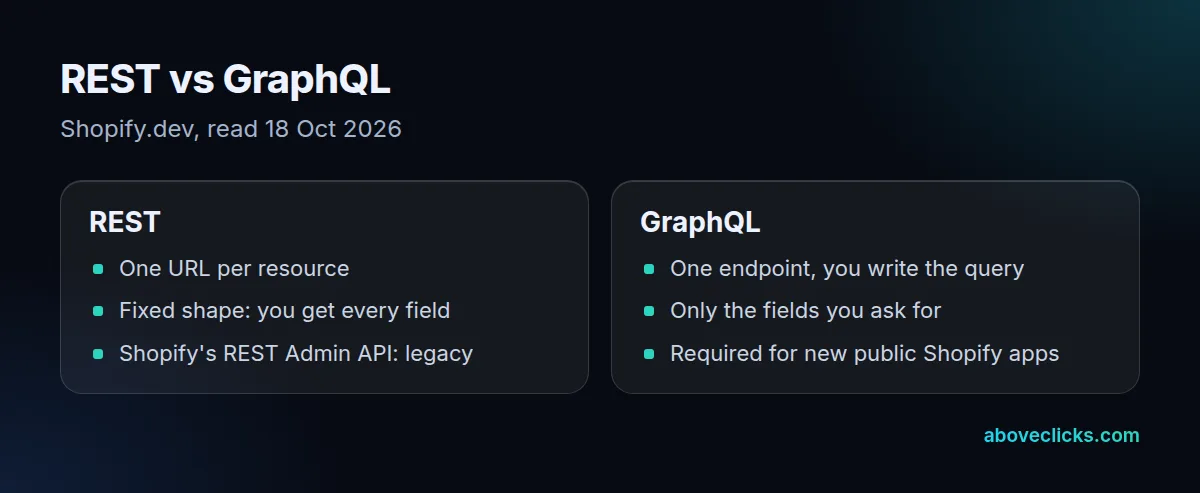
Shopify has picked a side. Its REST Admin reference says that interface is legacy as of 1 October 2024, and since 1 April 2025 new public apps must use GraphQL only.
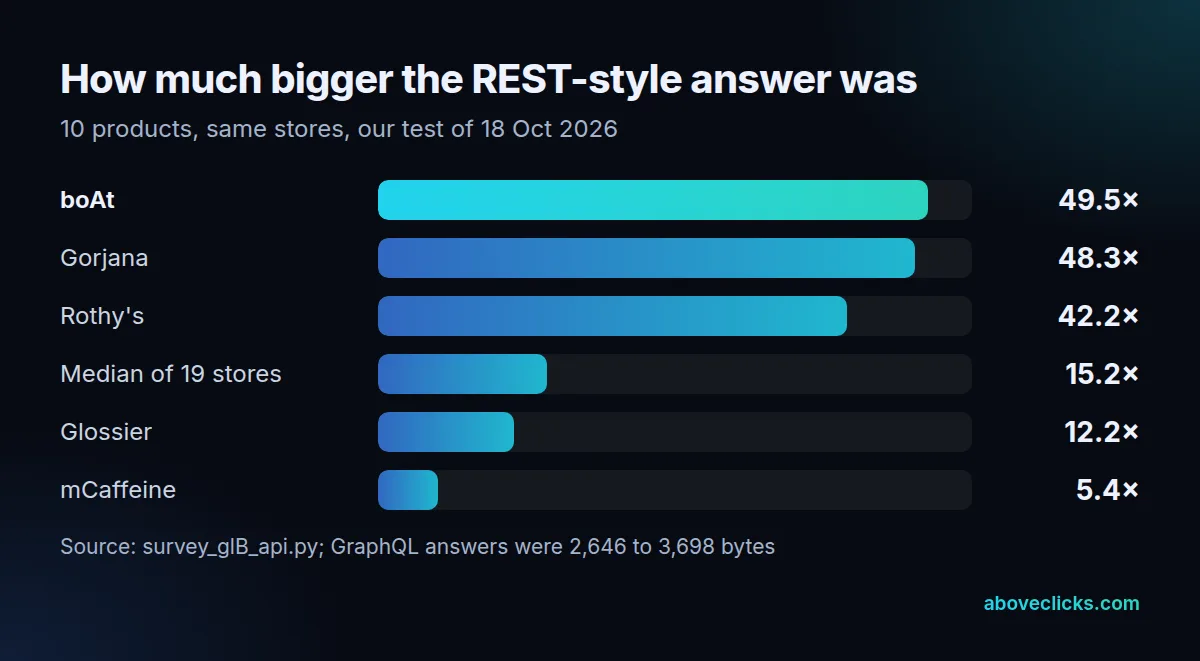
To see the difference, on 18 October 2026 we asked 19 live Shopify stores for 10 products both ways. The fixed /products.json answer weighed 16,508 to 183,031 bytes, because it carries every description, variant and image. A GraphQL query asked only for the four fields a product grid shows: title, link, image and price. Those answers came back at 2,646 to 3,698 bytes, a median of 15.2 times smaller, in about the same time. Less data to send is less data for a phone to download and parse, so ask only for what the page shows.
How often does Shopify release new versions?
Shopify releases a new version every three months, named by date like 2026-10, and supports each stable version for at least 12 months, with 9 months of overlap so apps can move up in time.
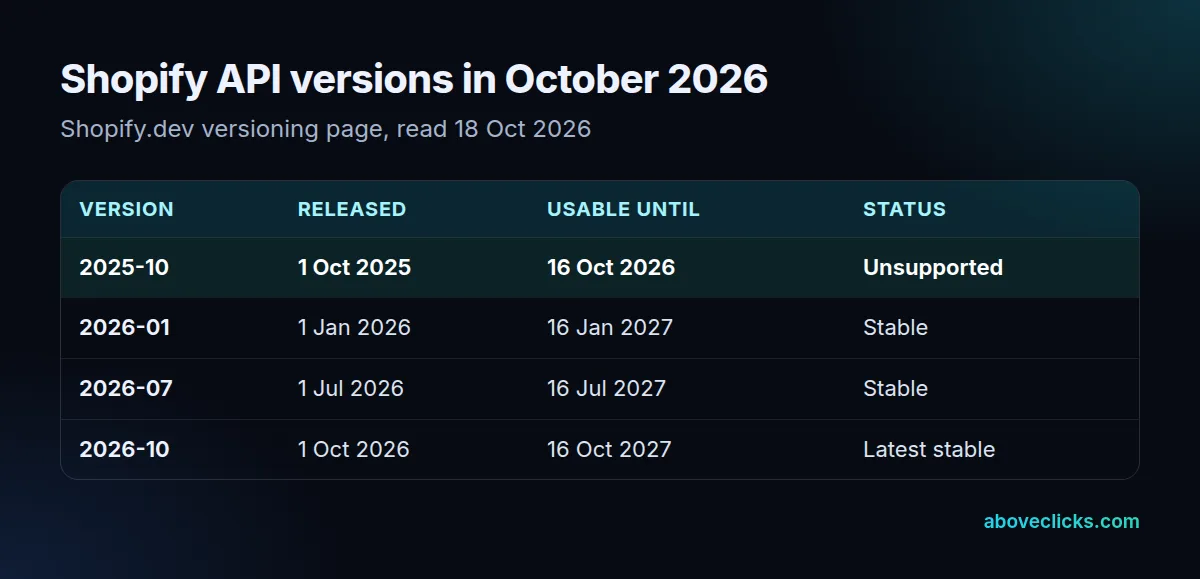
The versioning page lists the calendar: version 2025-10 became unsupported on 16 October 2026, and 2026-10 runs until 16 October 2027.
Example (a hypothetical stationery store): its stock-sync app was built on 2025-07 and never updated. Calls to a version past its date are answered by the oldest version still supported, so behaviour can change without anyone touching the code. Shopify recommends moving to the latest stable version each quarter; at the least, check before each version’s end date. Our Node.js development team builds and maintains integrations like this, and our business automation service connects them to the rest of the stack.