A knowledge graph is a database of entities, such as people, places, organizations and products, plus the facts and relationships that connect them. Google's Knowledge Graph powers its knowledge panels and helps it tell one brand from another, which is also how AI answers keep similar brand names apart.
A knowledge graph is a database of entities, such as people, places, organizations and products, plus the facts and relationships that connect them. Google’s Knowledge Graph powers its knowledge panels and helps search, and the AI answers built on it, tell one brand from another.
What does Google’s Knowledge Graph hold?
Entities and facts about them. Google introduced it on 16 May 2012 under the line “things, not strings”, saying it held “more than 500 million objects, as well as more than 3.5 billion facts about and relationships between these different objects” (Google). Those are 2012 figures; Google hasn’t published a current size in the sources we read.

Its most visible output is the knowledge panel. Google describes knowledge panels as “information boxes that appear on Google when you search for entities” in the Knowledge Graph, and says they are “automatically generated” from sources across the web (Knowledge Panel Help).
How does a brand get into it?
Through consistent public facts that search engines can match. There’s no application form; Google builds entities from what it finds, so the job is to make your brand’s facts easy to find and identical everywhere.
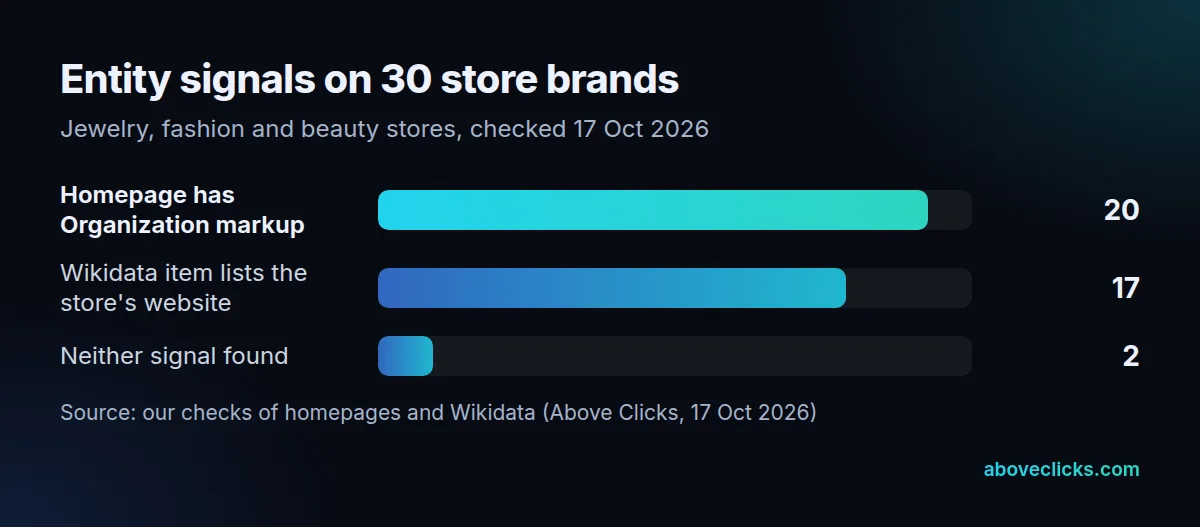
Your own site comes first. Google’s Organization markup documentation says adding organization structured data to your homepage “can help Google better understand your organization’s administrative details and disambiguate your organization in search results”, and its example lists profiles in sameAs. In our 17 October 2026 check, 20 of 30 store homepages carried Organization schema.

Why does it matter for AI search?
Because entities keep similar names apart. An AI answer about “Catbird rings” needs to know which Catbird you mean; an entity with a website, a location and product types attached resolves that.
Open databases are one public source of entity facts. We looked up each of the 30 stores in Wikidata, the free knowledge base, on 17 October 2026: 17 have an item whose official-website property lists the store’s own domain, and 13 don’t, including some well-known brands. The skims.com lookup also returned the item for co-founder Kim Kardashian, which lists the same website, a reminder that entities can blur.
Can you check what Google knows about your brand?
Partly. Search your brand name and look for a knowledge panel; if one appears, Google has an entity for you. Developers can also query the Knowledge Graph Search API, which Google describes as a way to find entities in its Knowledge Graph, returned in standard schema.org types and JSON-LD.
Google warns that the API “is not suitable for use as a production-critical service”, and it’s read-only, so it can show an entity but not change it. Verified entities can suggest edits through their panel.
For most stores, the practical route is fixing the inputs: markup, profiles and the About page. In our check, 13 of the 30 brands had no Wikidata item listing their website, 10 homepages showed no Organization JSON-LD (3 of them didn’t load for us) and 2 had neither signal, so even well-known stores leave part of this to chance.
Our technical SEO work covers the markup, our AI visibility audit checks how AI answers describe your brand, and the AI search optimization hub covers the rest.