Grounding is connecting an AI model's answer to specific, verifiable sources, such as live search results or a company's documents, so the answer rests on those sources rather than only on what the model learned in training. In AI search, the grounding sources are the pages that get cited, which is why the wording of e
Grounding is connecting an AI model’s answer to specific, verifiable sources, such as live search results or a company’s documents, so the answer rests on those sources rather than only on training. In AI search, the grounding sources are the pages that get cited.
How does it work in AI search?
The model searches, reads the results and writes from them, with citations. Google’s Gemini API docs say Grounding with Google Search “connects the Gemini model to real-time web content and works with all available languages”, so it can “cite verifiable sources beyond its knowledge cutoff”.
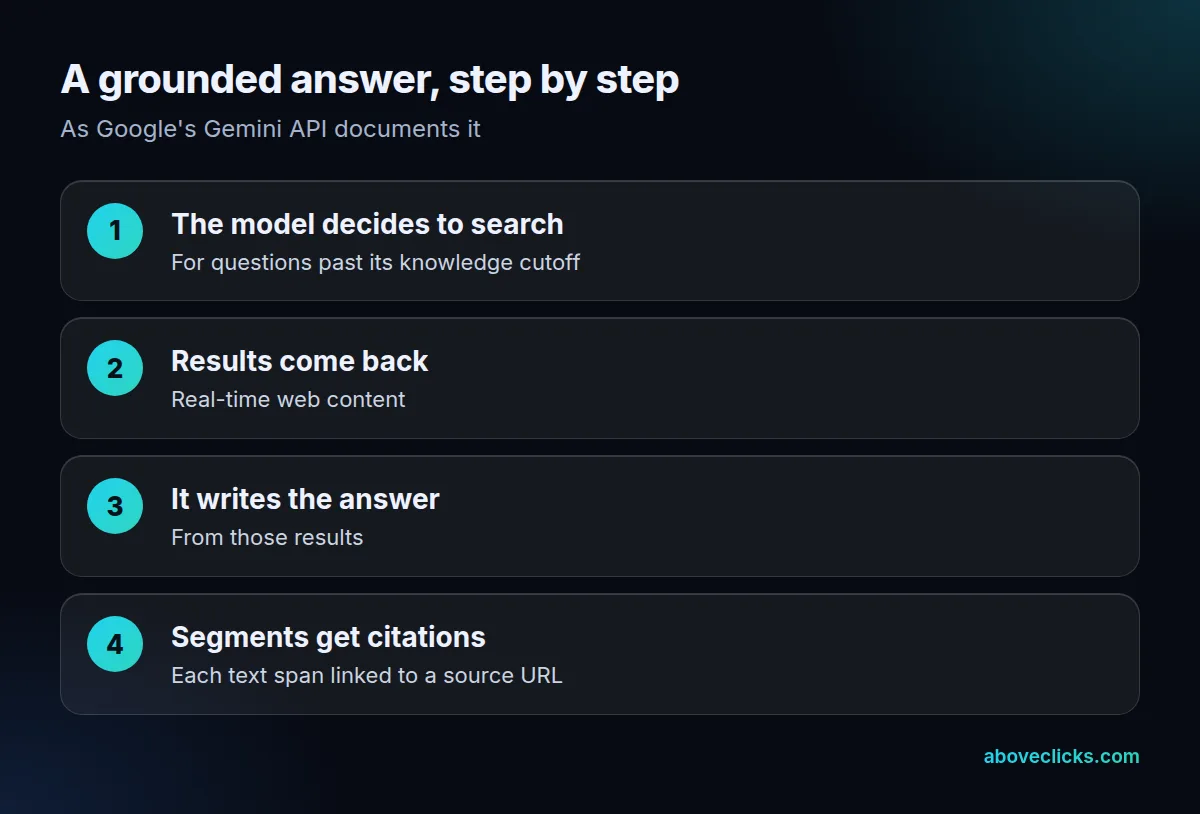
The citations are precise. In Google’s API, each citation annotation links a text segment, marked by its start and end position in the answer, to a source URL. A grounded answer is therefore a set of sentences each tied to a page, which is why the cited passage matters more than the page as a whole.
Answers usually draw on several pages at once. In Pew Research Center’s March 2025 browsing data, 88% of Google’s AI summaries cited 3 or more sources and only 1% cited a single source (Pew).
Is it the same as RAG?
Grounding is the goal; retrieval-augmented generation is the usual method. RAG retrieves passages first and has the model write from them, which grounds the answer in those passages.
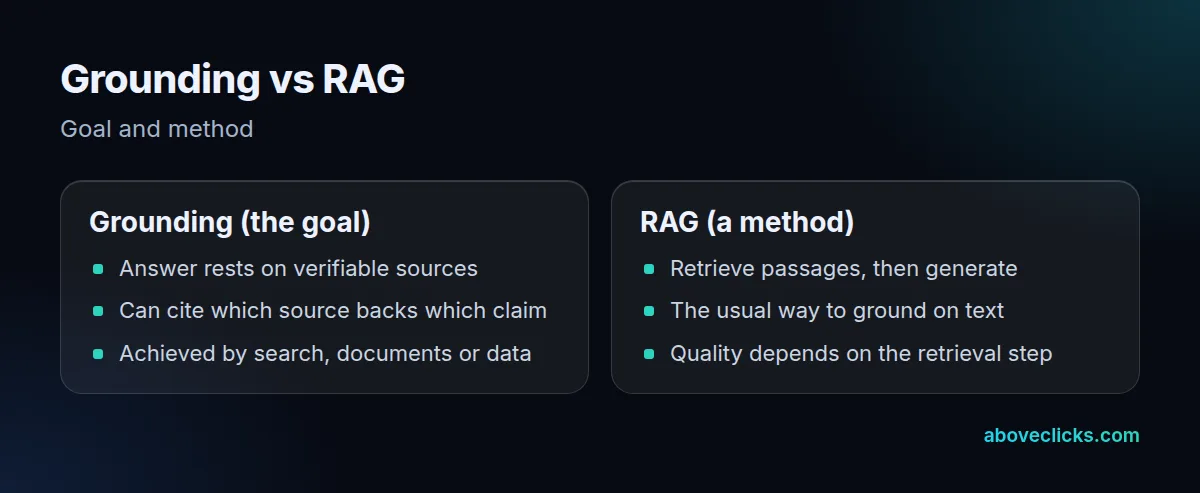
The weak point is retrieval. In our 17 October 2026 test on 345 passages of our own pages, a simple retriever put the right passage first for 3 of 5 buyer questions. When the wrong passage is retrieved, the answer is still sourced, just on the wrong source.
Which grounding can a site owner control?
Some of it. Google-Extended is a robots.txt token that manages whether Google may use your content for grounding in Gemini Apps and in Grounding with Google Search on Vertex AI (Google’s common crawlers); it doesn’t affect Search or AI Overviews.
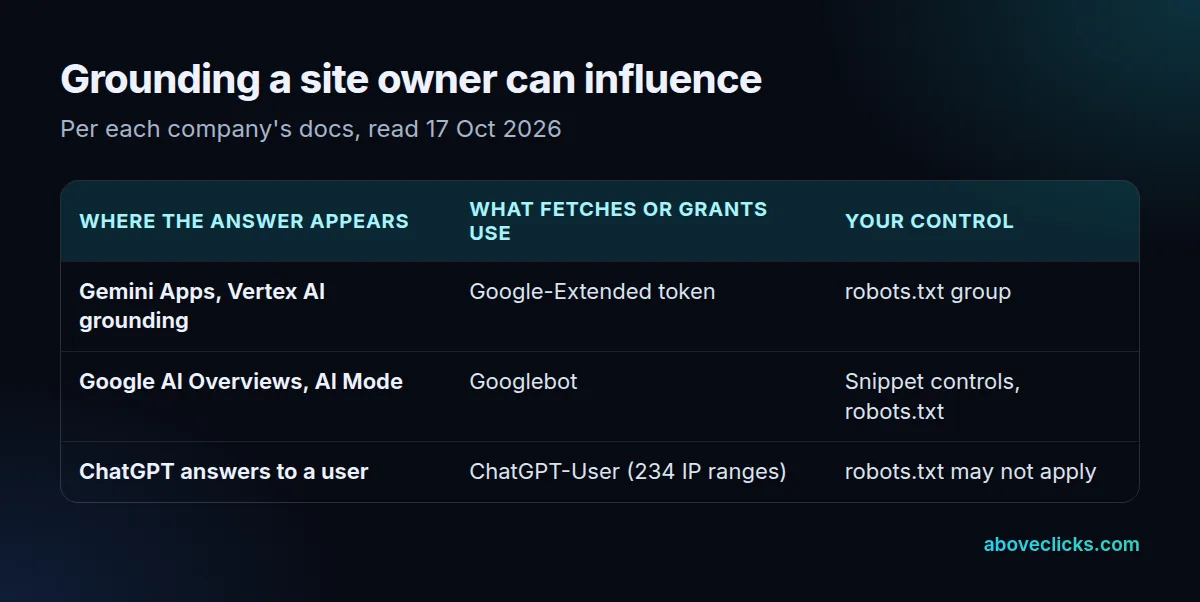
Other grounding happens through live fetches. When a person asks ChatGPT about your page, ChatGPT-User may fetch it, and OpenAI says robots.txt rules “may not apply” to those user-initiated visits (OpenAI). Its published list held 234 IP ranges on 17 October 2026, more than 10 times GPTBot’s 18.
What makes a page good source material?
Passages that answer one question each, in the words people use, with the facts stated outright. An AI answer quotes or paraphrases a span of your text, so that span has to make sense on its own: returns accepted within 30 days, unworn, with tags survives being lifted out of the page; see our policy above doesn’t.
In our test, the 2 misses were passages that answered correctly but used different words from the question. Name the subject in each answer sentence, put the number or rule in the same sentence, and keep source citations next to the claims they support. Product facts such as sizes, materials and delivery times belong in text, not only in images, so a model can read and quote them. Our Google AI Overviews service and generative engine optimization work apply this page by page; the AI search optimization hub covers the rest.