Direct checkout is a way of buying in which the shopper completes the purchase inside an AI channel, such as Google AI Mode, Gemini or Microsoft Copilot, without visiting the store's website. On Shopify it's switched on by default where supported, and the store stays the seller of record.
Direct checkout is a way of buying in which the shopper completes the purchase inside an AI channel, such as Google AI Mode, Gemini or Microsoft Copilot, without visiting the store’s website. On Shopify it’s switched on by default where supported, and the store stays the seller.
Which AI channels offer direct checkout?
As of October 2026, three of Shopify’s channel groups do: Google AI Mode and Gemini, Microsoft Copilot and Meta (Shopify agentic storefronts). ChatGPT doesn’t; Shopify says there’s “no option to activate or deactivate a ChatGPT direct checkout setting” because buyers finish on your own store checkout (Selling on ChatGPT).

Google’s version has the most conditions. On Shopify’s Google page, as read on 18 October 2026, the store must be based in the US and sell to US customers, with a valid Merchant Center account, and the checkout inside AI chat is shown only to US shoppers (Selling on Google AI Mode and Gemini). Stores on Shopify’s Agentic plan start with direct checkout switched off.
What do shoppers pay with?
Whatever the store’s checkout offers to agents, which on Shopify is set by the platform. Of the 30 stores we checked on 17 October 2026, 18 Shopify stores served a Universal Commerce Protocol profile, and all of them declared checkout and buyer-consent capabilities and listed the same 3 payment handlers: Google Pay, a Shopify card handler and Shop Pay.

Shopify adds that the Google checkout “supports a subset” of the accelerated checkout options on your store, so not every wallet you offer on your site appears there. Discounts still apply: automatic discounts and discount codes work, and so do Shopify Functions for shipping, discounts and cart validation. In the 3,635 products we checked on 16 of these stores, every one had a title, so the checkout always has a product name to show.
What doesn’t work in direct checkout?
Several product types, delivery methods and, most importantly, client-side tracking. As of October 2026, Shopify lists subscriptions, product bundles, customizable products and B2B-only products as unsupported, along with local delivery and pickup, and descriptions must carry any legal disclosures in the first 6,000 characters (Shopify Help Center).
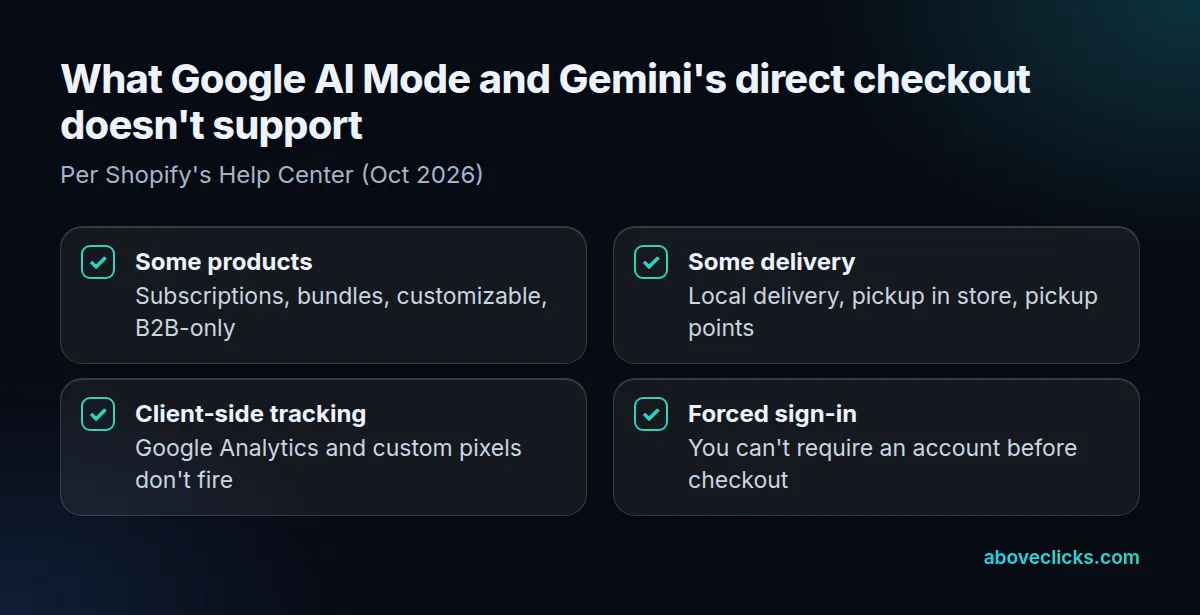
The tracking gap is the one to plan for: Google Analytics and custom pixels won’t fire, leaving 2 server-side events, and “The checkout fires only server-to-server pixels (started, completed), so none of the standard or custom client side pixels fire”. Orders still appear in the Shopify admin with channel attribution, but a GA4 report built on browser events won’t see them.
Should a store keep it on?
For most stores, yes, as long as the gaps are handled. Shopify says there are no fees for selling through Google’s direct checkout beyond standard payment processing fees, and discounts and Shopify Functions still apply. Switch it off for a channel if your products depend on something it can’t do, such as subscriptions or pickup.
Then fix reporting: count AI channel orders from the Shopify admin or server-side events, not GA4 alone. The Agentic section reports sales, orders, sessions and conversion per channel, over the last 30 days by default. If you later switch Shopify Catalog access off altogether, Shopify warns that sharing can take up to 7 days to stop. Our GA4 audit closes that gap, the agentic storefronts page covers the switches, our AI shopping channels service sets them up, and the AI for e-commerce hub covers the rest of direct checkout.