The agent payments protocol (AP2) is an open protocol, started by Google, that lets an AI agent pay on a person's behalf with signed digital proof of what that person approved. Merchants and payment networks check that proof before they accept the purchase.
The agent payments protocol (AP2) is an open protocol, started by Google, that lets an AI agent pay on a person’s behalf with signed digital proof of what that person approved. Merchants and payment networks check that proof before they accept the purchase.
How does the agent payments protocol work?
It replaces the old assumption that a human clicks buy with signed records called AP2 mandates. The AP2 docs describe 2 mandate types, each in 2 stages, so 4 records in all: a Checkout Mandate that is shared with the merchant, and a Payment Mandate that is shared with the credential provider, the card network and the payment processor.
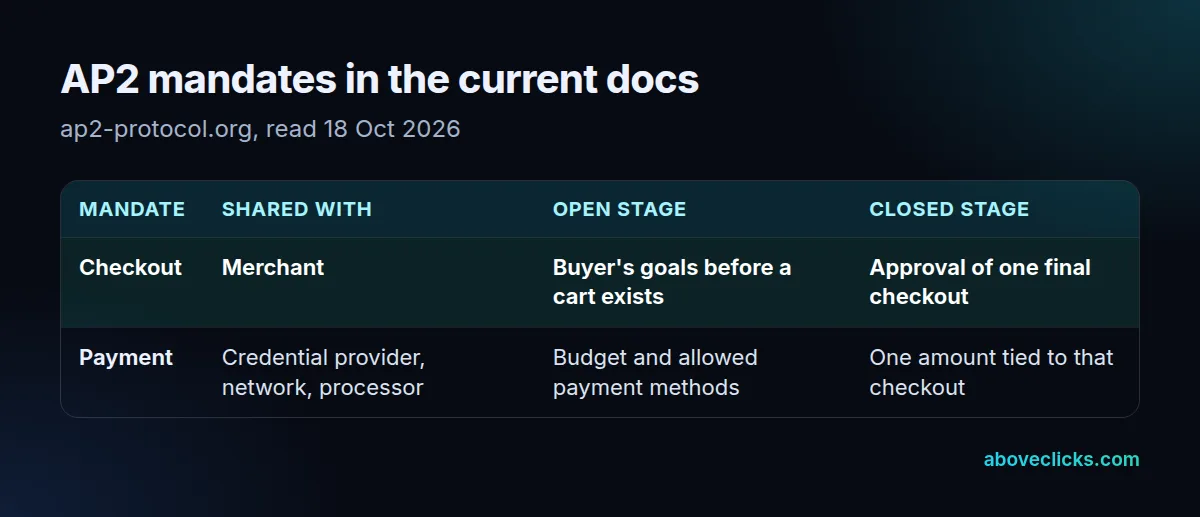
The Open stage holds the buyer’s limits, such as a budget or the allowed cards, before a cart exists, which lets an agent act while the person is away. The Closed stage approves one final checkout and one amount. Chained together, they give what the docs call “a complete, verifiable audit trail for both human-present and human-not-present transactions”. The docs name 3 questions today’s payment systems can’t answer when an agent buys: authorization, authenticity and accountability. If you read the 2025 launch post, you’ll see Intent and Cart Mandates instead; the docs for version 0.2 renamed them.
Who is behind the AP2 protocol?
Google, with a long list of payments companies. The Google Cloud announcement of 16 September 2025 named more than 60 organizations, including Adyen, American Express, Mastercard, PayPal, Coinbase and Etsy. On 28 April 2026 Google donated the agent payments protocol to the FIDO Alliance, the group behind passkeys, where work on the standard continues. The code and samples sit in a public GitHub repository under the Apache 2.0 license, with 3.2k stars when we looked on 18 October 2026.

How does AP2 relate to UCP and x402?
AP2 is a trust layer that sits inside other protocols rather than replacing them. The UCP docs say UCP is “fully compatible” with AP2, and the UCP spec we saved on 18 October 2026 defines 1 extension key for it, dev.ucp.common.payment.ap2_mandate. Because each payment mandate is tied to a checkout hash, a token can’t be replayed or its amount changed. It also works as an extension for Agent2Agent (A2A), Google’s protocol for agents that talk to other agents.
For crypto, the x402 extension built with Coinbase adds stablecoin payments. Cards came first; the docs’ roadmap adds e-wallets and real-time bank transfers, naming 2 examples, UPI and PIX.
Does a store need the agent payments protocol now?
Not yet, and there is nothing to switch on. We re-read the Universal Commerce Protocol profiles of 18 Shopify stores, fetched on 17 October 2026: all 18 declare checkout, but 0 declare the AP2 mandate extension. Across the 18 files we found 11 capability keys, none of them about mandates, and buyers pay through the same 3 handlers, Google Pay, a Shopify card handler and Shop Pay.
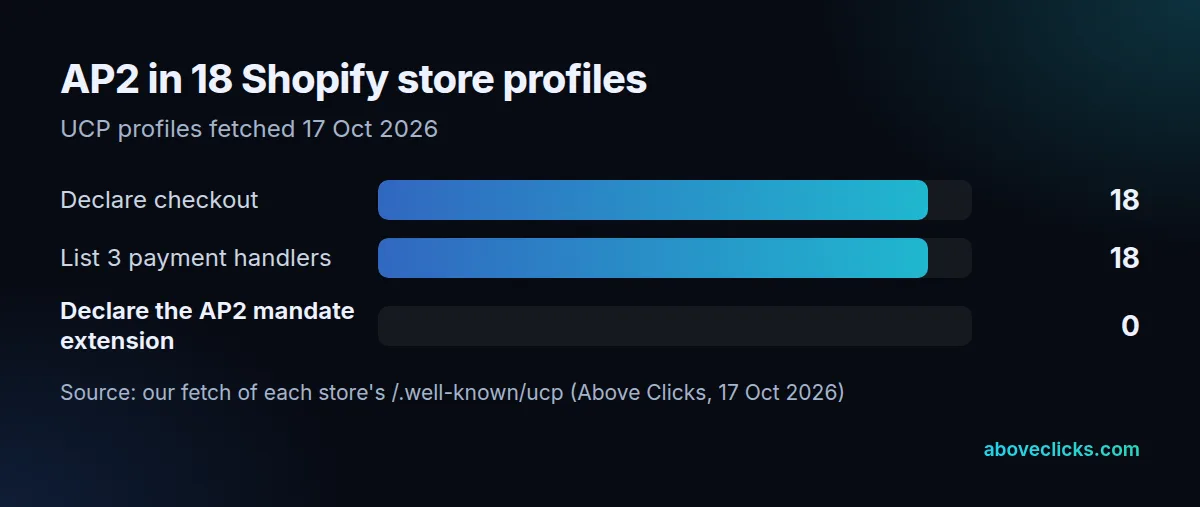
That will change as agent platforms adopt the FIDO standard, so check your store’s profile once a quarter. For now, focus on what agents already use: clean product data and the direct checkout settings. Our AI commerce readiness review covers both, and the AI for e-commerce hub tracks the agent payments protocol as it rolls out.