What is a GTM team? It is the group of people who take a product to customers, usually marketing, sales, customer success and product, working to one launch plan. For an online store, the team’s job is to agree who sells what, through which channels, and which numbers prove it worked.
This guide covers what a GTM team does, five roles and the one number each should own, a structure for a small store, and the tracking that keeps the team’s reports matching. GTM here means go-to-market; for the other meanings of the letters, see our guide to what GTM stands for.
What is a GTM team?
A GTM team is a cross-functional group that owns the path from first click to repeat customer. It is not a department with a fixed shape. It is a working agreement between functions.
That definition is ours, not a standard. Companies draw the lines differently. A software firm may put sales engineers and partnerships in the group, while a store may include only the founder, a marketer and whoever handles orders and support.
What stays the same is the purpose. A GTM team exists so that launch, selling and keeping customers are planned together, instead of each function pursuing its own targets.
Example (an invented store, not a client): a home goods store has 12 employees. Four of them sit in the GTM team: the founder, a marketer, a support lead and an operations person. The other 8 pack orders, source stock and keep the books. They are still essential, but they do not set the launch plan or own a channel number.
Size is not the test. Ask one question: who decides which customers we go after, and who finds out if it worked? The people who answer both questions are your GTM team, whatever their titles say.
What does a GTM team do?
A GTM team plans a launch, runs the channels, hands customers from one function to the next and reviews the results against numbers it agreed beforehand.
In practice that means four jobs:
- Plan: who the buyer is, what you charge and which channels you will use for a new product or market.
- Run: campaigns, outreach, email and partner work, each with an owner.
- Hand off: passing a lead, order or customer to the next function without losing the history.
- Review: comparing results with the plan on a fixed day, such as 7 days and again 30 days after a launch.
The handoff job is where teams lose most. HubSpot’s help pages list 7 default lifecycle stages, from subscriber to evangelist, and say the stages show how leads move between marketing and sales. Even if you never use that software, the idea holds: every handoff needs a name and a rule.
What roles are on a GTM team?
Five roles cover most small teams: a marketing lead, a sales or partnerships owner, a customer success owner, a product or merchandising owner and a data owner. Give each one number to answer for.

Example: with a $3,000 monthly ad budget and 40 new customers, cost per new customer is $75. That is the marketing lead’s number. It says nothing about whether those customers came back, which is why customer success owns a different one.
The table above is an invented store, not a benchmark. The point is the pairing. A role with a number can be asked how it is going. A role without one can only be asked what it is doing.
Each role also hands something over. Marketing hands over qualified leads and first orders. Sales hands over closed accounts with notes on what was promised. Customer success hands product feedback back to merchandising. Write each handoff in one line, with the name of the person who receives it.
The data owner is the role most small teams skip. This person does not analyze everything. They own the names: which events exist, how campaigns are labeled and which report is the source of truth. If nobody owns that, the other four numbers cannot be compared.
How should a small store set up its GTM team structure?
Start from the work, not the titles: list the channels, name one owner per channel and one person for the data. A four-person team can cover all five roles.
Example (an invented store, not a client): a skincare store with an $80 average order has four people. The founder covers marketing and the launch plan. A part-time partner manager handles wholesale orders. One support lead covers customer success and merchandising. An operations person is the data owner.
A GTM team structure like this has two rules. First, nobody holds two numbers that compete, such as acquisition volume and refund rate. Second, the launch plan lists each channel with its owner and its one key event, so a missing owner shows up before launch, not after.
With one person, the same GTM team structure works as a calendar: the same five roles, one per weekday, with the weekly check on Friday. A single owner still needs the written names.
What is a GTM team in sales and in business?
In sales, a GTM team usually means the people who bring in and close new revenue. In business more broadly, it means everyone on the plan, including support and product.
You will meet both uses. A recruiter listing a GTM role in sales means a seller, an account manager or a sales engineer. An investor asking about your GTM team wants to know who owns the plan and the results.
A GTM team is wider than a marketing team. Marketing creates demand; the GTM team also covers who closes it, who delivers it and who keeps the customer. If your store sells only online with no sales staff, the two groups overlap heavily, and the difference is mostly the extra attention to support and product.
The overlap is the handoff between marketing and sales. HubSpot’s defaults mark two points in it: a marketing qualified lead, which marketing has judged ready for sales, and a sales qualified lead, which sales has accepted. HubSpot’s own workflow example creates a follow-up task when a lead entered the sales qualified stage more than 5 days ago. Whatever your terms are, write them down, and set a deadline like that for each handoff. A lead that marketing counts as ready and sales counts as not ready makes both reports look wrong.
What tracking does a GTM team need?
Three things: campaign labels that stay consistent, a short list of key events, and one agreed view of attribution. Without them, each function reports from its own tool and the totals never match.
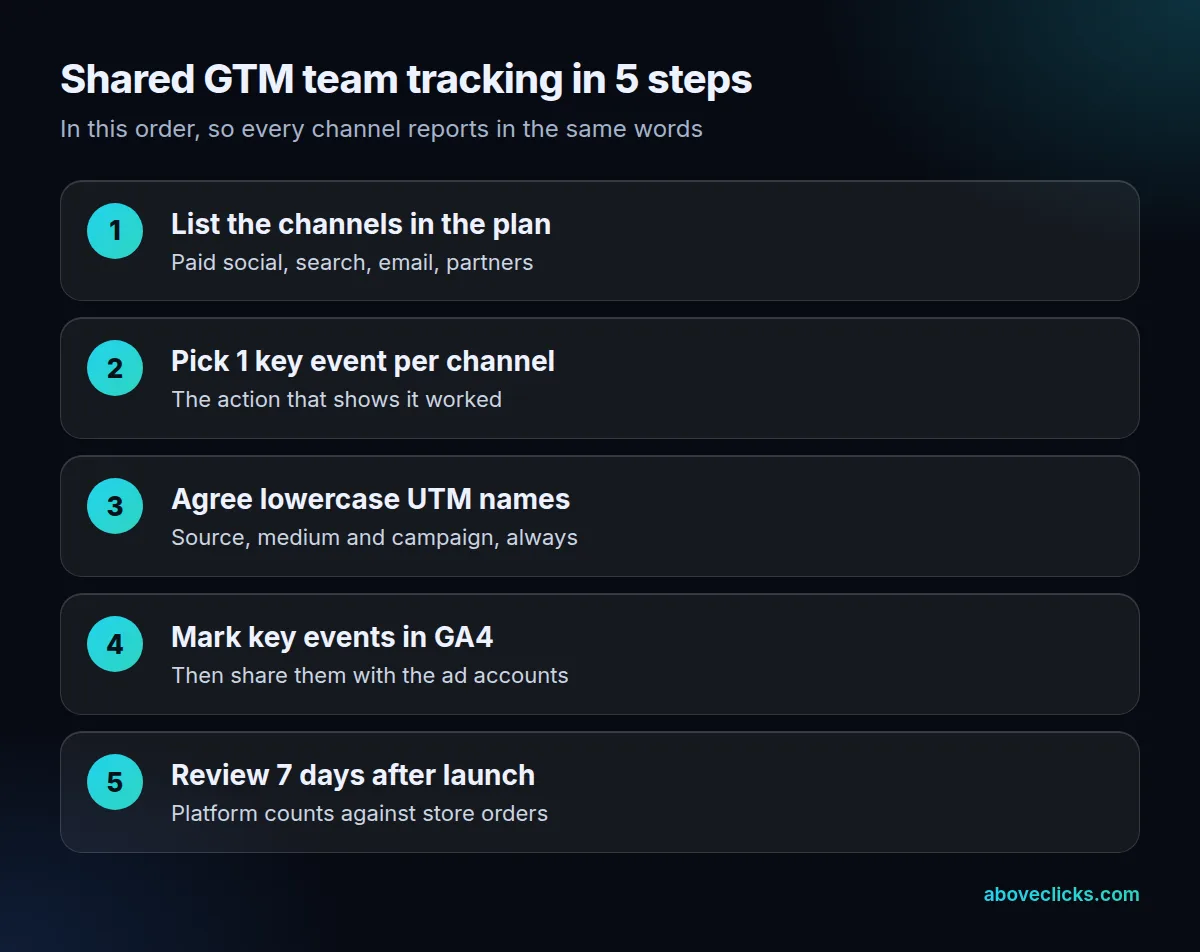
Here is what each step relies on:
- Tag Manager: Google Tag Manager needs 2 snippets on each page, and then tags, triggers and variables are managed in one container. Our Tag Manager setup page covers what we clean up. Do not confuse it with the team: the “GTM” in your analytics account is a tool.
- Campaign labels: Google says to always set
utm_source,utm_mediumandutm_campaign, and that values are case sensitive:SpringSaleandSpring_Salecount as two campaigns. Our UTM parameters entry lists the rest. - Key events: any event you collect can be marked as a key event. Creating Google Ads conversions from them gives the same counts in Ads and in Analytics.
- Attribution: Analytics offers 3 attribution models in its Attribution reports, and direct visits get no credit unless the whole path is direct. Pick one model and use it in every team report; our attribution model entry explains the choices.
- Checkout events: on Shopify, custom pixels collect events on the checkout and post-purchase pages without editing your theme code.
Example: the skincare store sends an email campaign as utm_campaign=Spring_Sale and a social post as utm_campaign=springsale. GA4 shows two campaigns, each with half the orders. Neither owner looks successful, and the launch review argues about the data instead of the plan.
If this is the part your team is stuck on, our tracking and analytics service starts with an audit that sends the gaps within 2 workdays.
How do you check a GTM team’s numbers?
Run one fifteen-minute check each week and one deeper check 7 days after each launch. The core test is whether platform purchases match store orders.

Our own process on live projects is to compare a week of purchases reported by the platforms with real store orders. A gap of more than about 10% usually means a missing or doubled purchase tag, as noted on our tracking and analytics page. The 10% is a rule of thumb for stores like ours, not a platform limit.
Order matters in the weekly check. Look at the names first (campaign labels and events), then the counts, then the attribution view. If the names are wrong, the counts are wrong too, and reading attribution on top of them is wasted effort.
Finish with an owner and a date for every gap. A gap with no owner will still be there next week. For more on the measurement area, browse our measurement guides, or request a free audit if you would like a second pair of eyes on your tracking.