Social media packages are priced by workload, not by label. A starter tier and a growth tier differ in platforms, posts and community hours, and those three numbers explain most of the price gap. This guide to social media packages lines up the tiers, the per-platform rates, the provider options and the pricing models, so you can pick the tier that matches the workload you actually need.
Prices below are published 2026 guide ranges, as of October 2026, and they are indicative, not quotes: scope differs between providers, so confirm the live price before you sign. Before picking a tier, check the platforms’ own business guidance too: Meta’s Business Suite explains how pages and ad accounts are organised, and LinkedIn’s Company Pages guide explains how a company page is set up and completed.
How much do social media packages cost?
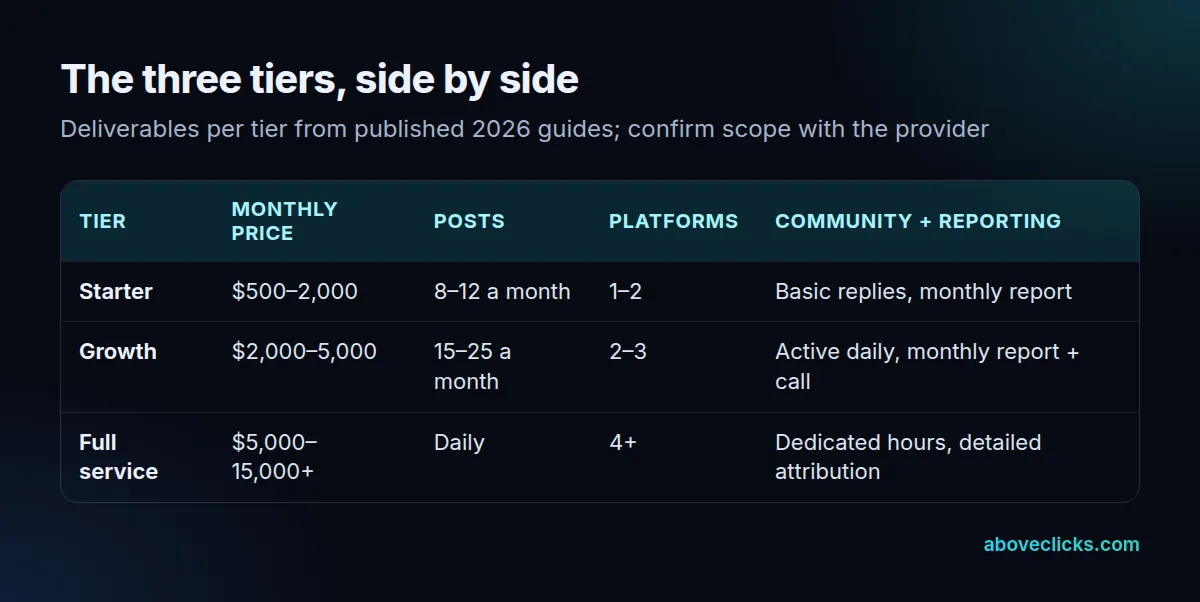
Agency social media packages run about $500–$2,000 a month at starter level, $2,000–$5,000 at growth level and $5,000–$15,000 or more at full-service level, as of October 2026, according to MySocial’s pricing guide, which compiles Cloud Campaign’s 2025 agency figures. Small-business guides land in the same place from the other direction: SocialRails’ pricing guide puts entry-level social media packages at $300–$800 a month, mid-tier at $800–$2,000, premium at $2,000–$5,000 and enterprise at $5,000 or more, as of October 2026. The two ranges overlap because the market has no standard tier definition, which is exactly why a buyer should compare deliverables, not labels.
Sprout Social’s small-business packages guide frames the same market in three provider bands: agencies at $2,000–$10,000 or more a month, freelancers at $500–$3,000, and software from $79 a month, as of October 2026. Social media packages at the bottom of the agency range and the top of the freelancer range cost nearly the same, so the choice between them is about cover and strategy, not just money. That comparison is in the provider section below.
What do starter, growth and full-service tiers include?
Starter social media packages typically include 8–12 posts a month across one or two platforms, basic engagement and a monthly report, as of October 2026, according to MySocial’s pricing guide. Growth tiers raise all three numbers: 15–25 posts a month across two or three platforms, active community management and a monthly report, sometimes with a strategy call. Full-service tiers move to daily posting across multiple platforms with full strategy and content production.
Vendasta’s agency services guide gives a sharper growth-tier definition: three platforms with three posts per platform per week, 5–10 community hours and a monthly report, at $2,000–$4,500 a month, as of October 2026. Sendible’s packages guide prices its standard tiers at Starter $1,500, Growth $2,500 and Pro $5,000 a month, as of October 2026, with enterprise work at $10,000 or more. Social media packages that name their post counts, platform counts and community hours are comparable; social media packages that only name a tier are not, so ask for the numbers behind the label.
How much does social media management cost per platform?
Platforms are priced by workload, and video-first platforms sit at the top. MySocial’s pricing guide, citing Ruul’s June 2026 rates, puts Instagram at $750–$1,500 a month, TikTok at $1,500–$3,000, executive LinkedIn at $2,500 or more, Pinterest at $500–$1,200, and X at $200–$400 as an add-on to an existing package, as of October 2026. A package that adds TikTok doubles the filming workload, which is why its price jumps rather than creeps.
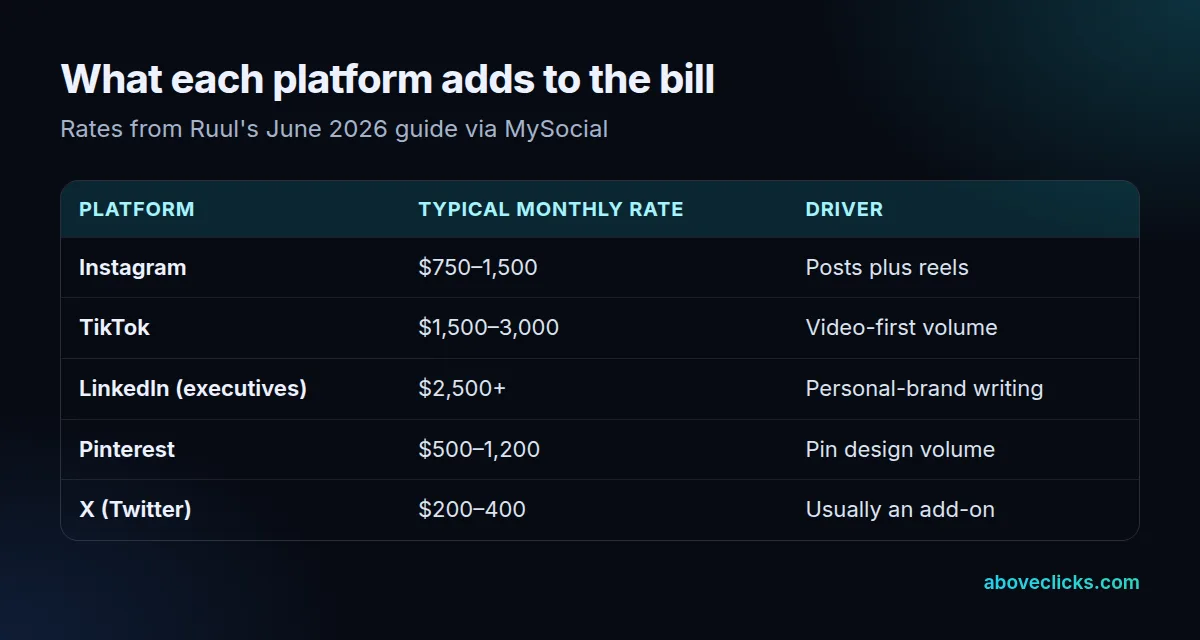
Per-platform pricing also explains why a cheap package can disappoint: a provider quoting one flat fee for “all platforms” is spreading the same post count across more surfaces. Social media packages priced per platform keep that honest, because each added platform carries its own post count and fee. If your buyers live on two platforms, pay for two platforms done well, and treat a third as a priced add-on with its own deliverables.
Should you hire a freelancer, an agency, or someone in-house?
A freelancer costs roughly $500–$2,500 a month, as of October 2026, according to Pallyy’s pricing guide, and buys personal attention at the lowest fee — with the risk that illness or overload leaves the pages silent. A small agency costs $1,000–$5,000 a month and buys team cover plus a wider creative range. A full-service agency costs $3,000–$15,000 or more and buys strategy plus production at the highest fee. An in-house specialist costs about $4,700 a month in salary, as of October 2026, according to MySocial’s pricing guide, and buys brand context and fast iteration, with hiring lag and no cover.
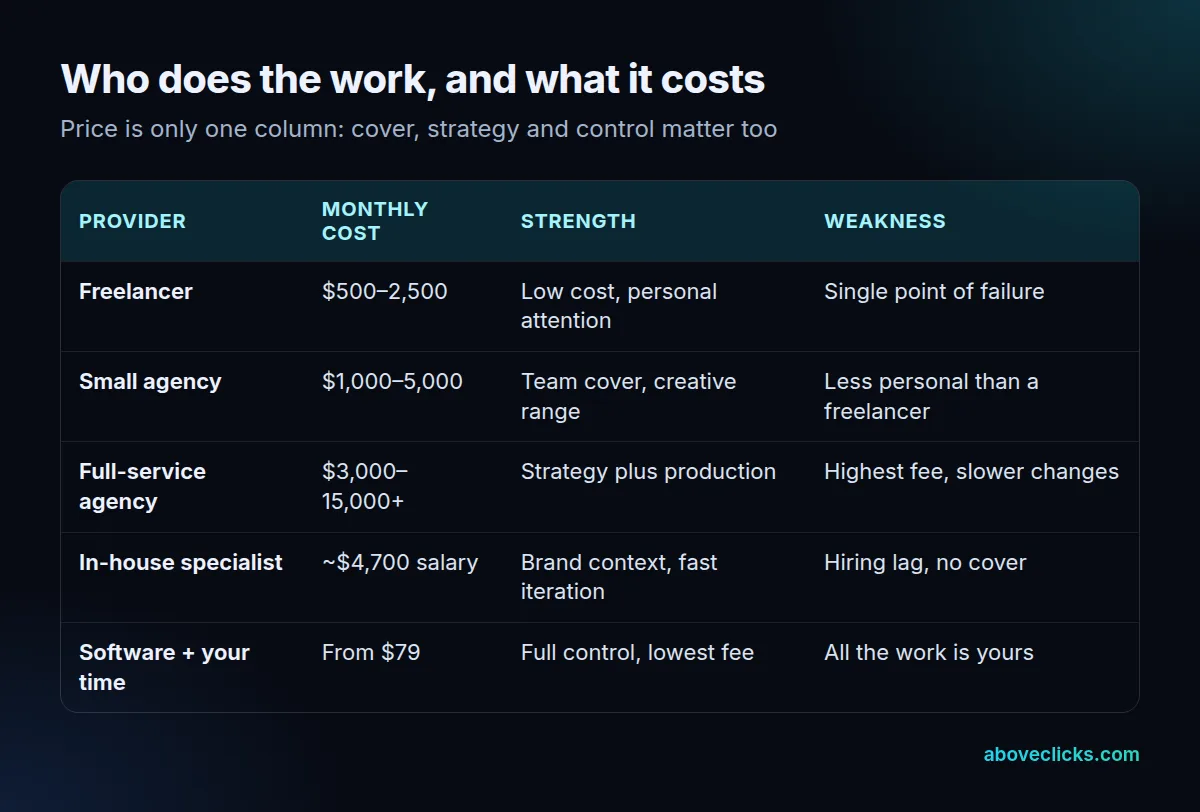
Software plus your own time is the fourth option: scheduling tools start near $79 a month, as of October 2026, according to Sprout Social’s packages guide, but every hour of planning, design, posting and replying stays yours. Social media packages from agencies make sense when you are outsourcing strategy and execution entirely; software makes sense when you have an internal owner with hours to spare. PitchSite’s pricing guide puts the same bands in one table: freelance or VA at $300–$1,500, specialist freelancer at $1,000–$3,500, boutique starter at $2,000–$5,000, boutique growth at $5,000–$10,000 and full-service or enterprise at $10,000–$25,000 or more, as of October 2026.
How much should a freelancer charge for social media management?
This question matters to buyers too, because it sets the floor under freelancer social media packages. Pallyy’s pricing guide puts freelancer rates at $25–$150 an hour, most between $35 and $75, and monthly retainers at $500–$2,500, as of October 2026. MySocial’s pricing guide breaks it by experience: beginners $20–$35 an hour with basic retainers of $750–$1,500, mid-level $35–$75 with standard retainers of $1,500–$3,000, and experts $75–$150 or more with premium retainers of $3,000–$7,000 or more, as of October 2026.
The method behind those numbers is worth knowing as a buyer: a freelancer’s price should cover take-home pay, tax, tools and the hours they cannot bill, since MySocial’s rate example assumes only about 65% of working hours are billable, as of October 2026. A freelancer quoting far below that floor is either cutting scope or cutting corners, and both show up in month two. Social media packages from freelancers are best judged by the same deliverable counts as agency tiers: posts, platforms, community hours and reporting.
What pricing models do social media packages use?
Six models cover nearly every proposal. A monthly retainer is one fixed price for an agreed scope, and it is the agency standard: about 91% of agencies offer retainers, as of October 2026, according to Vendasta’s agency services guide, citing Promethean Research. Hourly billing suits one-off work such as audits or campaign builds. Per-post pricing runs $75–$150 for a static post and $200–$500 for a video post, as of October 2026, according to MySocial’s pricing guide. Per-platform pricing is clean for add-ons but messy as the main price. Project pricing is a fixed fee for a launch, audit or campaign. Performance pricing is rare for organic social because it needs agreed metrics both sides trust.
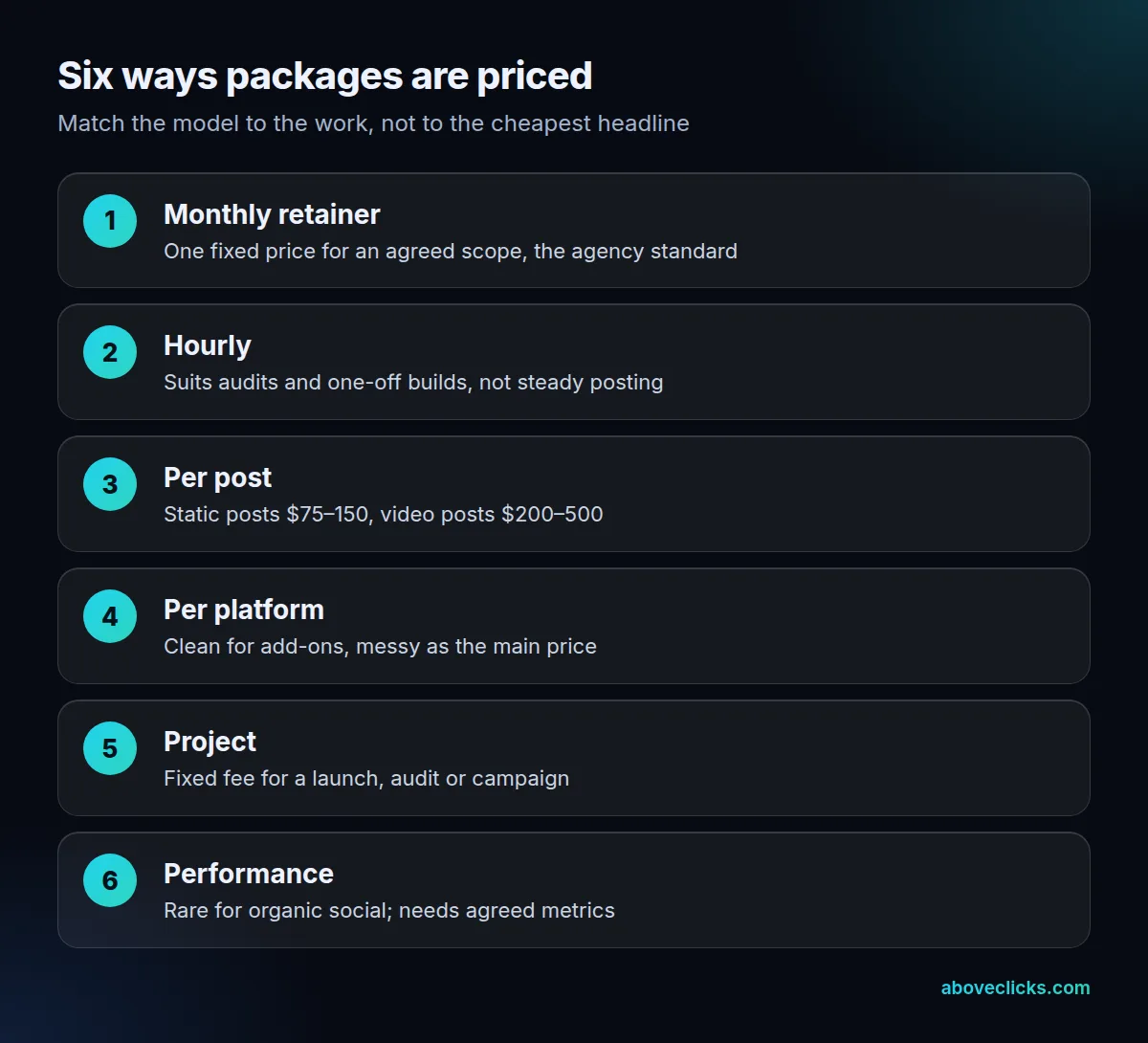
- Monthly retainer: one fixed price for an agreed scope, the agency standard.
- Hourly: suits audits and one-off builds, not steady posting.
- Per post: static posts $75–$150, video posts $200–$500, as of October 2026, according to MySocial’s pricing guide.
- Per platform: clean for add-ons, messy as the main price.
- Project: fixed fee for a launch, audit or campaign.
- Performance: rare for organic social; needs agreed metrics.
For ongoing posting, a retainer with a written scope is cleaner than an open hourly meter, because the buyer knows the monthly number and the provider knows the workload. Social media packages on any other model should still state the same four numbers: posts, platforms, community hours and reporting.
What do the platforms’ own guides say about a tier?
A tier is easier to judge when you know what each platform itself expects from a business presence. Google’s Business Profile help describes completing a profile with business details, hours and content, and its owners and managers guide explains who can edit info, respond to reviews and manage posts — the same access and community questions a tier’s scope should answer in writing. LinkedIn’s Pages overview describes how a company page drives brand awareness and engagement with a professional audience, which is why executive and company-page work sits in a different workload from a standard post calendar.
The same check applies across the other platforms in a tier. X’s help centre and Pinterest’s business help set out how business accounts are organised, TikTok’s ads help centre covers its advertising tools, and Pinterest’s business portal covers its business account setup. When a tier adds one of those platforms, ask the provider to name the extra posts, the extra community hours and the extra reporting for that platform, rather than accepting a wider tier label.
For reporting, Meta’s developer documentation covers how reporting data can be accessed programmatically, and Google’s Ads help explains how advertising accounts are structured — both useful when a proposal promises detailed reporting or paid management. On the software side, Shopify’s help centre covers selling through social channels, which is the relevant comparison when a tier is weighed against doing the work in-house with tools.
How do you pick the right tier?
Count first, then choose. Count the platforms where your buyers actually spend time. Count the posts per week that would keep those platforms alive without repeating the same message. Count the community hours your comments and messages need: a page that gets daily questions needs daily replies, not a monthly report. Then match those three counts to the tier table at the top of this guide to social media packages. If the counts land between tiers, pick the lower tier and add one platform or a few posts as a priced add-on, rather than jumping a full tier for one extra need.
To see how we size a tier from a buyer’s platform count and post volume before quoting, start with our services page, or ask for a free audit of the setup you have today. And revisit the tier every quarter: a tier that fit at launch can be too small after six months of growth, or too large after a platform stops performing. Social media packages are monthly by design, so use that flexibility. More guides are in general.