Social media marketing services packages are scope documents first and prices second. A package that looks cheap can be thin on community hours, and a package that looks dear can include video, reporting and strategy the cheaper one leaves out. This guide to social media marketing services packages lines up what agencies actually bundle, what they charge extra for, and how to read any proposal line by line.
If you are comparing social media marketing services packages for the first time, start with the inclusions, not the fee. Prices below are published 2026 guide ranges, as of October 2026, and they are indicative, not a quote: scope differs between providers, so confirm the live price with the provider before you sign. Before you compare any social media marketing package, check the platforms’ own business guidance too: Meta’s Business Suite explains how pages and ad accounts are organised, and LinkedIn’s Company Pages guide explains how a company page is set up and completed.
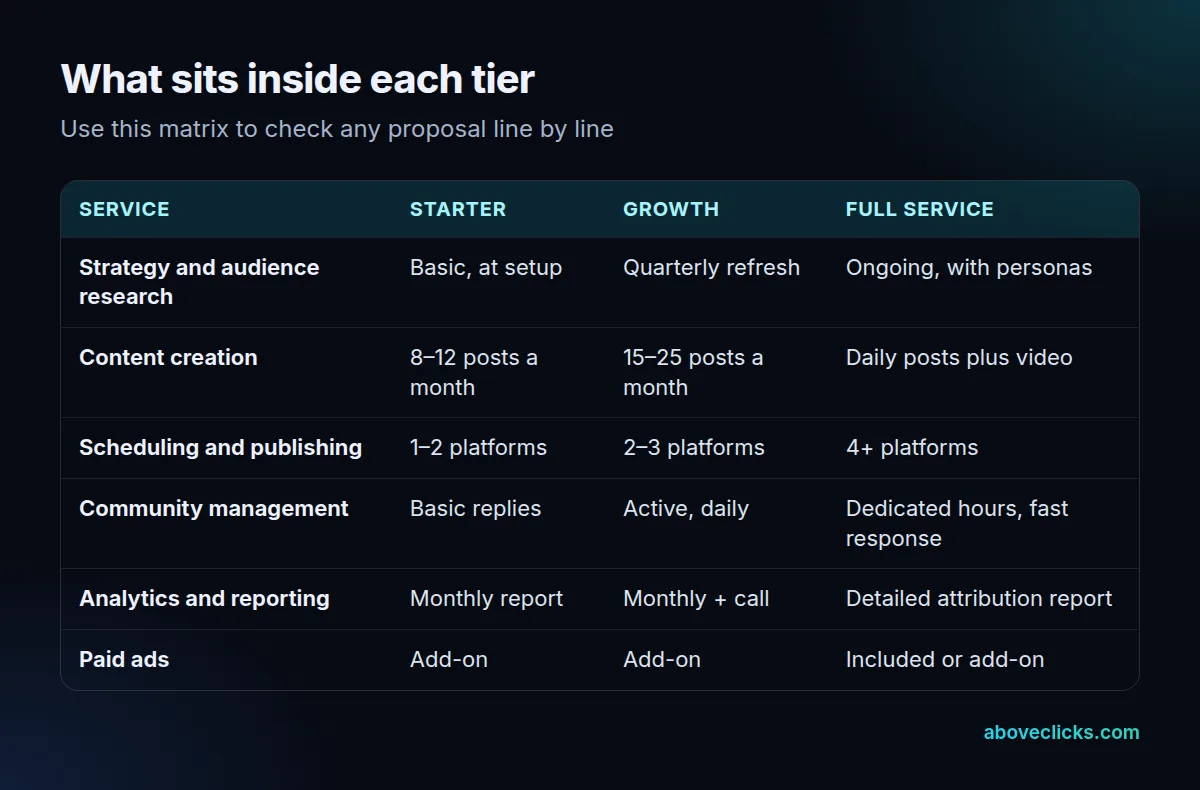
What is included in social media marketing services packages?
A standard package bundles five things: strategy, content creation, scheduling, community management and reporting. Strategy means audience research, competitor research, content pillars and a posting schedule. Content creation means the posts themselves: copy, images and short video. Scheduling means publishing on time across the platforms in the package. Community management means replies to comments and messages inside a defined response window. Reporting means a monthly analytics report against the goals set at the start.
That is the core, and most agencies add two more items at setup: a monthly content calendar the client approves, and first-month profile optimisation. Vendasta’s agency services guide describes exactly this standard shape, and ContentStudio’s packages guide lists the same inclusions: audience and competitor research, calendar and topic planning, post creation, scheduling, community management and analytics. When social media marketing services packages differ, the difference is usually in depth, not in kind: how many posts, how many platforms, how many community hours, and how detailed the report is.
What does each service inside the package actually deliver?
Strategy delivers a written plan, not a vibe. Expect audience personas, platform recommendations, content pillars and SMART goals for the campaigns, which is how Sendible’s packages guide frames the strategy deliverable. Content creation delivers finished posts in the agreed formats: static graphics, carousels, short video and captions. Scheduling delivers consistency: posts go out on the calendar dates, not when someone remembers. Community management delivers replies inside the promised window, plus comment moderation and inbox triage.
Reporting delivers the numbers that justify the fee: reach, engagement, follower growth, clicks and, on better packages, leads or sales attributed to social. A useful rule for social media marketing services packages is to ask what each service produces in a month, and to compare social media marketing services packages on those deliverables rather than on promises. If the answer is vague — “engagement” with no reply window, “content” with no post count — the package is not yet a scope document, and the price cannot be judged. Social media marketing services packages that name their deliverables are the ones worth comparing.
How much do social media marketing services packages cost?
Published 2026 guides put agency starter packages at $500–$2,000 a month, growth packages at $2,000–$5,000 and full-service packages at $5,000–$15,000 or more, as of October 2026, according to MySocial’s pricing guide, which compiles Cloud Campaign’s 2025 agency figures. Starter usually means 8–12 posts a month across one or two platforms with basic engagement. Growth usually means 15–25 posts across two or three platforms with active community management. Full service usually means daily posts across multiple platforms with full strategy and content production.
Freelancers sit below agencies: about $500–$2,500 a month, as of October 2026, according to Pallyy’s pricing guide. That gap is one reason social media marketing services packages from agencies cost more than a freelancer’s retainer: the agency price buys a team, backup cover and reporting depth.
Sprout Social’s small-business packages guide puts the same picture in three bands: agencies at $2,000–$10,000 or more a month, freelancers at $500–$3,000, and software from $79 a month for a business that keeps the work in-house. One survey figure helps anchor the middle: HeyOrca’s 2024 survey of agency and freelance social media managers found an average retainer of $2,107.14 a month, as of October 2026, via Vendasta’s agency services guide. Social media marketing services packages cluster around that middle because most buyers need steady posting plus replies, not a full creative team.
Which services are add-ons, not included?
Paid advertising is the biggest add-on. Most social media marketing services packages cover organic content, publishing and community, while paid social management is billed separately, commonly at 10–20% of ad spend, as of October 2026, according to Vendasta’s agency services guide. The ad spend itself sits on top of that fee. If a proposal promises ads inside the base fee, ask whether the fee covers management only or spend as well, because the two answers differ by thousands.
Video production is the second add-on. A standard post is cheap; a filmed and edited video post runs $200–$500, as of October 2026, according to MySocial’s pricing guide. Influencer outreach is usually priced per campaign, with creator fees separate. Reputation monitoring — review tracking and replies — is often a separate monthly fee. Executive LinkedIn work is commonly a standalone retainer of $2,500 or more a month, as of October 2026, according to the same pricing guide.
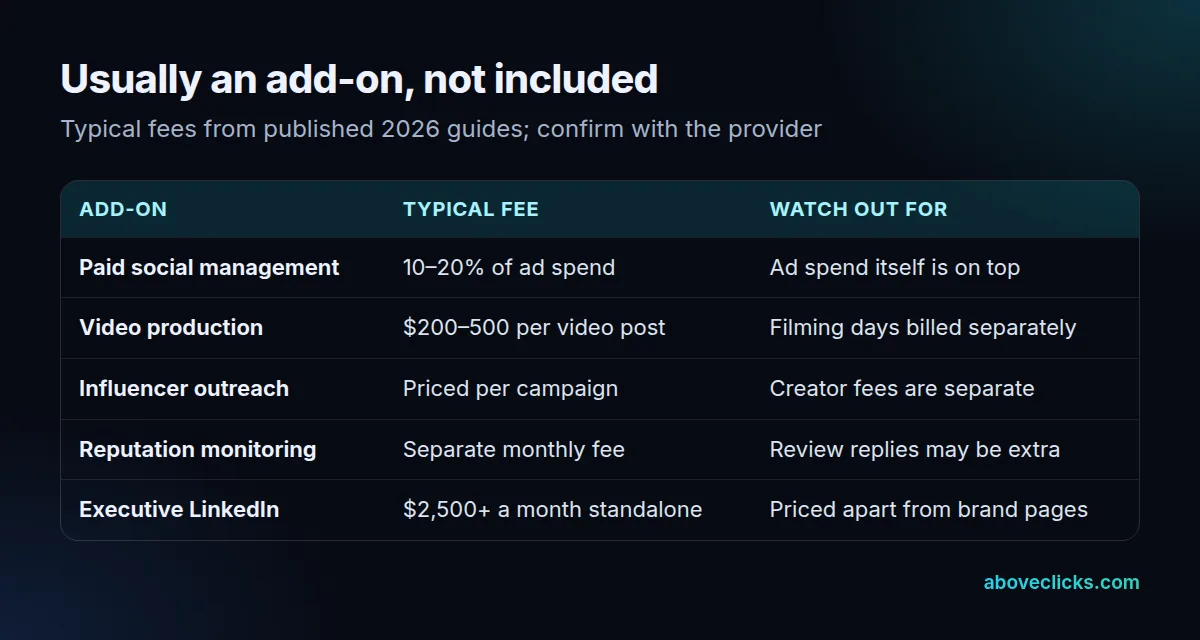
None of this means add-ons are bad value. It means the base price of social media marketing services packages is not the whole price, and a buyer who budgets only the base fee will be surprised in month two. Ask for every add-on in writing, with its fee, before you sign.
How do platform choices change the package?
Platforms change the workload, so they change the price. Video-first platforms cost more because someone has to film and edit. MySocial’s pricing guide, citing Ruul’s June 2026 rates, puts Instagram at $750–$1,500 a month, TikTok at $1,500–$3,000, executive LinkedIn at $2,500 or more, Pinterest at $500–$1,200, and X at $200–$400 as an add-on to an existing package, as of October 2026. A package that adds TikTok is not the same package at a higher price; it is a package with a filming workload inside it.
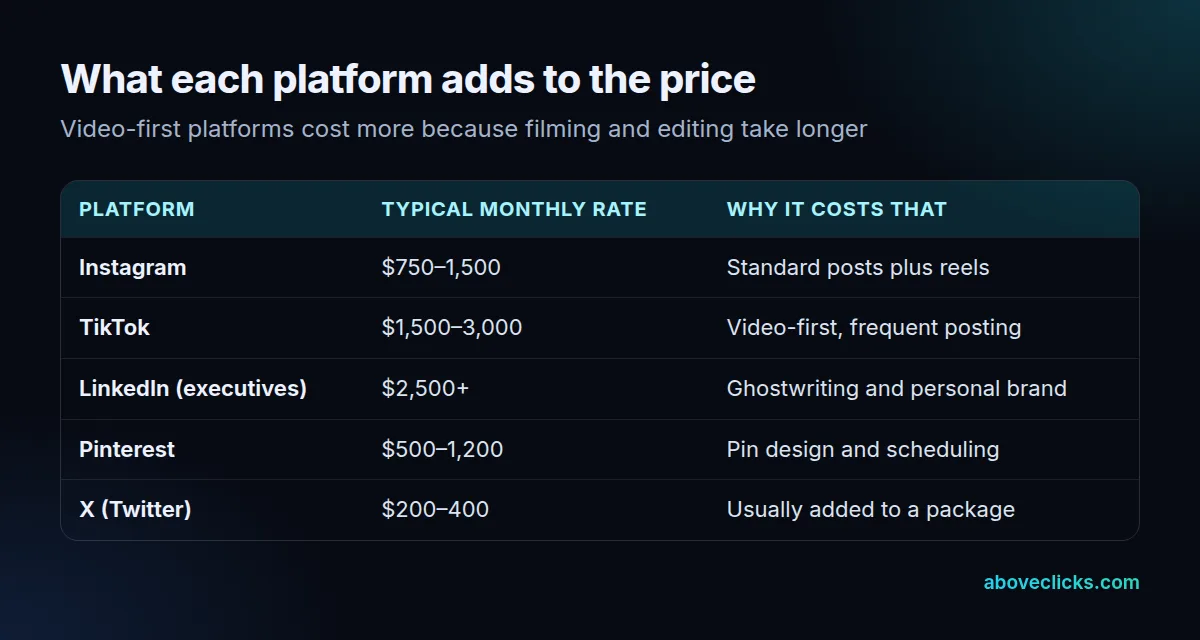
Two or three platforms done well beat five done thinly. Starter social media marketing services packages typically cover one or two platforms, growth packages two or three, and full-service packages four or more. Pick the platforms where your buyers actually spend time. Adding a platform should come with its own post count and its own price line, not a vague “all platforms” promise that spreads the same post count thinner. For paid add-ons, Google’s Ads help explains how advertising accounts are structured, which helps you separate management from spend.
How do you compare two packages side by side?
Lay two social media marketing services packages side by side and check eight lines: platforms, posts per month, post formats, community hours and response window, reporting cadence and depth, strategy refresh frequency, revision rounds, and add-ons with fees. A proposal that leaves any of those blank is not comparable, and that gap is information: it tells you what the provider does not want to commit to. Social media marketing services packages that win on price often lose on one of those eight lines, usually community hours or reporting depth.
Content mix is a useful ninth check. Pallyy’s pricing guide describes the 50/30/20 guideline, as of October 2026: about 50% of posts that engage or help the audience, 30% curated or shared content, and 20% that promotes the business. A package that is 100% promotional will tire the audience, and a package with no promotional posts will not sell anything.
Ask how the mix is planned, and check it against the calendar in month one. For the platform side of that mix, check the platforms’ own help first — for example, X’s help centre and Pinterest’s business help — and keep the mix, as of October 2026, in the calendar rather than in a sales promise. To see how we scope social media marketing services packages before quoting — platforms, post volume, community hours, reporting cadence — start with our services page, or ask for a free audit of the setup you have today.
What do the platforms’ own guides say a package should cover?
A package is easier to judge when you know what each platform itself expects from a business page. Google’s Business Profile help describes completing a profile with business details, hours and content, and its owners and managers guide explains who can edit info, respond to reviews and manage posts — the same access questions a package’s community scope should answer in writing. TikTok’s ads help centre and Pinterest’s business portal set out how business accounts and advertising tools are organised, which matters when a package adds a video-first or visual platform: the workload is set by the platform’s formats, not by the proposal’s headline.
That platform check also clarifies the cost of scope changes in social media marketing services packages. Adding a platform is not just another line in a calendar; it adds a profile to maintain, a format to produce and a response window to staff, so ask the provider to name the extra posts, the extra community hours and the extra reporting for that platform before agreeing.
Meta’s developer documentation covers how reporting data can be accessed programmatically, which is useful when a package promises detailed attribution reporting: ask whether the report is built from the platforms’ own reporting or from manual screenshots. A package that answers those questions with named deliverables, and whose social media marketing package scope names each platform separately, is a scope document you can actually hold a provider to.
What should the first 90 days of a package look like?
Days 1–30 are audit and setup: profiles optimised, brand voice and content pillars agreed, and the first calendar approved by you. Days 31–60 are the content launch: the first full month of posts goes out, and the response window for comments and messages starts running. Days 61–90 build the community rhythm: replies, engagement and the first performance review against the goals set at the start. Day 90 is the review: keep, cut or add scope on evidence, not habit.
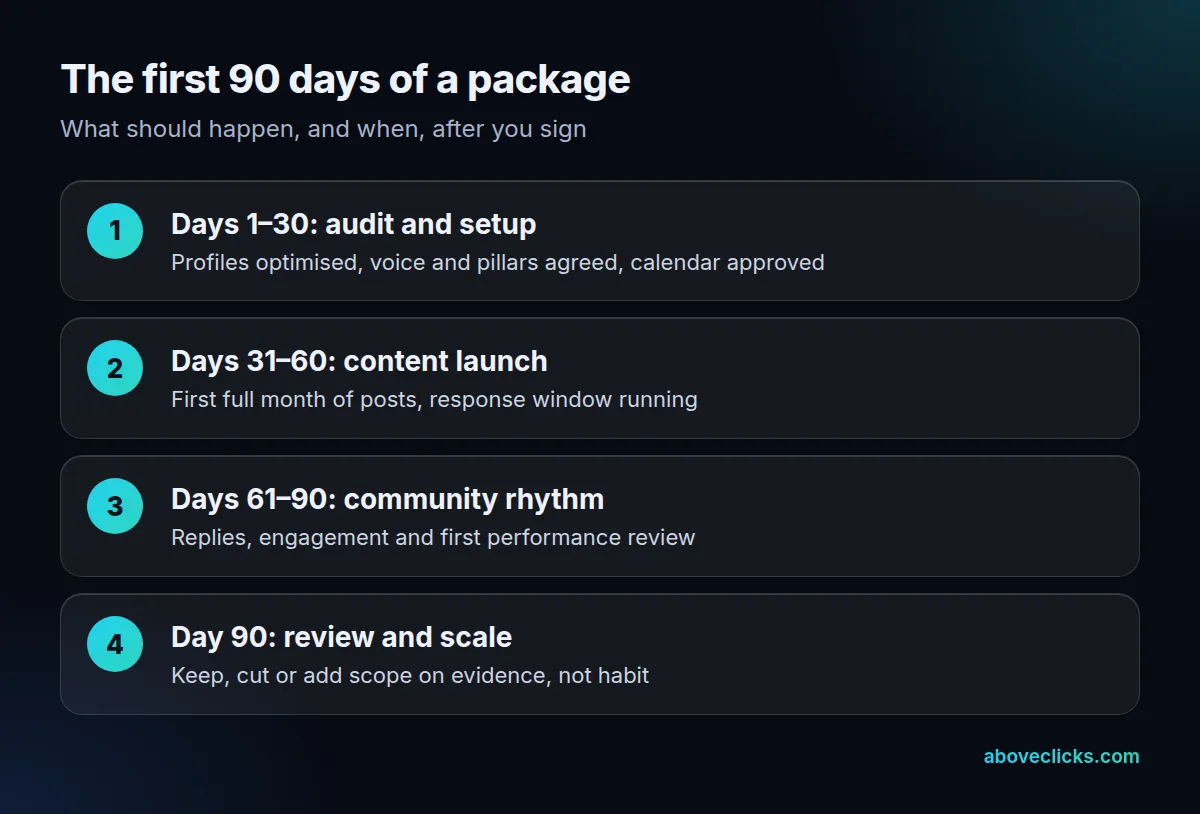
- Days 1–30: audit profiles, agree voice and pillars, approve the first calendar.
- Days 31–60: publish the first full month of posts, run the agreed response window.
- Days 61–90: build the reply rhythm, review performance against goals.
- Day 90: decide what to keep, cut or add, in writing.
If month one has no calendar approval step, or month three has no review, the social media marketing services packages on offer are missing the two moments where a buyer can steer the work. When you shortlist social media marketing services packages, put those two moments in the contract, not just in the sales call. Those moments matter more than any single post, because they are when the package bends toward what actually works for your business. More guides are in general.