Social media campaign packages are fixed-scope bundles of strategy, creative and posting for one goal, such as a product launch, sold for a single fee. Judge one by its deliverables, its end date and what it leaves out, such as ad spend.
This guide shows what social media campaign packages include, how they differ from a monthly retainer, how the cost of one 4-week campaign adds up, and which terms to get in writing before you pay.
What is a social media campaign package?
A social media campaign package is a fixed-scope agreement to run one campaign from brief to wrap-up report, with a start date, an end date and a list of deliverables. It differs from a retainer, which keeps running until someone cancels.
The unit that social media campaign packages sell is the campaign, not the month. A launch, a seasonal sale, an event or a new collection each get their own goal, their own audience and their own finish line. When the end date arrives, the work stops and a report says what happened.
The examples in this guide use one invented store: a skincare brand with a 4-week (28-day) launch for a new product. The numbers are made up to show the arithmetic, so swap in your own.
A social media campaign package works best when the goal can be counted. “Sell 200 units of the new serum in 28 days” can be checked on day 14 and again on day 28. “Raise awareness” cannot, and a package built on it will be hard to judge when the invoice arrives.
What do social media campaign packages include?
Five parts: a plan, the creative, publishing and ad setup, creator work if any, and reporting. Ad spend and creator fees are usually billed separately from the package fee.
A clear social media campaign package lists each part as a count, not an adjective. For the invented skincare launch, that means 8 short videos, 12 static posts and 4 ad variations, each with 2 rounds of changes, a mid-point check on day 14 and a wrap-up report within 7 days of the end date. The five parts of social media campaign packages look like this:
- Plan: one goal, one audience, the offer, the dates and the single number that defines success, written on one page before any creative starts.
- Creative: the exact number of short videos, graphics and ad variations, plus how many rounds of changes each one gets.
- Publishing and ad setup: the posting calendar, the paid campaign build and the tracking that shows which orders came from it.
- Creator work: briefs, product shipping, approvals and the rights to reuse the content. Our UGC video ads page shows how creator-style video fits a campaign.
- Reporting: a mid-point check and a wrap-up report against the one number set in the plan.
Four things usually sit outside the package: the ad spend itself, creator payments, product samples and paid music or stock licences. A quote that doesn’t say who pays for them isn’t finished, and the gap shows up later as a second invoice.
Should you buy a campaign package or a monthly retainer?
Buy a campaign package when you have one dated goal to hit, and compare the social media campaign cost against that goal. Buy a retainer when buyers need to see you every week. Many brands do both: a retainer for the baseline and a package for the big dates.

The table shows the split. A retainer is billed by a monthly quota of posts, so it repeats and its value comes from consistency. A social media campaign package is billed for the work needed to hit one goal, so it ends and has to justify itself by that date. Our guide to social media packages covers the monthly tiers, and the pricing models guide explains how fixed fees, retainers and hourly work compare.
Three questions settle it. Is there a date in the next 90 days that the business has to hit? Can the goal be met within 4 to 8 weeks? Do buyers need to see you every week the rest of the year? Two yes answers to the first two mean a campaign package. A yes to the third means a retainer, with a campaign package added only when a launch needs extra creative and ad work on top.
How much does a social media campaign cost?
Social media campaign cost has three parts: the package fee, creator fees and ad spend. The ad spend is often the largest part of social media campaign cost, and the platform’s own rules decide how much it needs to be.
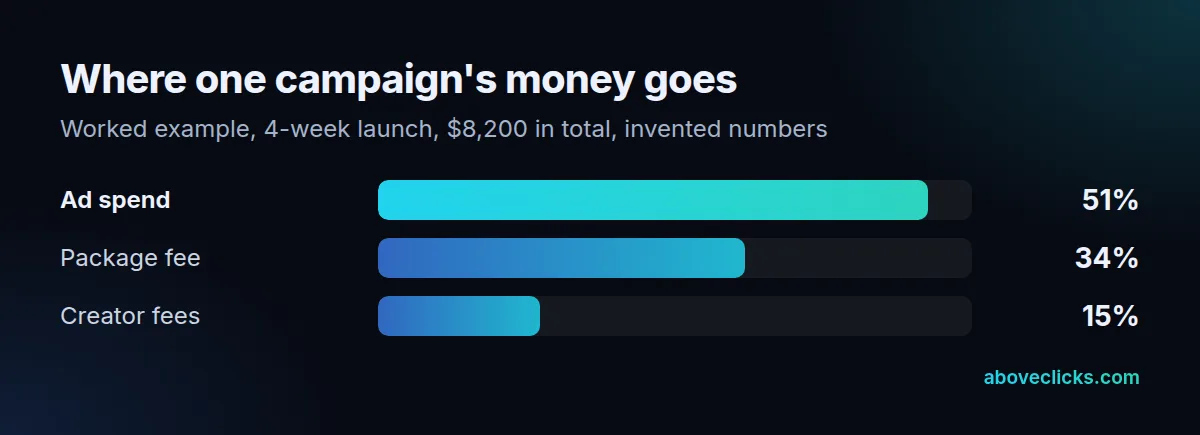
Here’s the worked example, with invented numbers and not a client result. The skincare store’s 4-week launch has a package at $2,800, creators paid $1,200 and Meta ads at $150 a day for 28 days, which is $4,200. The social media campaign cost is $8,200 in total, and the package is only 34% of it.
Why $150 a day? Meta says that with a cost per result goal, your daily budget should be at least 5 times that goal, so a $20 target cost per purchase needs at least $100 a day. Meta also says ad sets usually leave the learning phase after about 50 results in the week after the last significant edit, as of November 2026. Fifty purchases at $20 is $1,000 a week, or about $143 a day, so $150 is the sensible round number.
Now test the payback. At $20 a purchase, $4,200 buys about 210 purchases. With a $60 average order and a 40% margin, each order earns $24 in gross profit, so 210 orders earn $5,040 against the $8,200 total. First orders alone don’t repay this campaign.
That result is the point of doing the sum before you sign. The campaign needs repeat purchases, a bigger basket or a smaller scope. If the store expects 1 in 4 buyers to order again within 90 days, 210 first orders would bring about 52 repeat orders, worth roughly $1,250 more in gross profit. A quote that only shows the package hides the number that decides whether the campaign works.
Run the same sum on any quote. Add the package, the creator payments and the ad budget; divide the total by your gross profit per order; and compare the result with the orders the ad budget can realistically buy at your target cost per purchase. If the break-even order count is more than twice the expected count, shrink the scope before you add budget.
How long should a social media campaign run?
Long enough for the ads to settle and for you to read a result, which in practice means at least 4 weeks for a paid launch. Shorter runs spend most of their budget while the platform is still learning, so the social media campaign cost per result looks worse than it is.
Meta’s learning-phase page says that editing an ad set during the phase resets learning and that performance is less stable and cost per result usually higher while it lasts. So plan the first week as setup and learning, hold changes in weeks 2 and 3, and use week 4 for the final push and the report.
Budget type changes the social media campaign cost too. A daily budget is an average: Meta says it may spend up to 75% over on some days, but never more than 7 times the daily budget in a week, as of November 2026, in its budgets guide. A lifetime budget is a hard cap over the whole run, which suits a campaign with a fixed total.
If the end date is fixed, such as a sale weekend, work backward: creative approved 10 days earlier, ads live 7 days earlier, so the learning phase is over when the sale starts.
How do you compare social media campaign packages?
Line up deliverables, dates, the ad budget, usage rights, disclosure and reporting, then compare quotes item by item. Two social media campaign packages with different totals are only comparable when they cover the same list.

Here’s a quick example with invented quotes. Quote A is $6,000 for 12 short videos, which is $500 a video. Quote B is $4,500 for 6 short videos, which is $750 a video. B looks cheaper until you divide, and the divide only works because both quotes list a count. Compare each social media campaign package the same way, one deliverable at a time.
Next, ask three questions about money: who funds the ad budget, whose account it runs in, and what is billed if you end the campaign early. An ad account in your name means you keep the audiences, the pixel data and the history when the campaign ends.
Disclosure needs its own line when creators are involved. The FTC’s influencer disclosure guide says to disclose any financial relationship or free product, to put the disclosure in the video itself rather than only the description, and not to bury it in a group of hashtags. It names five vague terms to avoid: “sp”, “spon”, “collab”, “thanks” and “ambassador”. Plain words like “ad” and “sponsored” work.
The responsibility isn’t only the creator’s. The FTC says its focus usually falls on advertisers or their ad agencies when it acts, and that advertisers need a reasonable program to train and monitor their network. So social media campaign packages that use creators should say who briefs them on disclosure and who checks the posts.
If you want a second pair of eyes on a quote, send it with our free audit request, or see what our social media management work covers for a brand with a calendar to fill. More guides are in buying guides.