Shopify vs WooCommerce vs BigCommerce is a choice between three billing models: a flat plan with bundled hosting, free software with hosting you buy, and a plan tied to your sales. Which is cheapest depends less on the headline fee than on gateway fees, plan caps and hosting.
This shopify vs woocommerce vs bigcommerce comparison works through each vendor’s own published plans, one break-even example and a five-question test for choosing. It doesn’t repeat our Shopify vs WooCommerce SEO guide, which covers search in detail.
Which is better: Shopify, WooCommerce or BigCommerce?
None wins for every store. Shopify suits teams who want bundled hosting and little upkeep, WooCommerce suits teams who want control and can run WordPress, and BigCommerce suits stores that want built-in features and accept sales-based plans.
In shopify vs woocommerce vs bigcommerce, the entry plans show why. Take them: as of November 2026, Shopify Basic is $29 a month on yearly billing and BigCommerce Core is also $29 a month billed annually, so the headline fee can’t separate them. Treat any “winner” skeptically, including ours. In the shopify vs woocommerce comparison, the real question is who looks after hosting and updates. In shopify vs bigcommerce, it is how each charges as you grow. In woocommerce vs bigcommerce, it is whether you want to own the hosting at all. The sections below put numbers on each.

How do Shopify vs WooCommerce vs BigCommerce compare on cost?
As of November 2026, Shopify plans run from $29 a month (Basic, billed yearly) to $359 (Advanced), with Plus from $2,300. BigCommerce starts at $29 for Core, and WooCommerce software is free but hosting and extensions are extra, per the vendors’ own Shopify, BigCommerce and WooCommerce pages.
The figures, as of November 2026:
- Shopify (as of November 2026): Basic is $29 a month on yearly billing ($39 monthly), Grow $89 ($105), Advanced $359 ($399), and Plus starts at $2,300.
- BigCommerce (as of November 2026): Core is $29 a month billed annually, Growth $79, Scale $299, and Performance starts at $1,499.
- WooCommerce (as of November 2026): no platform fee or revenue share, hosting of $25 to $350 a month for most stores, and extensions at $29 to $299 a year each.
In the shopify vs bigcommerce vs woocommerce cost picture, two of these are not like the others. As of November 2026, Shopify and BigCommerce each bundle hosting, so their monthly fee is close to the whole platform bill (Shopify, BigCommerce). WooCommerce’s fee is $0, but you add hosting, a theme and paid extensions for things like subscriptions or bookings. Our guide to Shopify website costs covers the build side.
Does the gateway fee change which Shopify plan is cheaper?
Yes. As of November 2026, Shopify adds a third-party transaction fee on top of card fees when you use an outside payment gateway: 2% on Basic, 1% on Grow, 0.6% on Advanced. Above a break-even sales level, the dearer plan costs less in total.
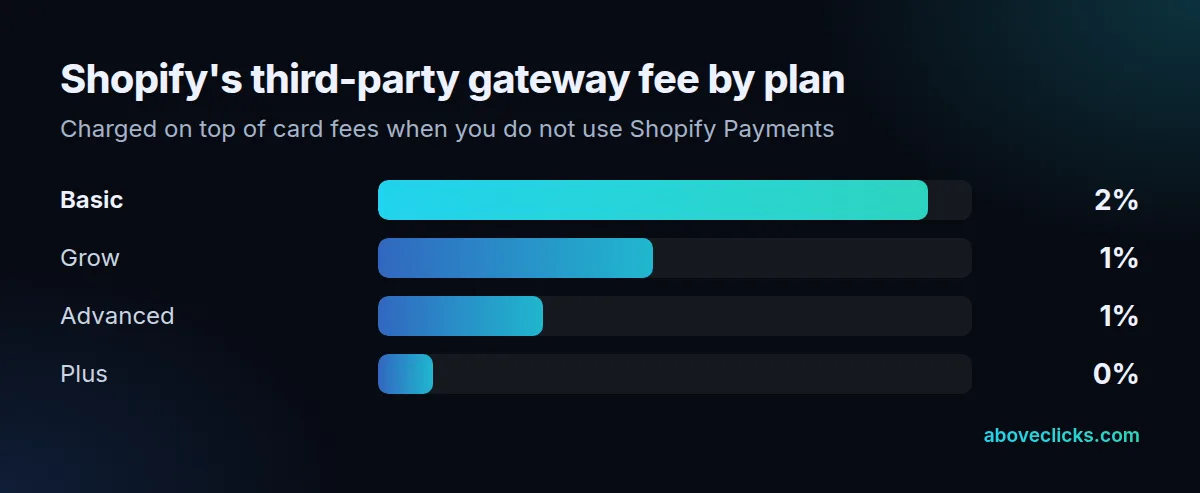
Here is a worked example with list fees as of November 2026 (annual billing), assuming a store whose sales all go through an outside gateway. These are Shopify’s published plan fees, and the store’s figures are invented:
| Yearly sales | Basic: $348 plus 2% | Grow: $1,068 plus 1% |
|---|---|---|
| $250,000 | $348 + $5,000 = $5,348 | $1,068 + $2,500 = $3,568 |
Using the list fees as of November 2026, Grow costs $720 more a year than Basic, so it pays for itself once the 1% saved exceeds $720: at $72,000 of yearly sales through the outside gateway. Between Grow and Advanced, the extra $3,240 a year is only repaid by the 0.4% saving at about $810,000.
The fee does not apply the same way to everyone. Shopify says you aren’t charged third-party transaction fees for orders processed through Shopify Payments, Shop Pay and Shop Pay Installments, but the service is only available in certain countries and regions. Check yours before you use this calculation.
Is BigCommerce better than Shopify?
Not by default. BigCommerce’s plans track your sales, so its cost rises as you grow instead of when you choose to upgrade. It suits stores that want to know the rule up front and use built-in features. Compare it with Shopify on your own sales, not on a feature list: that is the heart of shopify vs bigcommerce.
BigCommerce’s pricing page says annual online sales are calculated on a trailing 12-month basis using gross order value minus 10%. As of November 2026, Core covers up to $30,000 a year, Growth up to $100,000 and Scale about $33,333 a month, with 0.9% charged on sales above that cap. Core and Growth move you up automatically when you pass their limit.
That makes a good year expensive in a predictable way, using the caps as of November 2026. A store at $90,000 of sales has a gross order value near $81,000, which fits Growth at $79 a month; a store at $120,000 has crossed into Scale at $299. Shopify has no sales cap on its normal plans, so the same store would stay on its chosen plan and pay a fee only if it uses an outside gateway. Both models are fair, but decide which you prefer before you build; that is the practical difference in bigcommerce vs shopify.
In short, woocommerce vs bigcommerce is mostly a question of ownership: with WooCommerce you own the stack and its upkeep, with BigCommerce the vendor runs the stack and bills by sales band.
Is Shopify better than WooCommerce for small businesses?
Usually easier, not always cheaper. Shopify bundles hosting, so a small team has less to maintain. WooCommerce gives more control and a free core, but you need hosting, updates and a plan for extensions.
WooCommerce runs on WordPress, so WordPress’s own requirements apply to your host: PHP 8.3 or greater, MariaDB 10.11 or greater or MySQL 8.0 or greater, and HTTPS support. A good host handles that for you, but the choice and the cost are yours, and as noted above, WooCommerce hosting runs $25 to $350 a month for most stores as of November 2026. If nobody on your team wants to own it, a bundled platform removes a whole category of problems.
In shopify vs woocommerce, WooCommerce earns its place when you want custom behavior, already run a WordPress site with content you rely on, or need a setup that no hosted plan offers. Our WooCommerce development page shows how we scope that work.
Who looks after hosting, updates and security?
On Shopify and BigCommerce, the vendor hosts the store and you manage apps and settings. On WooCommerce, you or your host handle servers, WordPress updates and extension compatibility.
That split matters more than any feature table, and it has a number attached: as of November 2026, WordPress asks hosts for PHP 8.3 or greater, so an old host can block you from updating at all. A hosted platform lets you start without a developer for a standard catalog. For a small team, that is often the deciding factor in shopify vs woocommerce. In woocommerce vs bigcommerce terms, a WooCommerce store needs someone to apply updates and test them before they reach customers, and a plan for what happens when an extension stops working after an update.
Google’s guidance helps here: for ecommerce structured data, it notes that if you use a CMS, an integrated platform extension or plugin may be the easier way to add it. In any shopify vs woocommerce vs bigcommerce shortlist, check how product markup is produced before launch, and test a sample product page with Google’s tools. We compare how each platform handles it in our SEO comparison.
What if you outgrow your plan?
Plan for it before you build. As of November 2026, Shopify’s next step is Plus from $2,300 a month, and BigCommerce’s is Performance from $1,499 a month. WooCommerce has no tier to outgrow, but hosting and developer cost rise with traffic.
Most stores never reach those tiers, so don’t choose a platform for them on day one; a fair shopify vs bigcommerce comparison starts with today’s sales. What matters is that you can leave without losing your search visits. If you are weighing a move later, read how a BigCommerce to Shopify migration works. Our Shopify migration page lists what we cover, and the redirects are the part most often skipped.
How do you choose between them?
Answer five questions in order: who runs the store, who hosts it, how fast sales will grow, which payment gateway you will use, and which apps you must have. The answers usually point to one platform, whichever of shopify vs woocommerce vs bigcommerce you started with.
Two numbers carry most of the weight, both as of November 2026: BigCommerce’s $30,000 Core sales limit and the $72,000 Shopify gateway break-even worked out above from Shopify’s plan fees.
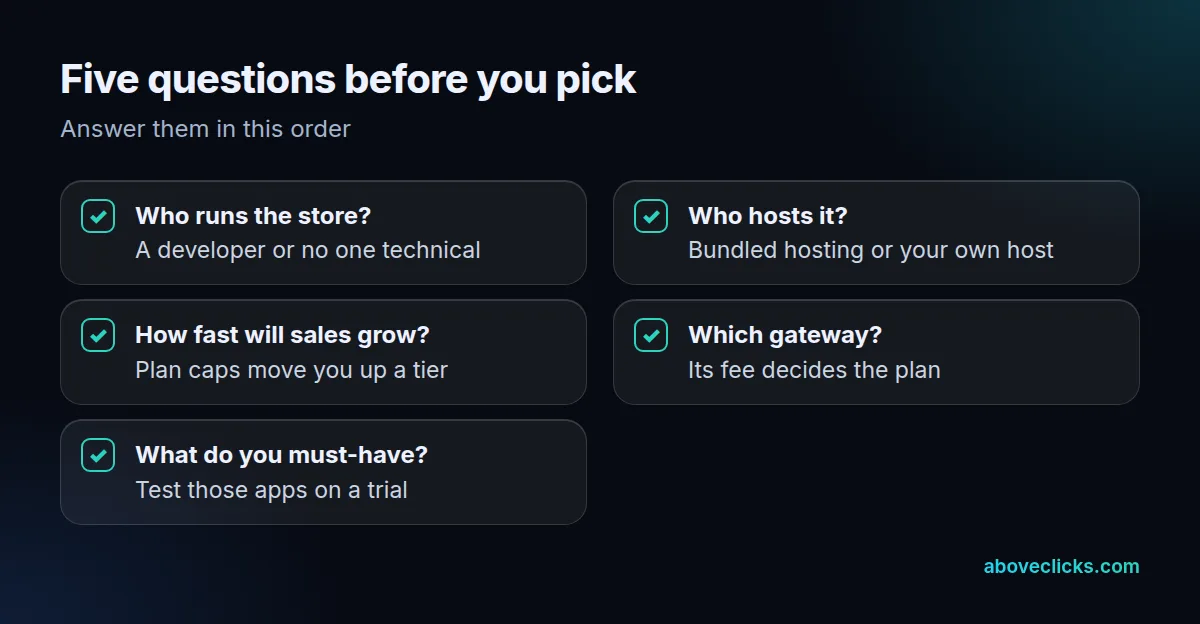
Use them like this, whether you are weighing shopify vs woocommerce or all three:
- No one technical on the team: pick Shopify or BigCommerce, not WooCommerce.
- Expect fast growth: work out BigCommerce’s next plan cap, and check Shopify’s gateway break-even above.
- Need a payment gateway Shopify Payments doesn’t cover: work out the gateway fee at your sales level before you pick a Shopify plan.
- Rely on one specific app or integration: test it on a free trial of each platform before you pay for a yearly plan.
- Already run a content-heavy WordPress site: WooCommerce keeps it all in one place.
If the shopify vs woocommerce vs bigcommerce question is still open for your store, send us your current setup. Our free audit reviews it and tells you which platform fits and what it would take to get there. For help setting up on Shopify, see our Shopify development service. More guides are in buying guides.