Real estate marketing mailers are printed pieces, such as postcards or letters, that an agent sends to a chosen set of homes. Judge a mailer program by what a year of mailing costs against the net commission of one closed sale.
This guide shows which of the real estate mailers fits which job, works the cost for a sample 600-home farm, compares 4, 6 and 12 drops a year, and lists what to check before anything goes to print.
What are real estate marketing mailers?
They are physical pieces mailed to homes you choose, usually a farm area where you want to be the name people know. Typical pieces are just-listed and just-sold postcards, market updates, home-value offers and event notes.
Most agents send real estate mailers through the Postal Service. The USPS Every Door Direct Mail retail option needs no special mailing permit, and USPS names realtors among its target users. It requires at least 200 pieces and allows up to 5,000 a day per ZIP Code, so a farm of a few hundred homes fits.
We don’t print or mail anything ourselves. Our real estate marketing service is the digital lead engine. What carries over is how we judge a channel: by qualified leads and visits, not pieces sent. Our real estate digital marketing page shows how that follow-up works.
Do real estate mailers work?
Real estate mailers can work when the farm is small, the mailing is steady and you count the replies. One drop rarely pays for itself. A year of repeat mailings has a better chance, because homes change hands slowly.
The Census Bureau’s geographic mobility table shows that 25.6 million of the 327.2 million people aged 1 and over lived at a different address a year earlier in 2023. That is 7.8%, and about 13.9 million of them moved within the same county.
Apply that national rate loosely to a 600-home farm and roughly 47 homes might change hands or tenants in a year. It is a rough guide, since a local rate can differ a lot. It also explains why a single mailing is weak: most of the farm is not moving this year, and you are building recognition for the year someone does.
A simple way to judge a farm is to ask three questions before the first drop. How many of its homes have you or your brokerage sold in? How many of its owners have held the home for 5 years or more? Can you reach it in a 15-minute drive for a showing? A farm that fails all three is a poor place to spend a year of real estate mailers, however cheap the postage.
Set a review date too. After 6 months, compare the replies from the farm with the cost so far, and decide to keep it, shrink it or drop it. Real estate mailers that run without a review date tend to carry on out of habit.
Which real estate mailer ideas fit which job?
Pick the mailer for the reason you are sending it. A listing announcement, a sold story and a value offer do different jobs, and each should have one next step the reader can take.
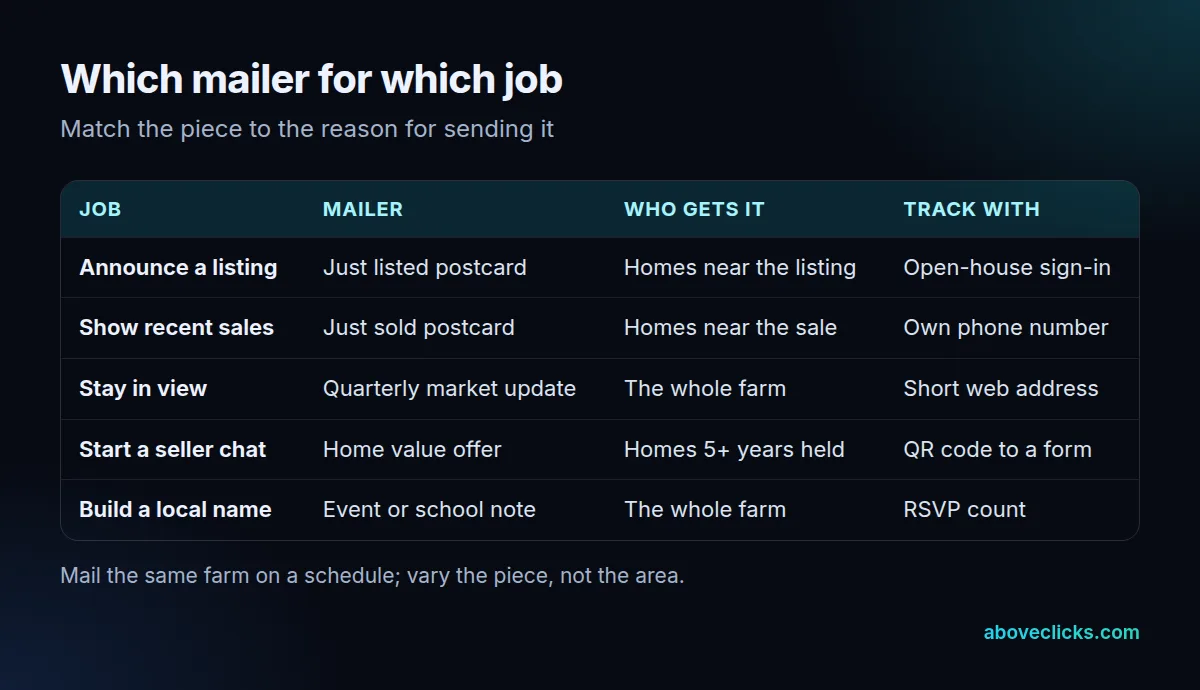
Size the list to the job: a 300-home farm suits a monthly just-sold card, while a value offer goes only to homes held 5 years or more. Two rules keep the real estate mailer ideas in the table honest. Every piece has its own tracking method, so you can tell which one produced a call. And a sold story shows an address and a sale only with the seller’s permission, so keep it to facts you can state.
More industry guides are listed under industries. Our guide to real estate marketing post cards covers sizes and mailing steps, and the direct marketing guide compares mail with other channels. This guide stays on the program arithmetic.
How much do real estate mailers cost?
For real estate mailers, print plus postage for every piece, multiplied by homes and by drops. Your own quotes decide the print figure; USPS sets postage. Worked through once, the math shows how few sales it takes to pay back.
USPS lists EDDM Retail flats at $0.26 per piece as of November 2026. That is the postage. Printing is separate and varies with size, paper and quantity.
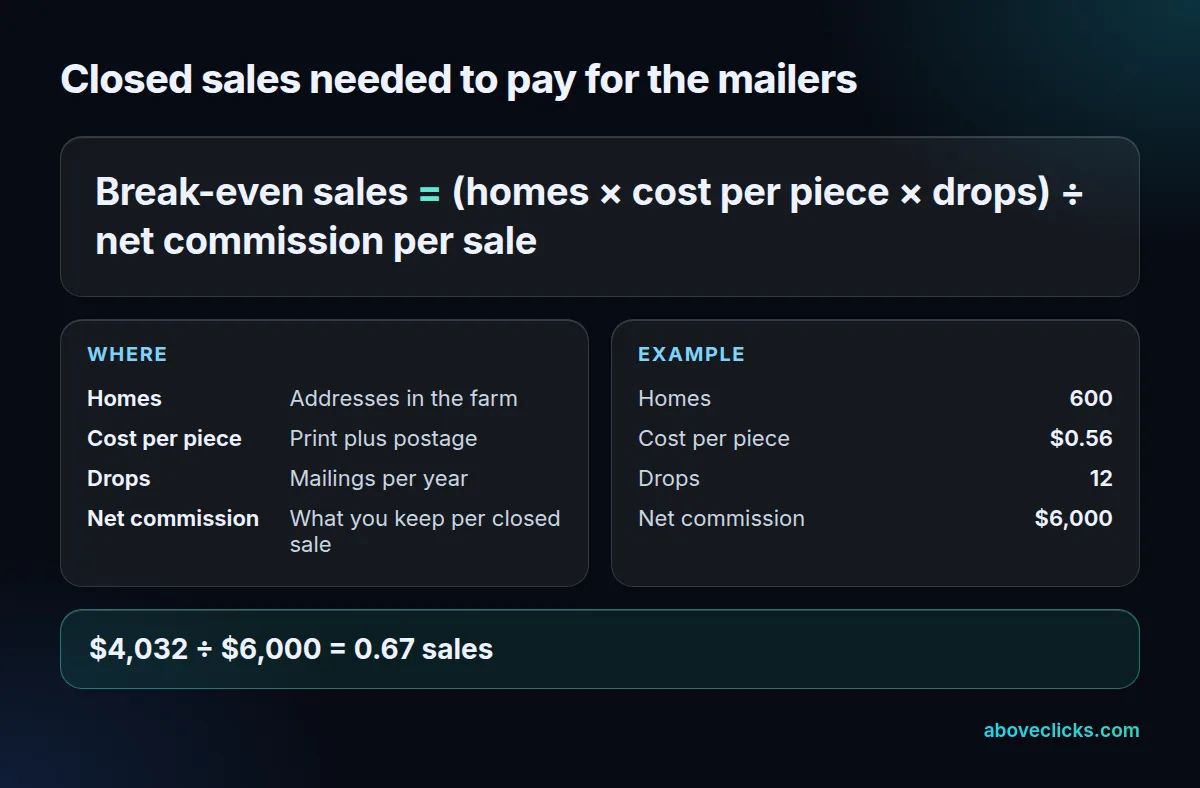
Worked example, with invented numbers: a 600-home farm, a printing cost of $0.30 a piece and so $0.56 per piece in total. One drop costs 600 × $0.56 = $336. Twelve drops cost $4,032 across the year. If you keep $6,000 net on a closed sale, the program breaks even at 0.67 sales, so one extra sale a year pays for it with room to spare.
Design time, your own hours and any list purchase come on top, so add them before you decide. Real estate mailers cost more as the farm grows, but the formula stays the same.
Test the example against worse numbers before you trust it. If printing rises to $0.50, one piece costs $0.76 and twelve drops to 600 homes cost $5,472, or 0.91 sales at $6,000 net. If your net commission is only $3,000, the original $4,032 needs 1.34 sales. Real estate mailers cost the same whether or not anyone replies, so the second case is the one to plan for.
Postage also changes. The $0.26 figure is USPS’s current listing, not a promise for next year, so check the USPS EDDM page before you budget a new year.
How many mailers should a farm area get each year?
There is no number that fits every farm, so compare a few against your break-even. The table works out the same 600-home example at 4, 6 and 12 drops a year.
| Drops a year | Pieces mailed | Total cost | Sales to break even |
|---|---|---|---|
| 4 | 2,400 | $1,344 | 0.22 |
| 6 | 3,600 | $2,016 | 0.34 |
| 12 | 7,200 | $4,032 | 0.67 |
All three need less than one sale to break even in this invented example. The real question is which schedule of real estate mailers brings more replies per dollar, and that only your own counts can tell you. Start with 6, count replies for the year, then move up or down.
Mailer frequency interacts with farm size. At 300 homes, 12 drops cost 300 × $0.56 × 12 = $2,016, the same as 6 drops to 600 homes. Choose the smaller farm if you want to be seen every month, and the larger one if you want more homes to know your name once or twice a year. Real estate mailers work best when the same people see the same name several times.
Spread the drops across the calendar and change the piece each time: market update, just sold, home-value note, local event. A small farm mailed often beats a large farm mailed once, and real estate marketing mailers reward patience. If your budget allows only 2,400 pieces, choose 400 homes six times rather than 2,400 homes once.
Keep the first three drops plain. Use your name, photo and phone number on every piece, one local fact such as a recent sale nearby, and one clear next step. Fancy design can wait until you know the farm replies at all.
What should real estate mailer templates check before printing?
Run the wording, the claims and the tracking before the file goes to the printer. Three mistakes are costly: a results claim you cannot back, wording that shows a preference, and a piece you cannot track.
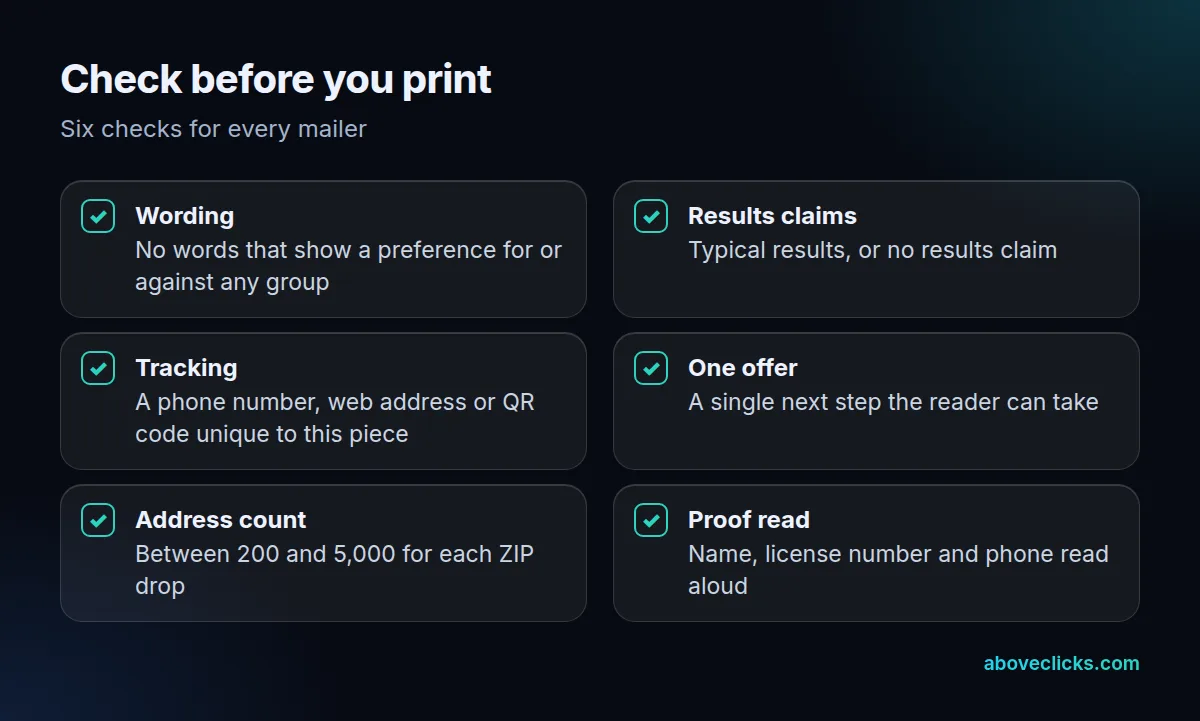
Housing ads carry a legal rule. 42 U.S.C. 3604(c) makes it unlawful to print or publish an advertisement for the sale of a dwelling that shows a preference, limitation or discrimination based on race, color, religion, sex, handicap, familial status or national origin. HUD’s Fair Housing Act overview lists the same protected traits. Check any of your real estate mailers, template or custom, and any phrase like “perfect for young families”, against that list.
Results claims need care too. A line such as “Sold in 3 days, $40,000 over asking” tells readers what to expect. The FTC’s endorsement guides Q&A says “results not typical” won’t change that reading. Either have proof the result is typical or state what is typical.
The third trap is a piece with no tracking. Without a unique number, web address or QR code, the year’s replies are guesses. Send each response to one follow-up path, such as a form that reaches your phone within seconds, and note which mailer it came from. Then you can compare drops, and your real estate digital marketing results sit beside your mail results in the same count.
Last, keep a one-page log of every drop: the date, the piece, the number mailed, the cost and the replies. After 6 drops you will see which real estate marketing mailers brought calls and which brought none. That log is also what you show a partner or broker when you ask for a larger budget. Our real estate marketing service works the same way on the digital side: every lead counted, every source named.