Real estate investment marketing attracts investors to a property offering, such as a syndication or a fund, instead of attracting buyers or sellers of a property. Because an offering can be a security, rules decide what you may say, and to whom, first.
This guide is for sponsors and operators raising money. It covers the two SEC routes that set the advertising limits, who counts as accredited, a 90-day plan and the claims to check. It is not legal advice; your securities lawyer decides. If you are sourcing properties from sellers instead, read our guide to real estate investor marketing.
What is real estate investment marketing?
It is the marketing you do to find, inform and follow up with people who might put money into a property offering. The product is the investment, so the first question is whether the offer is a security.
Two jobs get mixed up under the name real estate investment marketing. Marketing to property sellers and buyers finds deals and customers. Real estate investment marketing finds capital: the audience is people deciding whether to commit funds to your syndication, fund or joint venture, and they judge you on trust, track record and clarity.
That changes the work. An investor takes weeks to decide, asks for documents and compares you with other sponsors, so the plan needs an investor page, a careful email series and a record of every claim. The cost is usually in the compliance and follow-up, not in the ad click. A typical investor may ask 5 to 10 questions before a first call, so real estate investment marketing has to answer them in writing, in plain words, before anyone has to ask.
Which rules decide what you can say when raising capital?
For most private offerings, Rule 506 of Regulation D, in two versions. Rule 506(b) forbids general advertising; Rule 506(c) allows it but requires every purchaser to be accredited and verified.
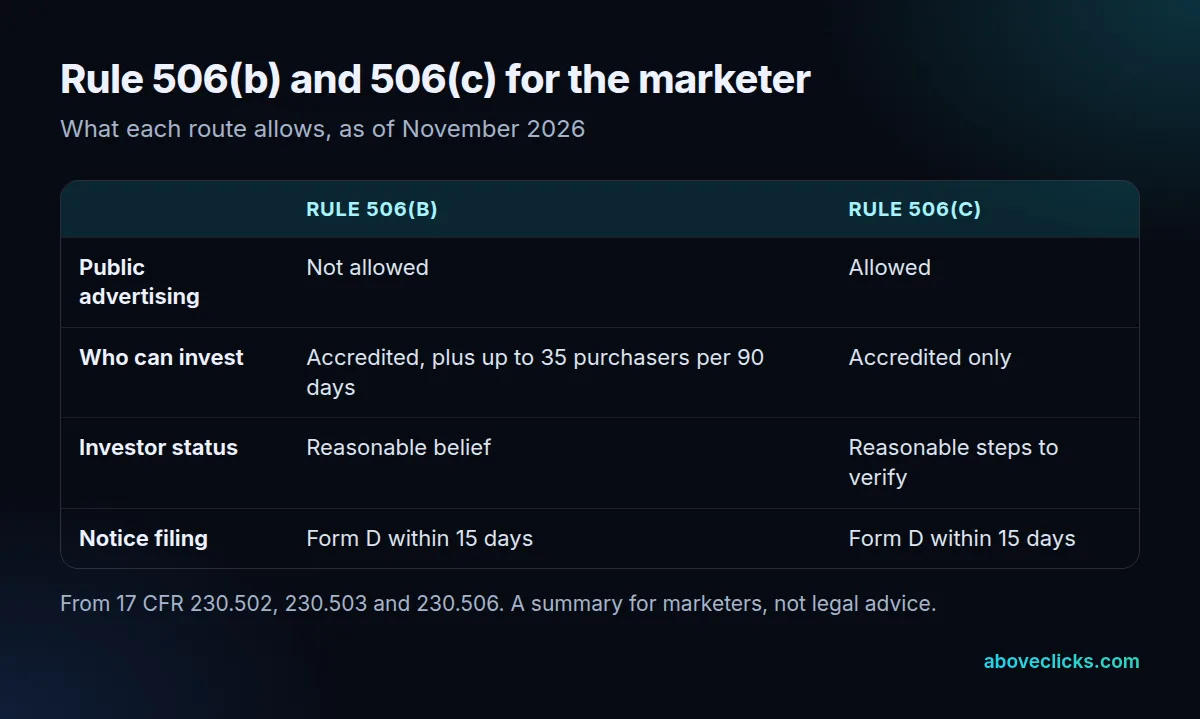
The table summarizes the rule text on the eCFR for anyone planning real estate investment marketing. Check it with counsel, because the details change what you can post.
What does real estate investment marketing look like under Rule 506(b)?
Quiet. Under Rule 502(c), neither the issuer nor anyone acting for it may offer or sell by any form of general solicitation or general advertising, including any advertisement or article published in a newspaper or magazine, or broadcast on television or radio.
In practice, marketing under this route builds relationships before an offering exists: a newsletter about the market, webinars about how you invest, and replies to people who contact you. Under Rule 506(b) there may be no more than 35 purchasers in any 90-calendar-day period, and each purchaser who is not accredited must have the knowledge and experience to judge the risk.
What changes under Rule 506(c)?
Advertising is allowed, and the burden moves to verification. Every purchaser must be accredited, and the issuer must take reasonable steps to verify it, according to the same Rule 506 text.
One listed method for income is reviewing IRS forms for the 2 most recent years; for net worth, documents dated within the prior 3 months. A written confirmation from a registered broker-dealer, adviser, lawyer or accountant can also count, if it was given within the prior 3 months. Verification adds time, so the marketing plan needs a step for it before any money is accepted.
Either route needs a filing. A Form D notice is due no later than 15 calendar days after the first sale in the offering.
Who counts as an accredited investor?
For a person, one of three tests: income, net worth or a licence. Income means above $200,000 in each of the prior 2 years, or $300,000 with a spouse.
The second test is a net worth above $1 million, not counting the main home; the third is a Series 7, 65 or 82 license in good standing. Those are the thresholds in the SEC’s investor bulletin on accredited investors, dated April 14, 2021 and read in November 2026. The bulletin also lists certain entities, including any entity in which all of the equity owners are accredited investors.
For the marketer, the point is the audience. In real estate investment marketing, a page, ad or email that attracts people who cannot invest wastes your follow-up time, and under Rule 506(c) it creates verification work that goes nowhere. Write the investor page so a reader can tell in 1 minute whether they qualify, and ask for qualifying details in a form rather than in public copy.
What should a real estate investment marketing plan cover?
The legal route, one investor page, lead routing, a follow-up series, a claim check and a report. A real estate investment marketing plan that starts with ads and leaves the rules for later pays for traffic it cannot use.

Here is how that looks across 90 days. In weeks 1 to 2, choose the route and write the page. In weeks 3 to 6, connect the form to one inbox or CRM, record the source of every enquiry and write the first emails. In weeks 7 to 12, publish what the route allows and read the report each month.
Our own timing for real estate marketing, as published on the real estate marketing service page, is an audit within 2 workdays, setup and fixes in about a week, and the first monthly report after 30 days. Every lead is routed to a CRM within seconds. The same discipline applies to investors: a person who asks a question and waits 3 days hears the answer from a competitor.
A good real estate investment marketing plan also lists what you will not say. Write that list with counsel before the first draft, not after the first complaint.
Which channels suit real estate investment marketing?
Owned channels first: your website, an email list, webinars and referrals. Paid channels come second, and only when your legal route allows public advertising and the ad platform’s own policies accept the offer.
In real estate investment marketing under Rule 506(b), an open social post that describes a live offering is the risky case. Public content about your market, your process and your team is different from an offer, but the line is a legal one, so ask. Under Rule 506(c), ads are allowed, and the plan should measure what happens after the click: qualified calls, verified investors and commitments, not clicks.
Some channel notes for real estate syndication marketing, a common form of real estate investment marketing:
- Email: the best-fit channel for a 4 to 12 week decision. Send fewer, more useful messages, with a plain unsubscribe link.
- Webinars: a live walk-through of how you source and manage deals, with a sign-up form that records who attended.
- Search: a page for each question investors ask, such as how distributions work, written without projecting returns.
- Referrals: existing investors, brokers and lawyers; keep a note of who introduced whom.
Whatever the channel, in any real estate investment marketing, record the source of every enquiry. If a commitment arrives 5 months after the first click, the record is the only way to know which work produced it. Our real estate digital marketing page explains how we connect that offline outcome back to the campaign.
Which testimonial and track-record claims need a check?
Any claim an investor could rely on: past returns, investor quotes, deal photos and projections. Hold each to what your documents show, and disclose any connection between you and the person quoted.
The FTC’s Endorsement Guides FAQ says a connection between an endorser and a marketer that a significant minority of consumers would not expect should be disclosed clearly and conspicuously. A relative, an employee or someone paid or given something of value is the usual example.
The FTC’s Consumer Reviews and Testimonials Rule took effect on October 21, 2024. It lets courts impose civil penalties for knowing violations, and it covers fake or false testimonials, so never write an investor quote yourself.
Three habits keep real estate investment marketing claims honest. Label every projection as a projection. Publish past results only with the period and the basis behind them. Keep the source document for every number in a folder your lawyer can open. A claim you cannot document is a costly trap, even if the offering itself is sound.
When should you hire an agency to help raise capital?
When the legal route is chosen and the plan needs building, tracking or follow-up you cannot run yourself. An agency should work inside your counsel’s limits, not ask you to loosen them.
Ask any agency 3 questions: which route do you assume, who reviews the copy before it goes live, and how will you report enquiries that turn into commitments months later? A good answer names a process, not a promise. Expect a review round of 2 to 3 days on every public page, and an agency that plans for it. If you want a second opinion on your current site, forms and lead routing, our free audit reads them and replies in writing; the legal questions still go to your lawyer. More on this sector is in our industries guides.
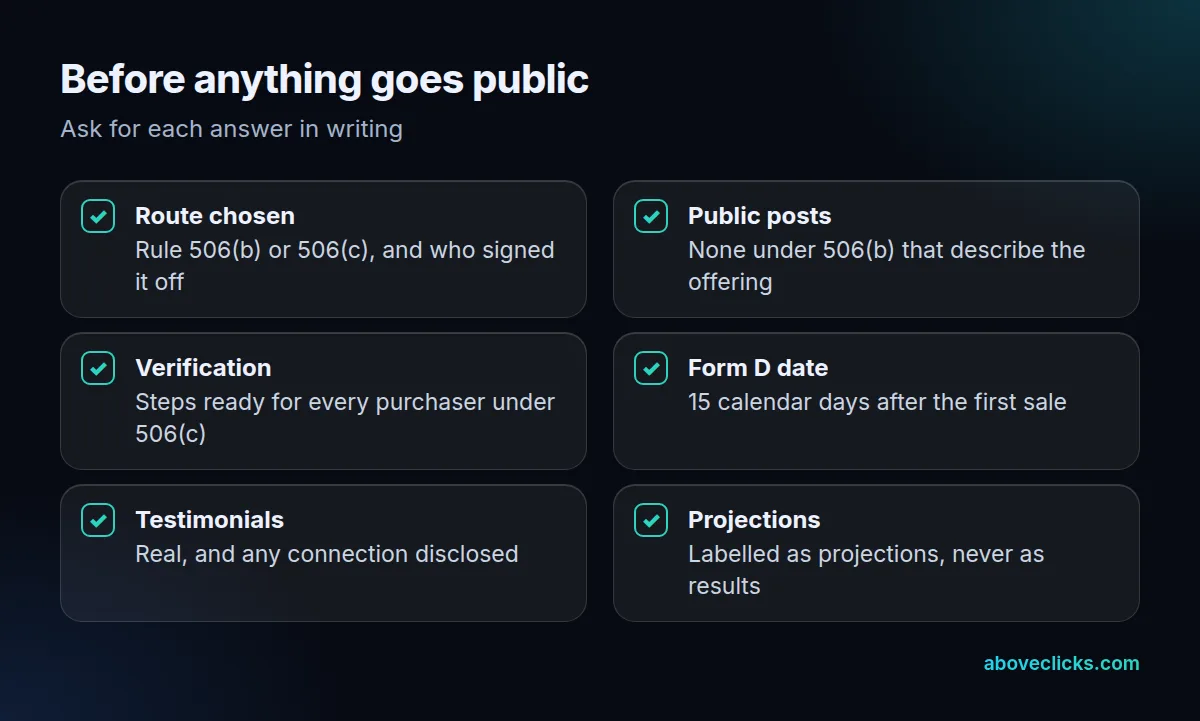
Print the checklist, add the date and the lawyer’s name to each line, and keep it with the offering documents. Real estate investment marketing that can show that trail is far easier to defend than a campaign with a good click rate and no record.