How to find local SEO clients comes down to one habit: look for local businesses whose public Google profile has fixable gaps, then show the owner the gap and offer one small first fix. This guide gives a 5-minute check, a six-step path and the rules that protect you.
It is written for freelancers and small agencies who want to know how to get local SEO clients without a big budget. If you are a business owner, the same check shows what a fair quote should cover; our guides to local SEO packages and why local SEO matters for a small business cover the buying side.
How to find local SEO clients without a big budget?
Search the way the owner’s customers search, note the businesses that are visible but poorly set up, and contact them about a specific gap. How to find local SEO clients is mostly a habit of looking, not a campaign.
Start from how Google itself describes local ranking, because how to find local SEO clients depends on what can be improved. Its local ranking guidance says local results are mainly based on relevance, distance and prominence, and that there is no way to request or pay for a better local ranking. That has a direct effect on how you sell: Google names 3 factors, and you cannot sell “a ranking”, only work on the parts the owner controls.
Those parts are your prospect list. Relevance is how well the profile matches the search, so look for missing categories and thin descriptions. Prominence rests partly on links and reviews, so look for unanswered reviews and a site nobody links to. Distance you cannot change, so skip businesses whose problem is only that they are far from the searcher.
Here is the six-step path that the rest of this guide fills in:
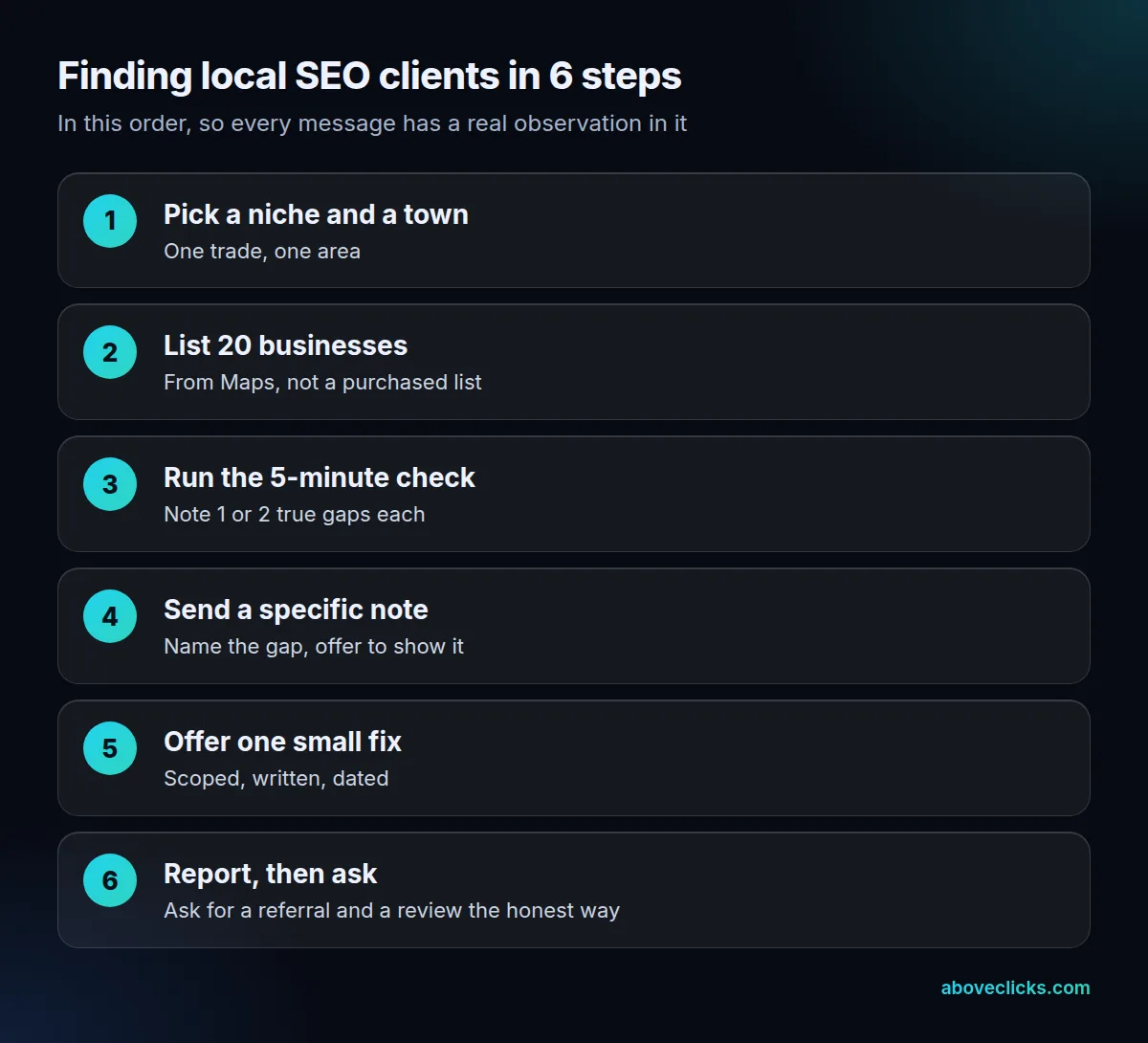
Keep the list small, because how to find local SEO clients is a quality problem, not a volume one. 20 businesses in one trade and one town, each with a real observation, will give you more replies than 500 names and the same sentence. The numbers matter less than the habit: 1 hour a week, every week, beats a burst of outreach followed by silence. That is how to find local SEO clients that stay.
Who makes a good local SEO client?
The best local SEO clients are businesses that depend on nearby customers, has a real service to sell, can answer the phone, and has visible gaps you can fix. They also have an owner who can make decisions without a committee. Good local SEO clients are easy to recognise once you know what to check.
Check 4 things before you spend time on a prospect:
- Eligibility. Google’s guidelines say a service-area business should have one profile with a designated service area and should hide its address. A virtual office that does not operate from that location is not eligible for a profile. If the prospect’s only address is a rented mailbox, that is a problem to raise before any work starts. The same page says a service area should not extend farther than about 2 hours of driving time from where the business is based, so a plumber claiming 6 counties is another flag.
- Local demand. If nobody searches for the trade in that town, SEO will not create customers. Search the service plus the town and look at who shows up.
- Capacity to deliver. A plumber booked 6 weeks ahead does not need more calls. A business that has slow weeks does.
- Fit with what you do. Pick the trades you understand, because how to find local SEO clients gets easier when you know the trade. A niche, such as dentists or home-service trades, lets you reuse every checklist and page template you make.
Avoid prospects who want a promised position, because the best local SEO clients understand what you can and cannot control. Since Google says rankings cannot be paid for, anyone asking you to promise a place on Maps is asking for something nobody can deliver.
How do you check a local business in 5 minutes?
Open the business’s profile on Maps, then its website, and tick 5 public checks: claimed profile, complete details, answered reviews, matching name address and phone, and a page for each service. Each failed row is a pitch.
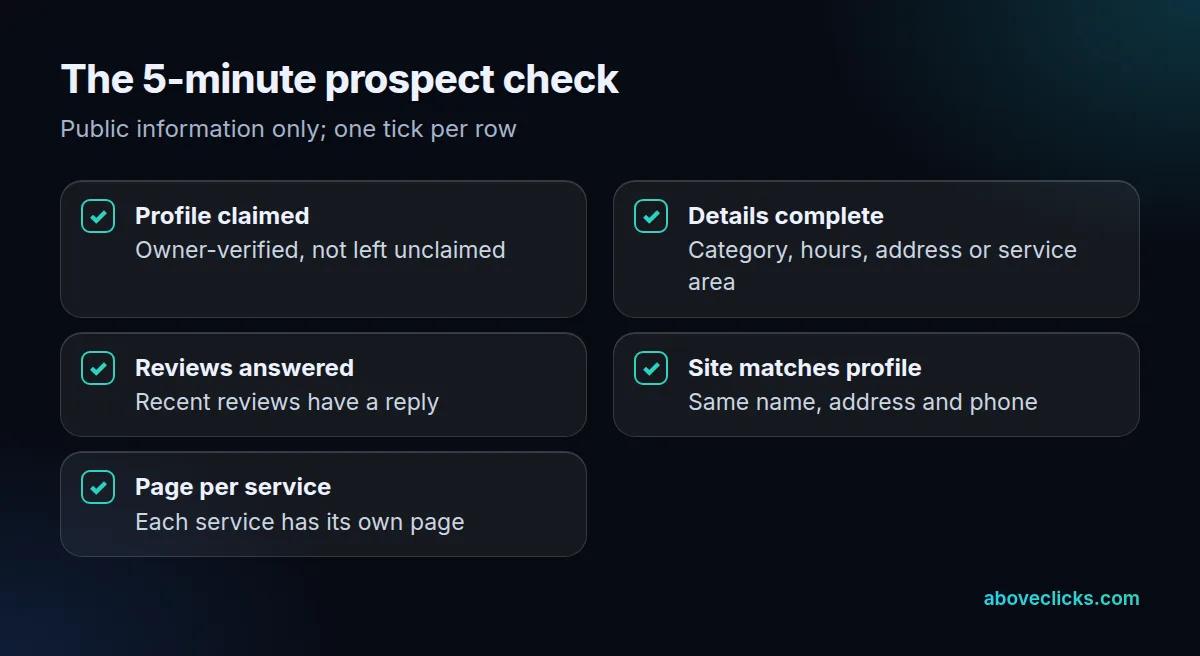
Why these 5 pages and details? They map to Google’s own advice. The ranking page says businesses with complete and accurate info are more likely to show up in local results, and it names the details to fill: address if customers visit, hours, category and attributes. It also says to respond to reviews and add photos. Google’s review tips add that reviews must reflect a genuine experience, and that replies should not carry deals or promotions.
How to run the check, in order:
- Search the business name and town. If no profile appears, or it looks unclaimed, note it. Google says you can add or claim a profile at no charge, so cost is never an excuse for the owner: that is 0 dollars of platform fees for the prospect.
- Read the profile top to bottom: category, hours, services, photos, link to the site.
- Open the 5 most recent reviews and see whether the owner replied.
- Open the website and compare the name, address and phone with the profile.
- Check that each service has its own page, and count the pages. If you can, look at the page source for LocalBusiness markup. Google’s structured data guide lists 2 required properties, the address and the name, and says more properties give a higher-quality result, so a page with only those 2 is a gap you can name. Gaps like these are where local SEO clients come from.
This is the part of how to find local SEO clients that most guides skip: the check is the pitch. Budget 5 minutes per prospect and 20 minutes a week for the whole list. Write down only what you could see and prove, which is the honest way to find local SEO clients. Never claim a fault you did not verify, and do not mention anything the owner cannot check in 2 minutes themselves. A good note is under 100 words. A note such as “the hours on your website differ from the hours on Maps” is true, visible and easy to fix, which is why it works.
Where do you find local SEO clients online?
In Google Maps itself, in local business groups, through referrals, through your own content and, if you are disciplined, by cold email. Pick 2 and run them for 3 months, with 10 prospects checked each week. Knowing how to get local SEO clients online means choosing channels you will keep up.
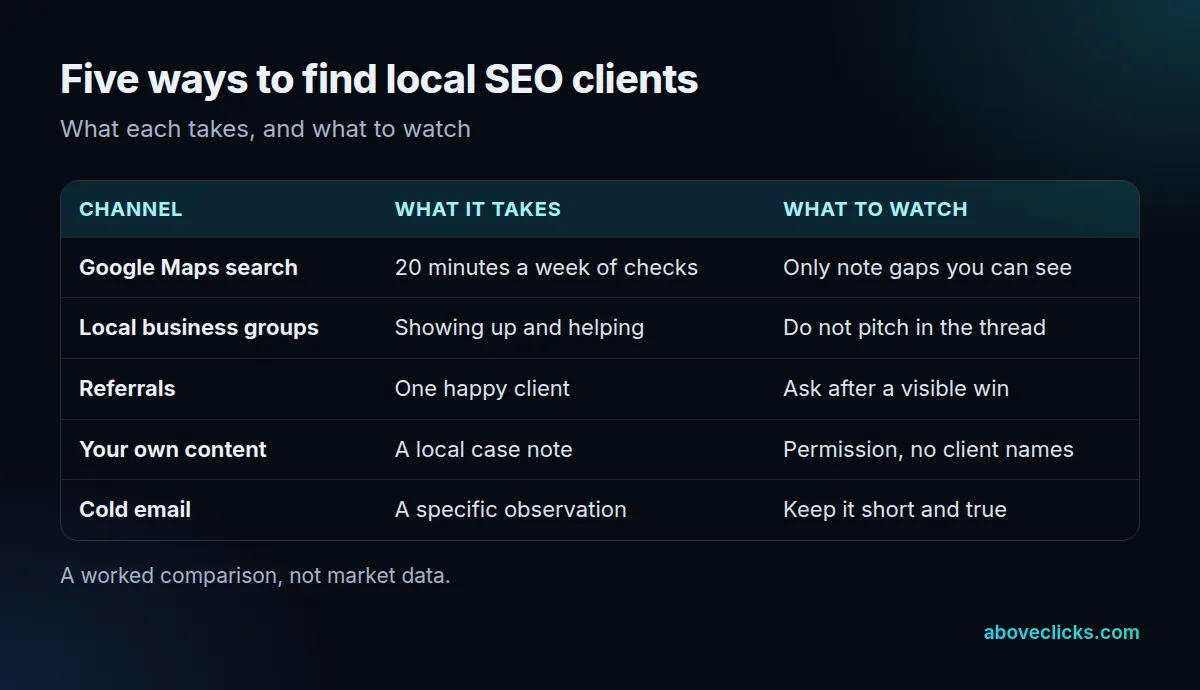
A few notes on each channel:
- Google Maps: it is both your prospect list and your proof. Search a trade and town, work down the results past the first 3, and run the 5-minute check on the ones that are visible but untidy.
- Local business groups: chambers, trade associations and community boards are full of owners. Help first: answer a question about their profile, and let people ask what you do.
- Referrals: one visible result for one client is worth more than any message. Ask after a win, not before.
- Your own content: a short local case note, with the owner’s written permission and no names unless they agree, shows how you work.
- Cold email: the hardest way to find local SEO clients, and only with a specific observation about the prospect’s own profile. Keep it to 3 or 4 sentences, say who you are and offer to show the gap. We make no claim here about the rules for commercial email in your country; check them before you send.
If you want to widen how to find local SEO clients, other directories and review sites can show the same business listed differently, which is another real gap to mention.
How do you pitch a local business without overpromising?
Name the specific gap, say what fixing it involves, and offer a small first piece of work with a written scope. Do not promise rankings, call volumes or dates. A pitch is the second half of how to find local SEO clients: the first half is the check.
A short pitch has 4 parts, and it is the second step of how to find local SEO clients that reply:
- The observation: “Your Maps profile lists 9am to 5pm; your website says 8am to 6pm.”
- Why it matters: inconsistent details are a known weak point; Google asks for complete and accurate information.
- The offer: a fix log for 1 month, not a long contract.
- The proof you can give: a before-and-after from your own work, with permission.
Say plainly what you cannot control. You can improve the profile, the pages and the review process. You cannot make Google rank a business first. The local business marketing page, written for the other side of how to find local SEO clients, shows how we frame the same split between what we do and what depends on search.
When the owner asks “how long will it take?”, say that profile fixes can be quick to make but that results depend on competition and on how Google updates its data. Put the first deliverables, not a ranking, on the calendar. Owners who see dated work stay longer, and that is how to find local SEO clients through referrals.
What should the first month with a new client look like?
Week 1 is access and a baseline, week 2 is profile and site fixes, week 3 is service pages and review replies, and week 4 is the first report. Everything in it should be dated and checkable, within 4 weeks.
A simple month, written down in the agreement:
- Week 1: get access (read-only or manager, never the primary owner role), record the profile’s current details, take screenshots of search results for 3 to 5 searches the owner cares about.
- Week 2: correct category, hours, services and photos; align the name, address and phone on the website.
- Week 3: write or fix the first service pages; reply to every open review.
- Week 4: send a 1-page report within 7 days of the last fix, of what changed, what is waiting on the owner and what comes next.
Our free audit uses the same idea for access: read-only first, so the owner can see what you found before anything is changed. Apply that to the profile as well. Ask to be added as a user rather than taking control: Google’s roles page says a profile has 1 primary owner and any number of managers.
Which rules protect you and the client?
3 rules: never take the primary owner role or ask for a password, never offer incentives for reviews, and never list an address that does not qualify. Each one protects the client’s profile, and your reputation.
Access. Google’s owner and manager roles page says a profile has only one primary owner, and that managers have mostly the same access as owners except that they cannot add or remove users or remove the profile. Ask the owner to invite you as a manager. When the work ends, the owner removes you in a minute and keeps control. Verification is also set by Google and cannot be hurried: its verification page says methods are chosen automatically and cannot be changed, and that a phone code does not reach an automated answering system, so the owner needs to answer or receive the text.
Reviews. Google’s Maps policy does not allow merchants to offer incentives, such as discounts or free goods, in exchange for a review, or to selectively solicit positive reviews. So a review process has to ask every customer the same way, with no reward. Build it that way from the first month, and tell clients why.
Address. Do not help a client list a virtual office or a remote mailbox. Google’s guidelines say those are not eligible, and a profile that breaks the rules can be a liability for the owner.
Write these rules into your scope, since how to find local SEO clients is only half the job; keeping them is the other half. They make your work safer, and they also make your pitch easier to trust. Google also says reviews from conflicts of interest, such as a contractual or consulting relationship, are not allowed, so do not post reviews for your own clients. The same rules apply whether you are learning how to find local SEO clients or already have 10.
If you would rather see how a done-for-you version works, our local services marketing and average cost of local SEO pages show the buyer’s side. More guides are in the industries topic.