Real estate investing marketing is the work of reaching property sellers, buyers and lenders so an investor can find, sell and fund deals. Judge it by the cost of a closed deal, not the cost of a lead.
This guide splits real estate investing marketing by audience, matches channels to goals, shows a worked funnel, covers the website and Business Profile basics, and lists the ad and calling rules to check before you spend.
What is real estate investing marketing?
It is every effort to put an investor’s business in front of the people the deals depend on. That includes homeowners who might sell, cash buyers who might take a deal, and lenders or partners who might fund one.
Good real estate investing marketing is specific to the deal you want next. It differs from agent marketing, where the goal is a listing or a buyer client. An investor usually buys first and sells or rents second, so the marketing runs in two directions at once. We cover raising money from outside investors in our guide to real estate investment marketing, and seller lead sources in off market real estate leads. This guide is the wider view that ties them together.
In the worked example later in this guide, 1 deal comes from 60 leads, a rate of about 1.7%, so every wasted step in real estate investing marketing is expensive. Three mistakes cost investors the most: marketing to sellers only and having nobody to sell to, judging channels by cost per lead, and starting ads or calls without checking the rules.
Who are you marketing to: sellers, buyers or lenders?
All three, in the order your next deal needs them. A deal you cannot buy, sell or fund is not a deal, so the audience that limits you this month gets this month’s budget.
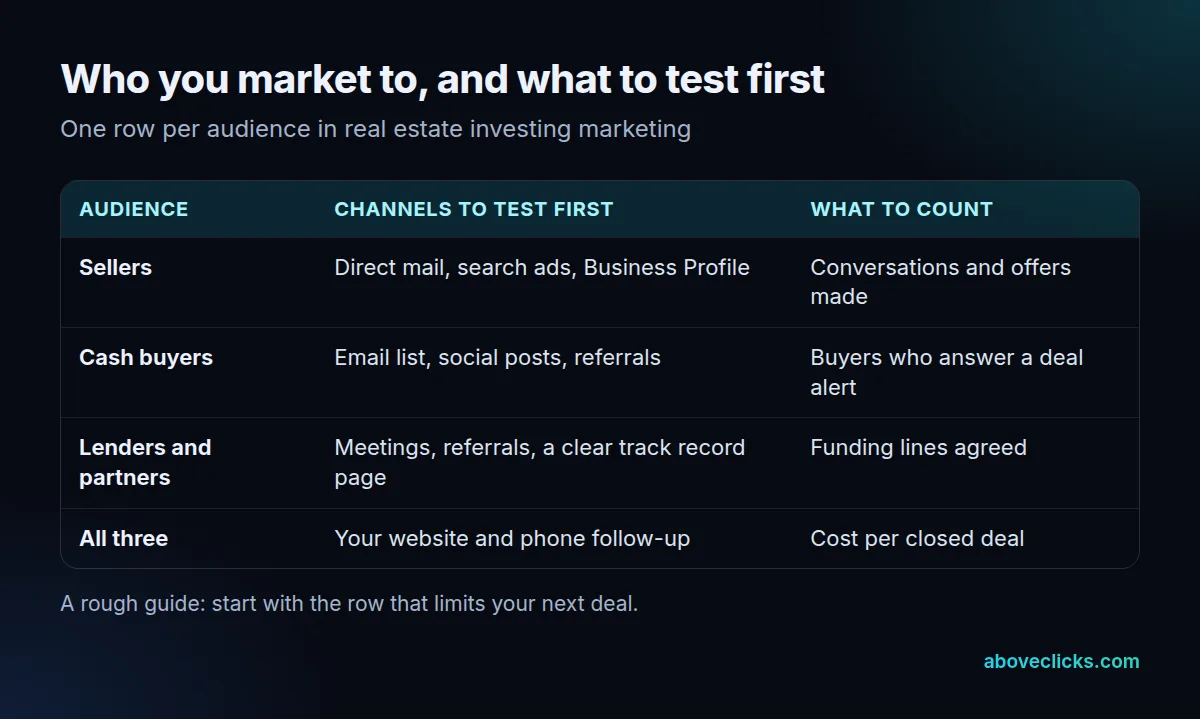
Sellers are the supply. They respond to a clear promise and a quick, polite answer, not to jargon. Cash buyers are the demand. They want a short deal alert with the facts they need to say yes or no, and they stay on your list only if the alerts are accurate. Lenders and partners look for proof you finish what you start, so a track-record page and a steady paper trail matter more than ads.
Real estate investor marketing often stalls here. Many investors build the seller side first and then scramble for buyers. Keep a small buyers’ list from the first week, even if it only has five names, and send it a deal alert at least once every 30 days. For example, a seller who reaches you on a Monday should hear back within 24 hours, while a buyer on your list should see the street, the asking figure and the repair estimate in one short message.
Which channels suit real estate investing marketing?
The ones that match the audience and that you can measure in your real estate investing marketing plan. Test two channels at a time, for 90 days, instead of five for a month.
For sellers, the usual tests are direct mail to owners on a list you built or bought, search ads for the questions an owner types, and a complete Business Profile. For cash buyers, email and referrals beat paid reach, because the list is small and the relationship is the product. For lenders, meetings and referrals still do most of the work.
Real estate investor marketing works best when each channel has one owner and one number to beat. Paid social and search can fill the top of the funnel fast, which is exactly why they need checking.
Our own published real estate ad results show the gap: on our real estate results page, Meta lead ads brought 486 leads at $10.03 a lead in September 2026, while two Google accounts recorded conversions at $60.32 and $50.43 each. Those are developer and agent accounts, not investor accounts, and a lead is not a conversion. The point is that the same month can show a cheap form fill and a much dearer enquiry, and only follow-up tells you which one turned into a deal.
If you want a second opinion on your real estate investing marketing mix, our free audit reads your pages and ad accounts, and our real estate marketing service page shows how we run lead follow-up.
How do you get real estate investor leads without wasting budget?
Count what happens after the lead, because that is where most of the money disappears. Cheap real estate investor leads that never answer the phone are the most expensive kind.
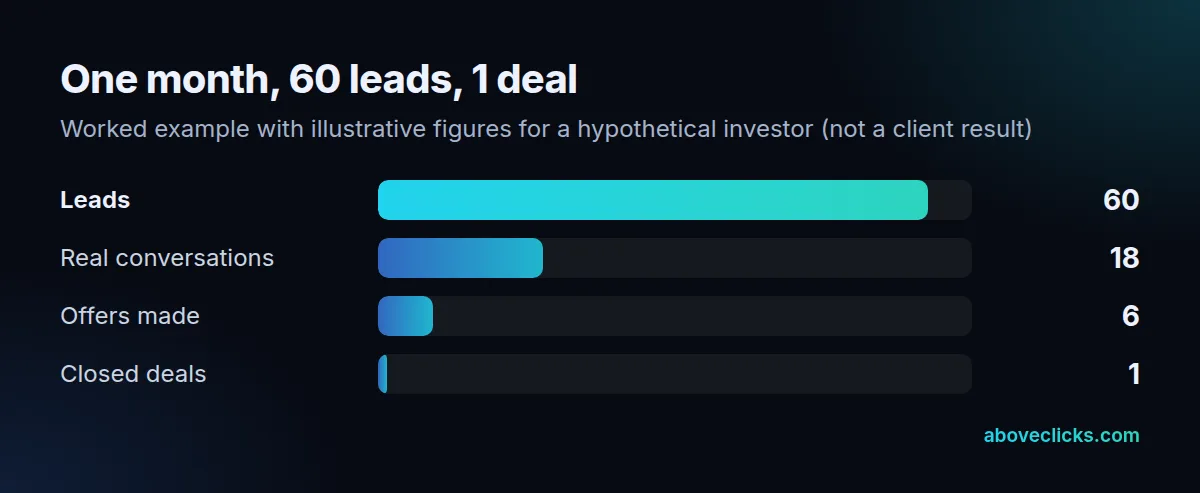
Here is a worked example with illustrative figures for a hypothetical investor (not a client result). Channel A cost $1,200 and produced 40 leads at $30 each, but no deal. Channel B cost $1,800 and produced 20 leads at $90 each, and one closed deal. Together that is $3,000 for 60 leads, 18 real conversations, 6 offers and 1 deal. Channel A looked three times cheaper per lead and was the worse buy, because it cost $1,200 and bought nothing.
To keep a funnel like this honest:
- Call every new lead within the same day, and note why each non-buyer said no.
- Write down the source of every lead, including calls and referrals.
- Review the numbers monthly and cut the channel with the most spend and the fewest offers.
The same logic holds for real estate investor leads from a bought list: the list is a cost, and its worth shows up only in offers and deals.
What should a real estate investor website show?
Who you are, what you buy, where you buy, how fast you answer, and how to reach you. A real estate investor website that asks for the same details on every page loses sellers who wanted a simple answer, and one that promises a reply within 24 hours must keep that promise.
A good page for sellers says what kinds of property you buy, the areas you cover, how the process works in 3 to 5 short steps, and how to contact you by phone and form. A page for buyers shows how to join your deal alerts. A page for lenders and partners shows completed projects with their real figures, and no figure you cannot back up.
Your Business Profile is the other half of a local presence. Google lists verifying your business, keeping information complete and accurate, replying to reviews and adding photos among its local ranking tips. If you work from an office with no walk-in customers, Google’s guidelines say a service-area business should have one profile with a designated service area, may not list a virtual office unless it is staffed during business hours, and cannot use a remote mailbox or P.O. box as its address. Follow them, or the profile risks suspension and the effort is wasted.
Which ad and calling rules apply to real estate investing marketing?
Housing ad rules on the platforms and the FTC’s telemarketing rules. This is general information, not legal advice, and your state may add its own rules.
Ads. Google’s personalized advertising policy says that for housing ads in the United States and Canada you cannot use age, gender, marital status or parental status targeting, and you cannot use ZIP code location targeting. Meta asks advertisers to pick a Special Ad Category for housing, employment and financial products, limits audience selection tools for those ads, and warns that ads may be rejected if the category is wrong.
Whether a “we buy houses” ad counts as housing is for the platform to decide. Read the current policy text before you build the audience, and expect narrower targeting.
Calls. As of November 2026, the FTC’s Do Not Call guidance says sellers who must use the registry must sync their lists at least every 31 days, and violations can bring fines up to $53,088 per violation.
A company may call someone it has an established business relationship with for up to 18 months after the last purchase or payment, unless they ask it to stop.
Calling a consumer on the registry is also allowed with written consent that includes the phone number and a signature. Most calls to businesses to solicit sales are exempt.
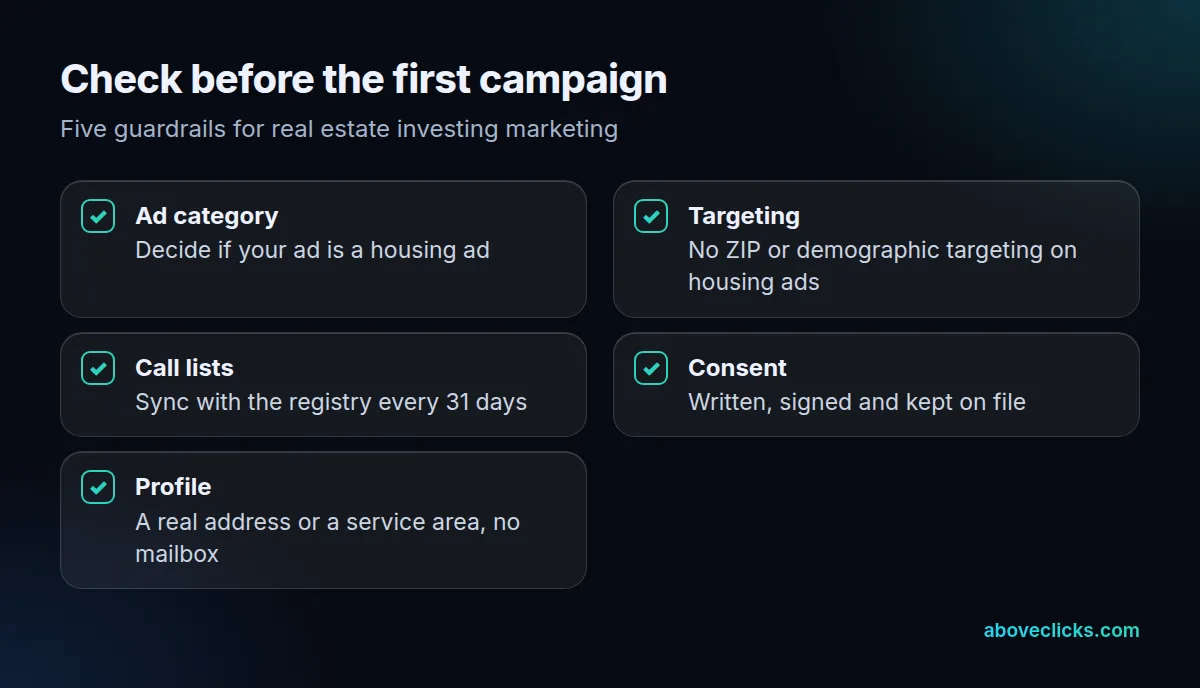
Keep a simple log of consent and opt-outs from the first call, because a record you cannot find is as bad as one you never made.
How do you measure real estate investing marketing?
By cost per closed deal: total marketing cost divided by deals closed in the same period. Add the cost of lists, ads, mail, tools and time, not only the ad spend.
In the worked example above, $3,000 over one closed deal is $3,000 a deal. If the average deal then earns more than that after all other costs, the plan works. If it earns less, no amount of cheap leads will fix it.
Because deals take weeks to close, read the numbers over a rolling 90 days and compare with the same period a year earlier if your market is seasonal. Track these in one place:
- Spend by channel, including mail and list costs.
- Leads, real conversations and offers by channel.
- Deals closed and profit per deal, with the channel that found them.
Review the table every month and the real estate investing marketing plan every quarter. Move budget toward the channel with the lowest cost per deal, and keep a small test budget so you find the next one. When you want a hand with that, real estate marketing is a service we run, and the industry page shows how we report results. More guides are in our industries section.