Ongoing monthly SEO services are recurring work (checks, page changes, content and reporting) that a provider repeats every month for a set fee. Judge them by the changes that reach your live pages, not by hours billed.
Most pages that sell monthly SEO services list tasks and a fee. They rarely say which tasks must repeat or how you would know they happened.
This guide sorts the work into tasks that should repeat and tasks that should end, shows how to check each month yourself, and gives a cost-per-change test you can run on any quote.
What are ongoing monthly SEO services?
Work that a provider repeats every month so a site keeps improving after the first fixes: checking indexing, rewriting pages, adding content and reporting. It differs from a one-time project, which ends when a fixed list is done.
Repeating makes sense because results arrive slowly. Google’s SEO starter guide says some changes show up within hours while others could take several months, and suggests waiting a few weeks before judging a change. A single month is too short to show results, but it is long enough to show whether work was done.
Not every site needs ongoing seo services. If you have a short fix list, a one-time SEO package plus a check every few months may cost less. Monthly work fits stores that keep adding products and pages.
Example: a store with 400 product pages adds 20 new products a month. Each new product needs a title, a description, internal links and an indexing check, so the work repeats as long as the catalog grows. A store that adds nothing for 6 months has little left to repeat.
The services also differ in who does the work. Some providers only advise and your team makes the changes; others edit the site themselves. Both are valid, but the fee should say which one you are buying. More guides on buying SEO are in the buying guides section.
What do ongoing SEO services include every month?
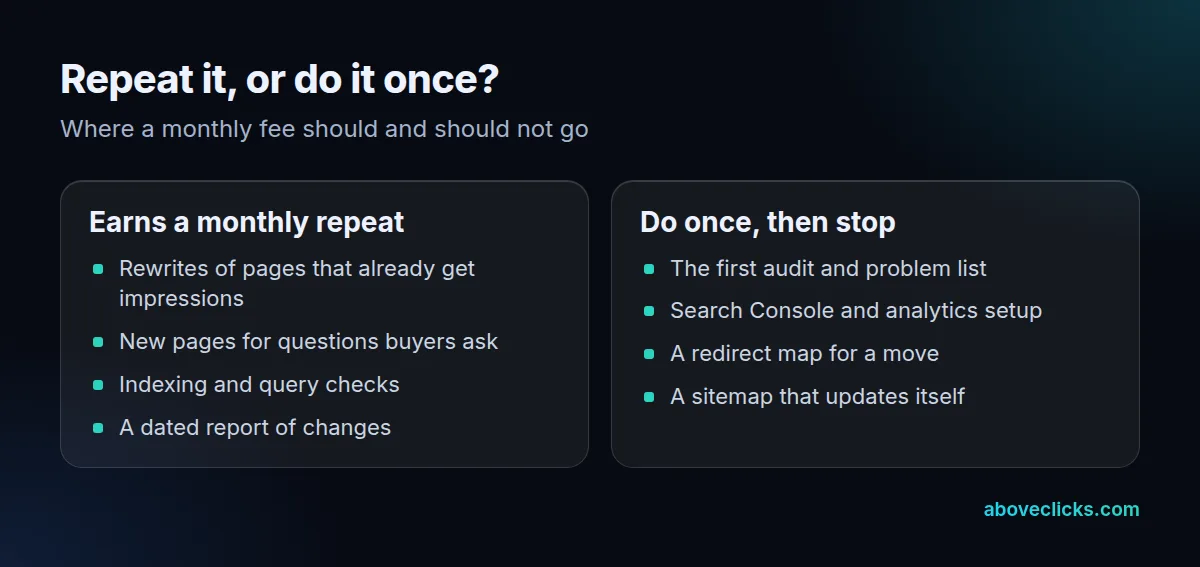
A small core that repeats, plus a rotating share of page work and content. Everything else in ongoing seo services, such as the first audit, should happen once.
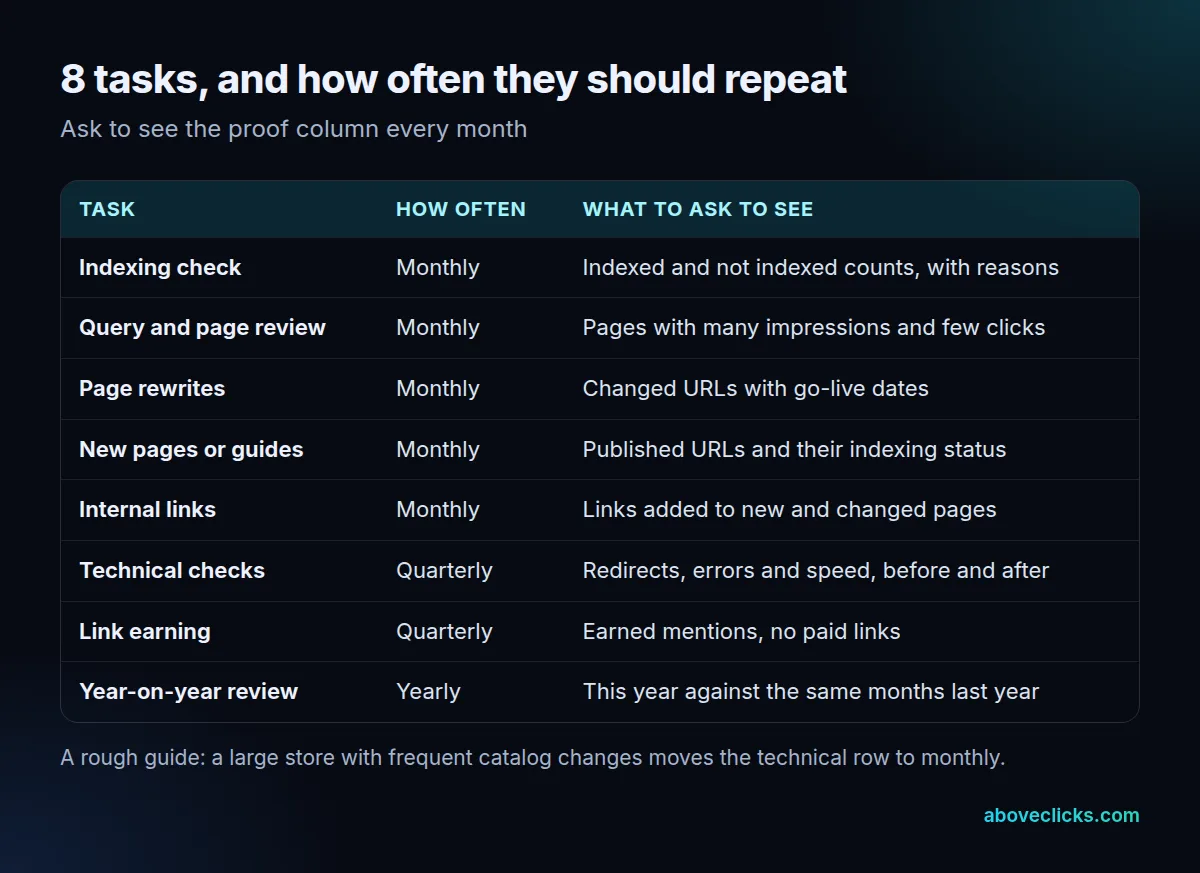
The table above sorts 8 tasks by how often they should run. Five of them repeat monthly, and two of those, the indexing check and the query review, cost little time once they are set up. The quarterly and yearly rows catch slower problems.
For scale, our own ecommerce SEO monthly plan covers Search Console monitoring, a monthly report and typically two to four pieces of content a month, with the first report after 30 days. Use numbers like that as a yardstick: ask any provider of monthly seo services what “monthly” means in pages, fixes and reports.
What a good month looks like in practice, as a short log: 5 page rewrites with go-live dates, 2 internal-link additions, 1 new guide, 1 fixed redirect and a report that lists all 9 items. A bad month is a report of rankings with no list of changes.
Two things look like monthly work but should be questioned. One is bulk content: Google’s spam policies describe scaled content abuse as many pages generated mainly to manipulate rankings. The other is paid links: the same policies list buying or selling links for ranking as link spam. If either appears in a monthly SEO services plan, ask why.
A useful split is by who benefits from the repeat. Checks repeat because sites change under you: a developer ships a theme update, a plugin adds duplicate URLs, a page is unpublished by mistake. Page work and content repeat because each page can only carry so many searches, so growth needs more pages or better ones. Reports repeat so you can see both.
Filler is everything else: a monthly “site audit” that is the same automated printout, keyword lists that never change into page edits, and directory submissions with no clear purpose. If an item on the monthly list never leads to a change on a live page, ask what it is for.
How can you tell if your SEO company is working?
With ongoing monthly seo services, check the same three things every month: whether the important pages are indexed, whether clicks and impressions on changed pages moved, and whether the change log matches what you can see on the site.
Start with Search Console’s Performance report, which shows clicks, impressions, click-through rate and average position, and defaults to the past three months. Google’s traffic-drop guide suggests widening the range to 16 months, so you can see yearly seasonality before blaming or crediting the work.
Then open the Page indexing report. It says a page that is not indexed is not necessarily a problem, because duplicates and pages with a noindex tag are expected. It also caps the example list at 1,000 URLs, so a large store should ask for counts by reason rather than a screenshot of the list.
Add your own store data on top of this. Search Console shows visits from Google, but only your store’s order data shows whether those visits bought anything. Ask for both in one report, so a rise in clicks that never reaches an order is noticed.
A simple monthly routine for checking monthly SEO services:
- Open Performance for the last 3 months and compare it with the previous period.
- Filter to each page the provider says it changed, and note clicks before and after.
- Open Page indexing and check that new pages moved to indexed.
- Match the change log to the live pages, URL by URL.
Our monthly SEO report guide shows how a report should lay these out.
How much should you pay for monthly SEO services?
Enough to cover the changes that matter for your site, and no more than a provider of monthly seo services can show it shipped. Market averages hide wide differences in scope, so test the fee against delivered work.
We don’t publish market ranges for seo monthly charges here, because scope varies too much to compare. Use one formula instead: divide the monthly fee by the changes that went live.
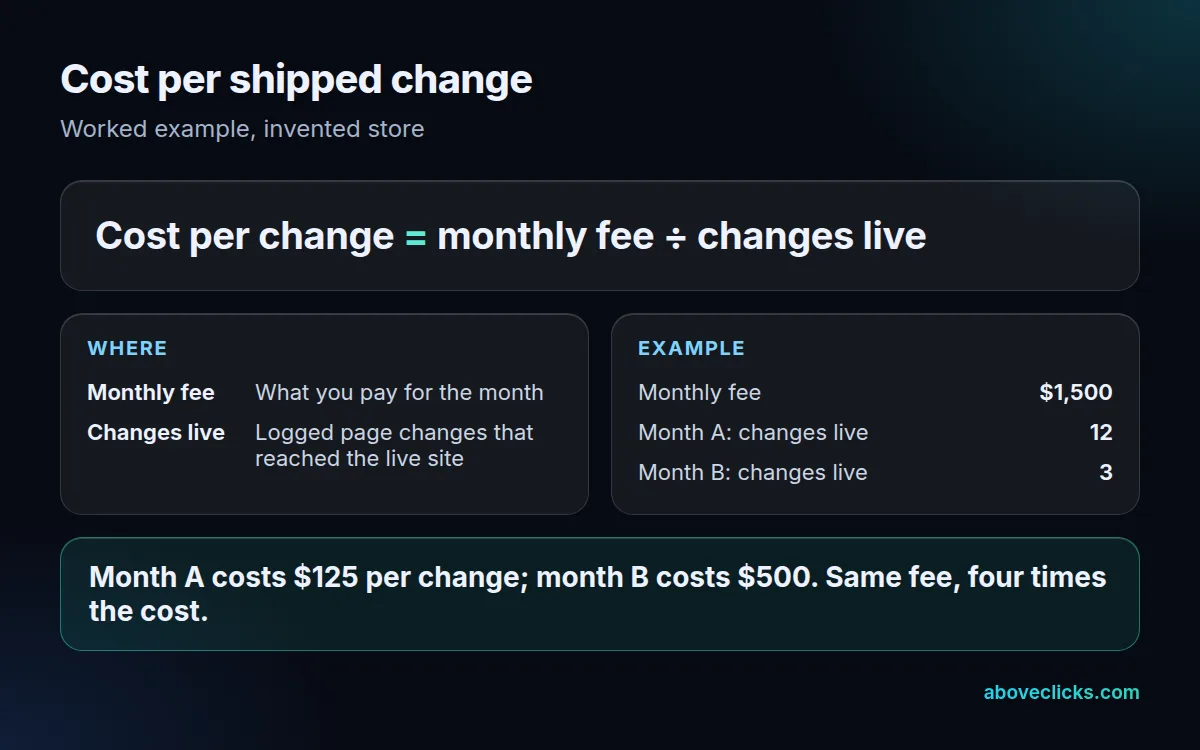
In this invented example, the store’s monthly bill is $1,500. In month A the provider logs 12 changes live, so each costs $125. In month B only 3 go live, so each costs $500. One slow month is normal, since approvals and developer queues get in the way. Three slow months in a row is a pattern to raise.
What moves the fee up or down is mostly the size of the rotating part: how many pages are rewritten, how much is written new, and how many markets or languages are covered. The checks and the report change the fee far less.
Three questions make any quote easier to compare:
- What is delivered each month, as a list of pages, fixes and reports?
- Who writes and who publishes the changes?
- What happens to the fee when the work grows or shrinks?
The monthly SEO package guide covers the 12-month plan and contract terms, so check those before you sign.
Be wary of seo monthly charges that come with a promised ranking or position. No provider controls Google’s results, and Google’s own guidance says only that changes can take hours to months. Ask for the list of work instead of the promise.
How long should you pay for ongoing SEO?
Long enough to see the effect of the first fixes, then ongoing seo services are worth paying for only while each month still ships changes that matter. Google’s guidance gives a rough clock to work from.
The starter guide says to wait a few weeks to assess a change. The traffic-drop guide adds that some changes take effect in a few days while others take several months, and that it may take months before Google’s systems decide a site is producing helpful content in the long term. So judge the first 3 months on work shipped, and the following 3 on results.
A stop-or-change test at month 6:
- Is there a dated list of changes that went live? If not, stop.
- Did the rewritten pages gain clicks against the same months last year? If not, ask for a written diagnosis.
- Is the list still growing each month, or has it shrunk to reporting? If it has shrunk, move to a cheaper plan.
Redirects are a good example of work that should end. Google’s redirect guide says to use permanent redirects when you are sure they won’t be reverted, so a redirect map is built once and checked, not rebuilt every month.
Before you stop, ask for a handover: the change log, any briefs and drafts, and removal of any Search Console verification the provider added. A site that keeps its own admin access can end ongoing SEO services in a day, without chasing passwords.
In short, pay for ongoing monthly SEO services while each month ships changes you can see, and move to a lighter plan once the list of useful work gets short.
If you want a second opinion on what a provider has done so far, our free audit reads your Search Console and points to the top fixes.