How to increase conversion rate ecommerce stores can trust starts with sizing every fix in orders, then fixing the known causes of lost sales before you test anything. The usual trap is judging a change by the rate alone, because a rate can rise while orders fall.
This guide shows how to increase conversion rate in ecommerce with a routine, a worked example that sizes four fixes in money, the reasons shoppers leave, the speed targets that matter, and what the work costs.
How to increase conversion rate ecommerce stores can trust: where do you start?
With the count, not the page. Conversion rate is orders divided by sessions, so first check that both numbers are right, then read the funnel by device and fix what is known before testing what is not.
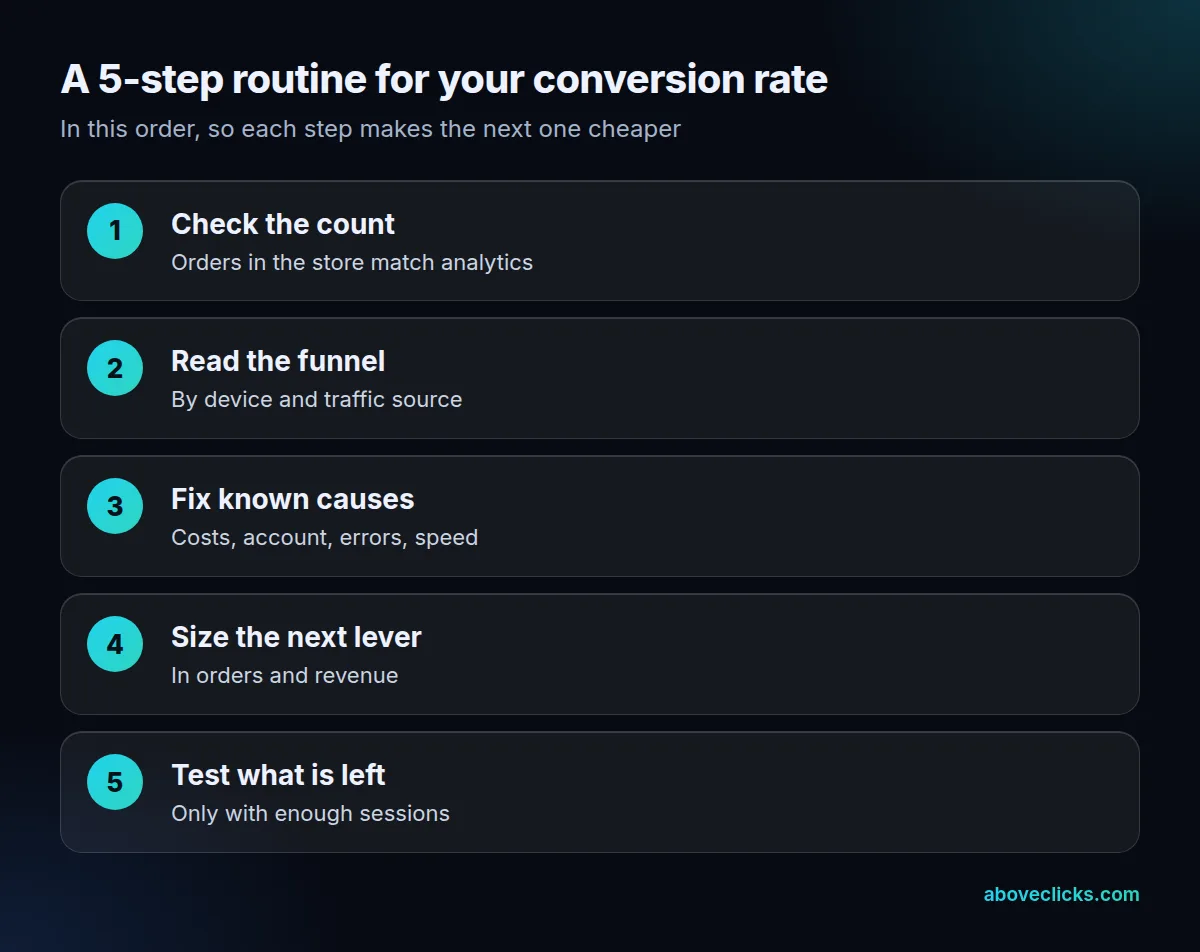
Shopify’s help page defines each funnel step the same way: sessions for a step divided by total sessions. The last step is your conversion rate. Other platforms and GA4 use their own session rules, so pick one source and keep it fixed month to month.
Do the count check first. Export last month’s orders, compare them with purchases in your analytics for the same dates and time zone, and fix tracking if more than a few percent are missing. Our guide on how to improve conversion rate covers that order of work step by step. This page adds the part it leaves out: choosing between fixes by what each one earns.
In the example store used below, 600 orders from 40,000 sessions is a 1.5% rate. If analytics shows 560 orders while the store admin shows 600, every test is judged against a wrong baseline. Treat how to increase conversion rate ecommerce teams ask about as a sequencing problem: the right fix in the wrong order wastes a month.
What is a good ecommerce conversion rate?
Your own rate in earlier months, split by device and traffic source. There is no single good figure, because the product, the order value and the mix of visitors move the rate far more than the platform does.
We quote no market average here. Published averages mix very different stores, and a store selling $15 refills to repeat buyers cannot compare itself with one selling $900 furniture to first-time visitors. Write down last month’s rate, the same month last year, and the phone and desktop rates. That is the baseline every later change is judged against, and it is the honest starting point for how to increase conversion rate ecommerce plans, because a benchmark from another store tells you nothing about yours.
One dated caution: Shopify says its session measurement rollout runs from September 21 to 23, 2026, and that sessions and conversion rate might be different in your reports afterwards, as of November 2026. A step in the line on 21 September can be a counting change, not a customer change.
Which lever is worth more: checkout, add to cart or order value?
They can be worth exactly the same, so the cheapest one to move goes first. A 10% relative gain at any step of the funnel adds the same share of orders, while a 5% rise in order value adds the same share of revenue.
Example: an invented store has 40,000 sessions a month, a 1.5% conversion rate and an $80 average order. That is 600 orders and $48,000 of monthly revenue, or $1,200 for every 1,000 sessions. Here is what four fixes and one traffic decision do to those numbers.
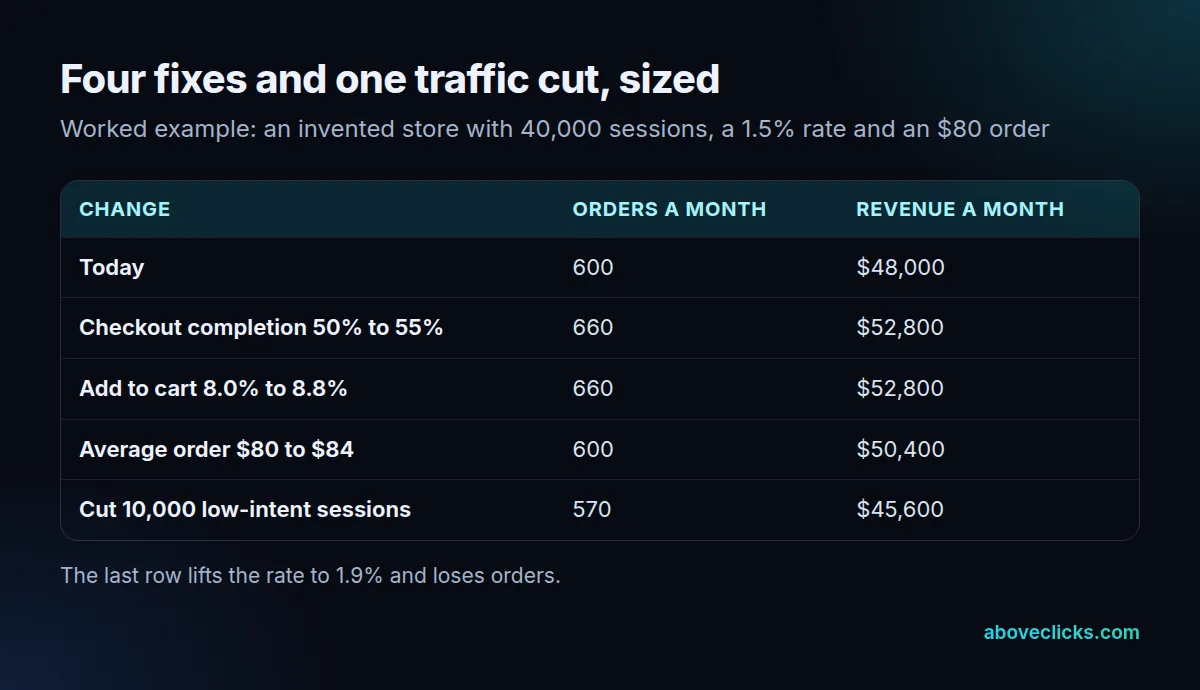
Raising checkout completion from 50% to 55% and raising add to cart from 8.0% to 8.8% are both a 10% relative gain, so each adds 60 orders and $4,800 of monthly revenue. Lifting the average order from $80 to $84 adds $2,400 of monthly revenue with no extra orders. The first two are worth twice the third, but only the fix that is cheapest to build tells you where to start.
The question for how to improve conversion rate ecommerce owners should ask is therefore not which tip is popular, but which fix adds the most orders for the least work.
Use the same sums on your own store. Multiply sessions by your rate for orders, then by your average order for revenue, and change one number at a time. This is the table we would draw before ranking any list of tests, and the same method sits behind the ranked list in a CRO audit.
How to improve conversion rate ecommerce shoppers lose to known causes?
Start with the reasons that can be fixed. Baymard finds that 42% of US online shoppers have abandoned a cart because they were just browsing, which no page can change, so work on the other reasons first.
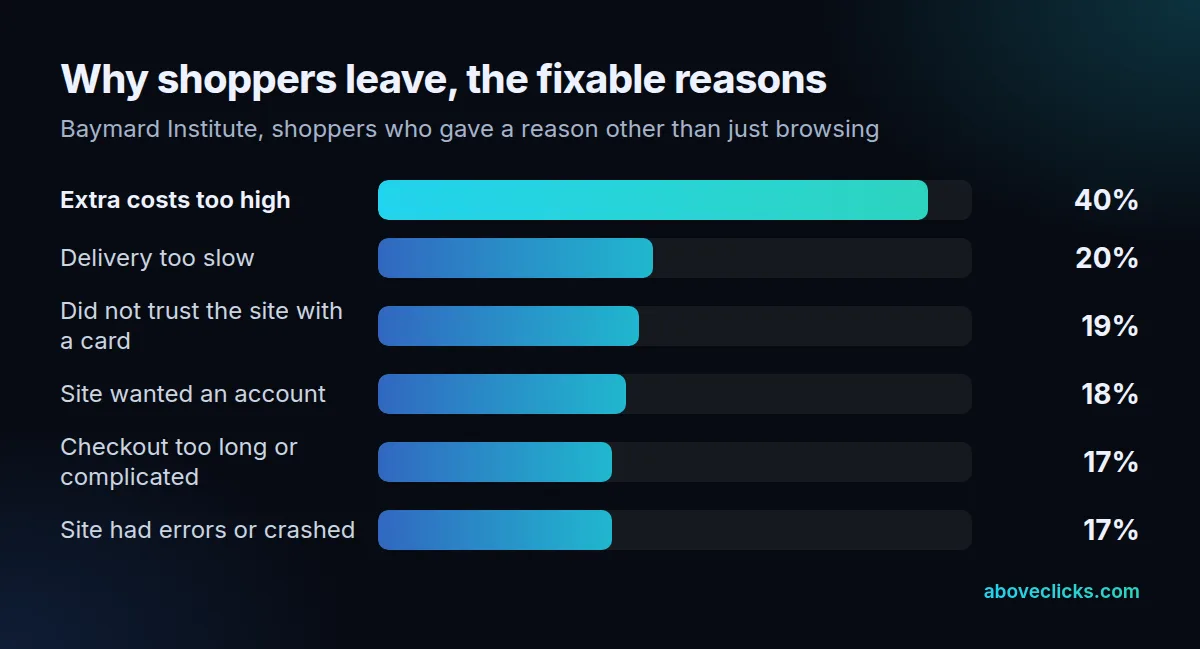
Baymard’s list puts extra costs first at 40%, then slow delivery at 20%, lack of trust in the site with card details at 19%, a forced account at 18%, a long or complicated checkout at 17% and site errors at 17%. Its average documented abandonment rate across 50 studies is 70.22%, so most carts end without an order whatever you do.
Each reason points to a check:
- Extra costs: show shipping and tax early, before the last step.
- Delivery: state dates on the product page and in the cart.
- Trust: show payment logos, returns terms and contact details near the pay button.
- Account: offer guest checkout.
- Length: Baymard counts 23.48 form elements in the average US checkout against 12 to 14 in an ideal one, so remove fields.
- Errors: test the pay step on a phone and on a slow connection.
These six checks are the cheapest part of how to improve conversion rate ecommerce stores can start this week. They need no A/B test. They are known causes, so fix them, then compare whole weeks before and after. For help finding the ones in your store, five people who match your buyers placing an order while you watch is enough to start: Nielsen Norman Group finds that testing with up to 5 users turns up most usability problems.
How to increase conversion rate in ecommerce on phones?
Split the funnel by device first. Shopify’s behavior reports show conversion rate by device and sessions by landing page, so you can see where phone visitors differ from desktop ones.
Example: in the invented store, phones bring 28,000 of the 40,000 sessions and convert at 1.0%, which is 280 orders. Desktop brings 12,000 sessions at about 2.7%, which is 320 orders. Lifting phones from 1.0% to 1.2% adds 56 orders and $4,480 of monthly revenue, more than the order-value fix above, so how to increase conversion rate in ecommerce for this store means the phone cart and checkout first.
Check the phone path yourself: add a product, open the cart, pay with a saved wallet and with a card, and note every field, pop-up and wait. Anything you stumble over costs orders. That is where how to increase conversion rate ecommerce stores with mostly phone traffic should begin.
Does a faster store convert better?
Often, yes, and the targets are public. How to improve conversion rate ecommerce shoppers see on a slow phone starts with these three numbers. Google’s guide to Core Web Vitals recommends a largest contentful paint of 2.5 seconds or less, an interaction to next paint of 200 milliseconds or less and a layout shift of 0.1 or less, measured at the 75th percentile of visits.
A published test shows the size of the effect. Vodafone ran an A/B test in which a 31% better LCP produced 8% more sales. That is one retailer’s result, not a promise for yours, and it came from a store with very large traffic.
Speed is a standard part of how to increase conversion rate in ecommerce, but measure it before you spend on it. For your store, check the Core Web Vitals report in Search Console or PageSpeed Insights, then fix the worst template first, usually the product page on a phone. Heavy hero images, apps that load scripts on every page and late-loading fonts are the usual causes. Re-measure after each change, so you know which one helped. Keep a dated log: it is the proof of how to increase conversion rate in ecommerce that you can show later.
Can a higher conversion rate mean fewer orders?
Yes. Because the rate divides orders by sessions, removing low-intent sessions raises it even when orders fall. Judge a change by orders and profit, with the rate as a check, not as the goal. Any plan for how to increase conversion rate ecommerce stores follow should say which number it is judged by.
Example: in the invented store, 10,000 of the 40,000 sessions come from a prospecting campaign that converts at 0.3%, which is 30 orders. Pause it and the store has 30,000 sessions and 570 orders. The rate climbs from 1.5% to 1.9%, the report looks better, and monthly revenue drops by $2,400. Whether pausing is right depends on what that campaign costs against the margin on those 30 orders, so look at profit before deciding.
The second trap is testing without enough sessions. A common rule of thumb for a two-version test at 80% power and 5% significance is about 16 × p × (1 − p) ÷ d² sessions per version, where p is your rate and d is the absolute gain you want to detect. At 1.5% and a 10% relative gain, d is 0.15 points, which gives about 105,000 sessions per version. The example store would need over 5 months to finish one test.
So for how to increase conversion rate ecommerce stores with modest traffic, test big, obvious differences, and fix known causes without testing. If your traffic is small, a clean before-and-after comparison of whole weeks is more honest than an underpowered test.
What does ecommerce conversion rate optimization cost?
The cost of how to increase conversion rate ecommerce work depends on scope: how many pages and checkout steps are in play, whether tracking needs repair first, and whether you want a ranked list or the changes made. A fixed-scope audit costs less than an ongoing testing program.
We don’t publish market ranges here, because they move too fast to stay true. Ask any provider of how to increase conversion rate ecommerce services three questions:
- What exactly is delivered, as a list: audit, fixes, tests, reports?
- Who makes the changes in your theme and checkout, and who signs them off?
- How is success judged: by orders and profit, or by the rate alone?
Judge any quote against the sums above. A fix that adds 60 orders a month at a $75 order value brings in $4,500 of revenue, and the quote should be weighed against the profit on it, not the revenue. Our conversion rate optimization page and the Shopify CRO page list the scope and starting price cards. If you want an exact plan for how to increase conversion rate ecommerce shops like yours need first, our free audit reads your funnel and sends a written list. Our Shopify-specific funnel guide is how to increase conversion rate on Shopify. More guides are in buying guides.