Local SEO makes a business appear when people nearby search for what it sells, and that is why local SEO for small business matters. This guide shows how Google decides who appears and what to fix first.
What is local SEO for a small business?
It is the set of steps that help your business appear in Google’s map and local results for searches near it: a complete Business Profile, accurate details on your website, and genuine reviews.
Google describes local results this way: when a customer searches for a business or place near their location, they find local results on Google Maps and Search. Local SEO for small business is mostly about being the clear match in that list. It sits next to your normal website SEO but works on different things, such as your profile, your address and your reviews.
The checklist in this guide fits into 30 days, and its first steps cost no money. Put simply, why local SEO for small business matters comes down to who is searching, which the next section covers.
Why local SEO for small business pays off: what do you get?
You get found by people who are already looking nearby and close to buying. A map result with a call button turns a search into a phone call faster than a website visit does.
Three reasons explain why local SEO for small business pays off, and none depends on a big budget:
- The searcher is nearby and ready. Someone typing a trade or a shop type with a place or “near me” wants one answer today, not a long comparison.
- The first steps are free. Adding or claiming a Business Profile is free, so a small business starts with time, not an ad budget.
- The playing field is smaller. You compete with the businesses near you, not every business online. A town with a few plumbers is a far easier list to rank in than a national keyword.
Our own reports show what that can look like. In one HVAC report on our local business marketing page, the Business Profile had 3,784 views and 184 interactions in February 2026, and 9,862 views and 578 interactions in August 2026. That is one trade across two seasons, with the name hidden, and it is not a promise for yours.
How does Google decide who shows up locally?
Google says local results are mainly based on relevance, distance and prominence. You can change relevance, build prominence slowly, and never change distance.
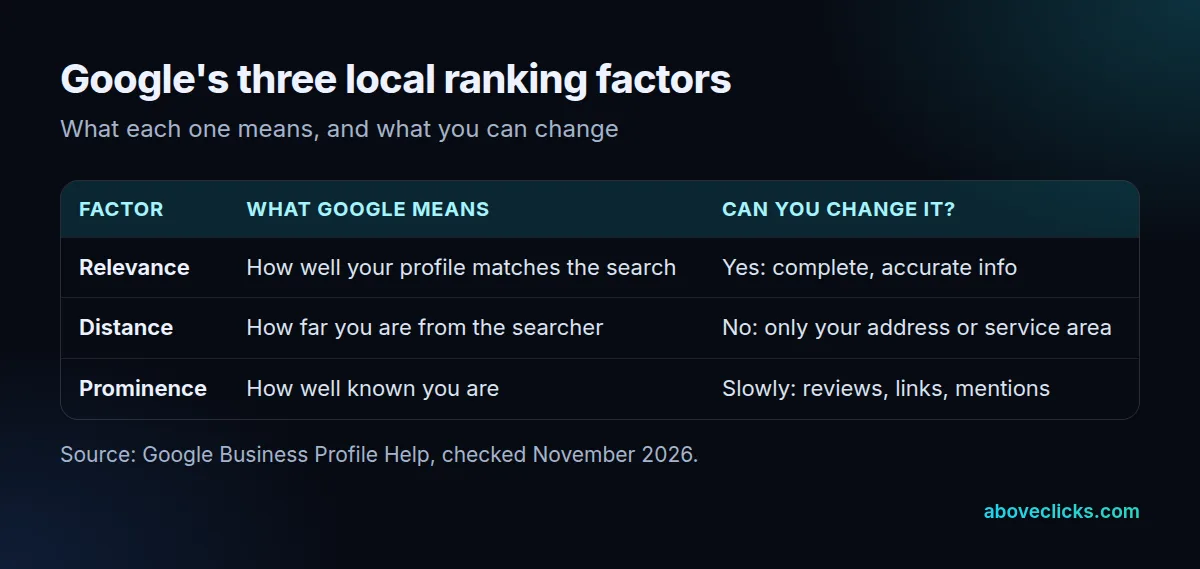
Relevance is how well your profile matches the search, so complete and detailed info helps. Distance is how far you are from the searcher; if they don’t share a location, Google uses what it knows about it. Prominence is how well known you are, and Google ties it to how many websites link to you and how many reviews you have.
Distance is the part owners worry about, and the reason to stop worrying. Why local SEO for small business rewards the two factors you control is easiest to see in a worked example: a plumber 2 to 3 miles from a searcher and a rival 8 miles away. The nearer plumber starts ahead on distance, but if the rival has a complete profile and more reviews, that lead can vanish. You cannot move your shop, so the useful work is on the other two factors, and that is the practical answer to why local SEO for small business still works when your address is fixed.
What should a small business fix first?
Here is why local SEO for small business is mostly a checklist: five gaps, fixed in the order below, each one free. The first two decide whether the rest can work at all, and step 2 takes about 20 minutes on a first pass.
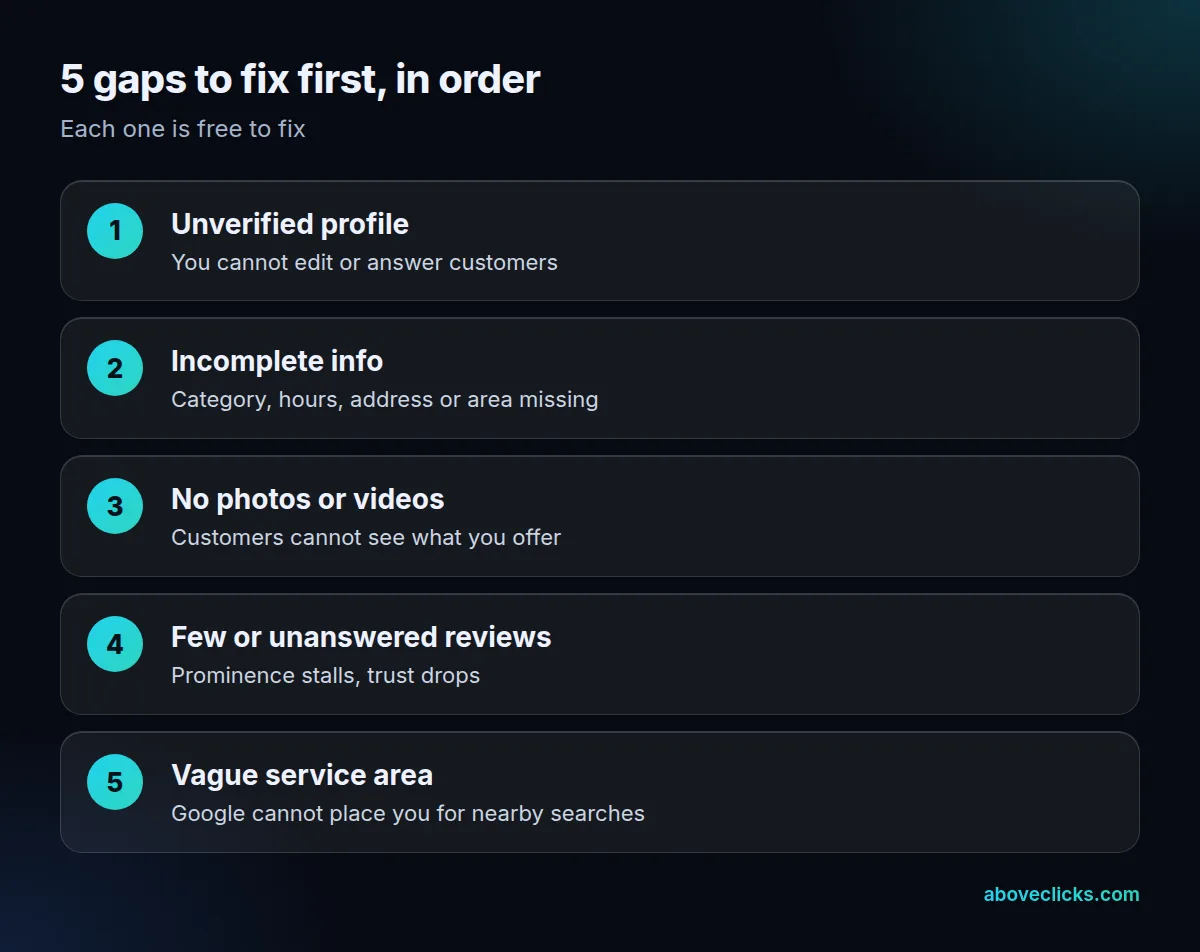
- Verify the profile. Google says you need to verify your business to edit its details and to interact with customers. The options depend on your business type and region, and Google picks them.
- Complete the info. Businesses with complete and accurate info are more likely to show up, according to Google. Add your address, hours, category and the services you offer.
- Add photos and videos. They show customers what you offer before they call.
- Ask for reviews, then answer them. You can share a Google link or QR code, and replying to reviews shows you value the feedback. Never pay for reviews: Google prohibits incentives, such as free or discounted goods, in exchange for reviews.
- State your service area honestly. Google’s business guidelines say a service-area business should have one profile with a designated service area, and a virtual office is only accepted if it is staffed during business hours.
A sensible pace for a one-person business: steps 1 and 2 in week 1, step 3 on days 8 to 14, step 4 from week 3, and step 5 checked once in week 4. Keep the same address and phone number in your profile and on your website. That consistency is a quiet part of why local SEO for small business works for owners who do little else.
Google’s LocalBusiness markup can describe your hours and address on the website, though Google does not promise that features using markup will appear. Treat it as a tidy-up for step 2, not a ranking trick.
Does every small business need local SEO?
No. Why local SEO for small business is not universal comes down to one thing: it fits businesses whose customers search for them by place or service, and it can be skipped by those whose work never comes from search.
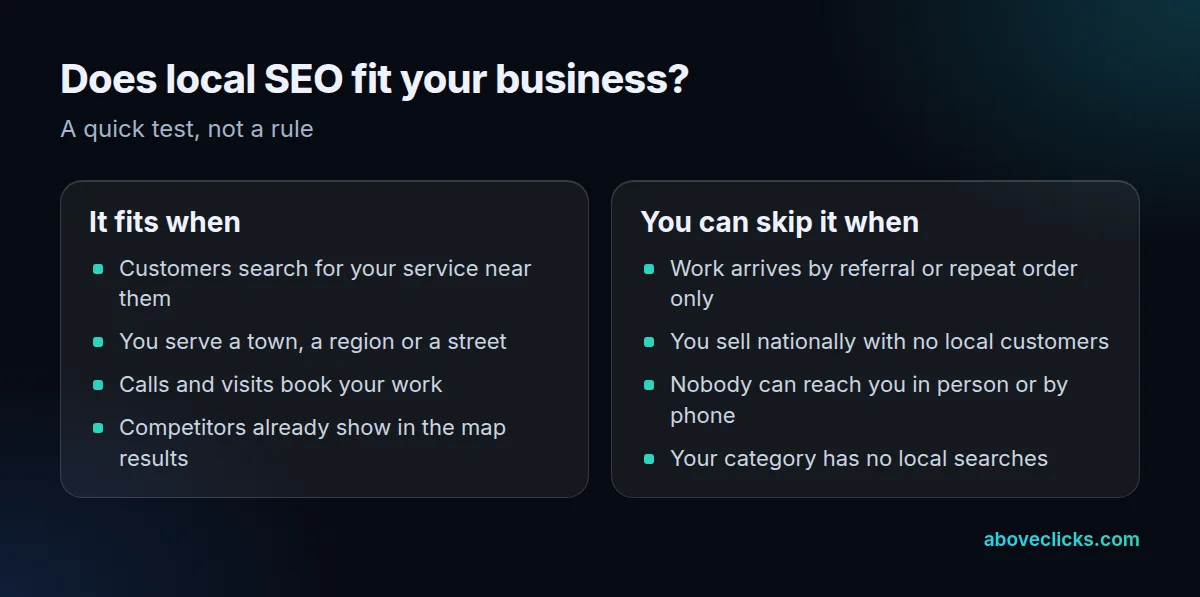
You can test your own case in 15 minutes. On your phone, search 3 phrases a customer might use: your service with your town, your service with “near me”, and your service with a nearby area. If competitors fill the map results each time, that is the plainest proof of why local SEO for small business belongs in your plan.
If you are on the right side of the figure, the cheapest next step is a self-check of your profile against the list above. If you are on the left, read the pieces on the average cost of local SEO and on local SEO packages before talking to anyone.
How long does local SEO take to work?
There is no fixed time, so judge it by your own numbers rather than a promise. That is why local SEO for small business feels slow at first. Profile fixes can show up quickly; reviews and prominence build over months.
Check progress in two places, because why local SEO for small business is worth it only shows in your own numbers. The Business Profile shows how people interact with it, and Search Console’s Performance report shows clicks and impressions from Google Search. Compare the same 12 weeks of last year, because trades are seasonal. If an agency gives you a number of weeks for first-page rankings, ask what the number is based on.
Reviews take the longest because they depend on customers. Ask every customer within 1 to 2 days of a finished job while the work is fresh, and keep answering new reviews so the profile looks lived in.
What mistakes make local SEO for a small business fail?
Most failures come from the profile and the follow-through, not from clever tactics. Three show up often, and each one is on the list above.
- Treating the profile as finished. Opening hours change, services change and holidays arrive. An out-of-date profile sends customers to a closed door, which hurts the trust that why local SEO for small business depends on.
- Chasing reviews the wrong way. Buying reviews or trading discounts for them breaks Google’s rules. Slow, genuine reviews from real customers are the only kind worth having.
- Reading only visits. Profile views feel good but pay nothing. Count calls, direction requests and booked jobs instead, and compare them with the same weeks last year.
None of this needs a tool or a budget, and none of it needs a technical background either. A phone and half an hour are enough to start, which is the simplest answer to why local SEO for small business suits owners with no spare staff. It needs one owner who checks the profile every 30 days and answers every review.
Is local SEO worth it for your business?
Yes, when customers search for what you do near them, you answer calls quickly, and you keep collecting genuine reviews. If any of the three fails, fix that first.
A short worth-it test:
- Search your service and your town on your phone. Do you appear in the map results?
- If not, which of the five gaps above is open?
- After 90 days of fixes, are calls, direction requests or website clicks higher than in the same weeks last year?
If the answer to the third question stays no, get a second opinion. Our local services marketing work starts with a free audit of your profile, ads and calls, and the free audit is the quickest way to see which gaps apply to you and whether why local SEO for small business applies to your trade. More guides are in industries.