How to evaluate a marketing agency comes down to one habit: score each one on the same weighted card. Do it before you sign and again after 90 days, so the decision rests on evidence, not on how well the pitch went.
This guide on how to evaluate a marketing agency gives you that 100-point card, shows how to check case studies instead of just reading them, explains the account-access test, and ends with a 90-day review and the red flags that end a shortlist.
How to evaluate a marketing agency with a scorecard?
To evaluate a marketing agency fairly, give every shortlisted one the same five parts and a fixed number of points per part, then add them up. The point of a scorecard is that two agencies get compared on the same terms, not on whoever presented better.
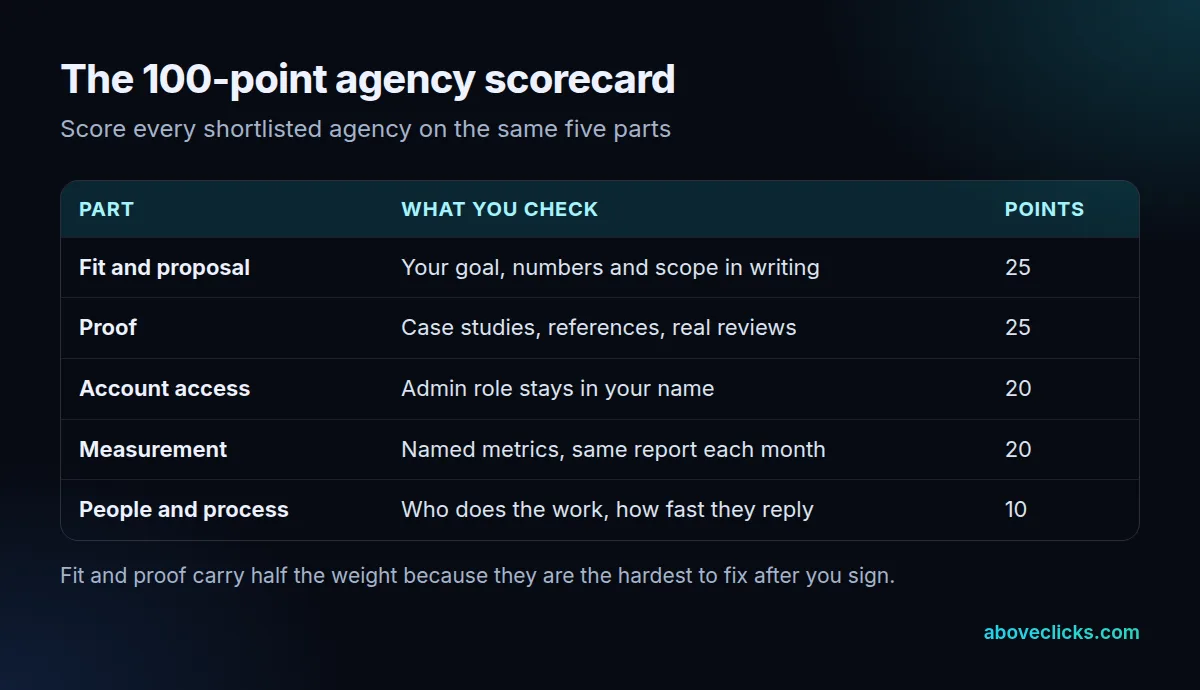
Fit and proof carry half the weight because they are hardest to fix once you have signed. Access and measurement carry 20 points each because they decide whether you can ever check the work. People and process carry 10, since a good process matters less than a good result but a slow, unreachable team can sink a good plan.
Use the same card every time you evaluate a marketing agency, whatever the channel. Score each part from the evidence you hold, not from what was said on a call. A claim without a document, a link or a reference scores half marks at most. If you have not written your questions yet, our guide to the questions to ask a marketing agency covers the first call; this guide covers what to do with the answers.
To evaluate a digital marketing agency in a channel you do not know well, use the same card, because it tests process and proof rather than tactics.
What should the proposal show?
When you evaluate a marketing agency proposal, look for your goal, in your numbers, with the scope and the exclusions written down. A proposal that could be sent to any store with the name changed should lose most of its 25 points, because it shows the agency did not evaluate your store before pitching.
How to evaluate a marketing agency proposal in practice: check five things, one point each time you can say yes, scaled to 25:
- It restates your goal in your words, such as a target for orders or leads, not “grow your brand”.
- It names the numbers it will report and says where each one comes from.
- It lists what is in scope and what is not, including who produces creative and who pays for tools.
- It says what the first 30 days look like, with dated steps.
- It explains how the fee is built, so you can compare it with the others. Our pricing models guide explains retainers, hourly work, commission and fixed projects.
No primary source publishes a market range for agency fees, and we do not invent one here. What you can do is compare the proposals you hold on the same terms: what is delivered each month, as a list, and what changes if the work grows.
Be careful with forecasts when you evaluate a marketing agency. Google’s own SEO Starter Guide says there is nothing that will automatically rank a site first, and that some changes take effect in a few hours while others could take several months. A proposal that gives an exact ranking or revenue forecast for month 2 is a reason to lower the proof score, not to be impressed.
What proof should you ask for?
The second part of how to evaluate a marketing agency is proof: case studies you can trace, a reference you can call and reviews that are real. Together they are worth 25 points, and each one only counts if you can check it.
For every case study, ask for four things in writing: the time period, the metric, the starting point, and what else changed in that period, such as a sale, a new product or a bigger budget. A result such as “revenue doubled” with no period and no baseline is a story, not a measurement.
Then ask to speak to the client behind it, because a call is the fastest way to evaluate a marketing agency’s claims. Prefer a client in your trade or at your size; a reference from a store that spends 10 times more tells you little. A good question for a reference is what the agency did when something went wrong, because that tells you more than a summary of the wins.
Reviews and testimonials need a second look when you evaluate a marketing agency. The FTC’s reviews and testimonials rule, effective October 21, 2024, covers fake or false reviews and testimonials. The FTC’s own questions and answers say a business that puts testimonials on its own website is disseminating them, which means it is responsible for whether they are real. That is a fair standard to hold an agency to: ask whether the quotes on its site come from named clients who agreed to be quoted.
We apply the same idea to ourselves. Our free audit is a written review of your Meta and Google Ads, Merchant Center, tracking and SEO, with the top 5 fixes ranked by impact, and no obligation to work with us. Read-only access or screenshots are enough. Whichever agency you choose, a sample of its real work before you sign is worth more than a pitch.
Who should own the ad, analytics and Search Console accounts?
You should, with the agency added as a user. When you evaluate a marketing agency, this is the easiest part of the card to test on day 1, because the platforms show who holds which role.
Ask the agency to work inside accounts you own, since you cannot evaluate a marketing agency’s results from accounts you cannot open. Then check the roles yourself:
- Google Ads: under Access and security, Google Ads Help says you can invite users with an access level and remove them later. It also warns that if an account has only one administrator, you may lose access to your tags if that person becomes unavailable, so keep at least 2 admins, one of them yours.
- Google Analytics: the Administrator role manages users and can grant any role, while the Viewer role can see data and settings. Per Analytics Help, 5 roles are available, so an agency that only needs reports does not need Administrator.
- Search Console: a property needs at least 1 verified owner, and delegated owners can be added and removed. Search Console Help explains both.
Score this part out of 20 like this: all three accounts in your name with you as admin is full marks; accounts where you are only a viewer is half; accounts under the agency’s login, with you receiving screenshots, is zero. If the agency also handles tracking, our tracking and analytics page lists what a clean setup looks like.
How do you compare two agencies side by side?
To evaluate a marketing agency against another, score each part separately, write the evidence next to the number, and compare the totals only after that. The table below is a worked example with two invented agencies, so you can see how the card behaves.
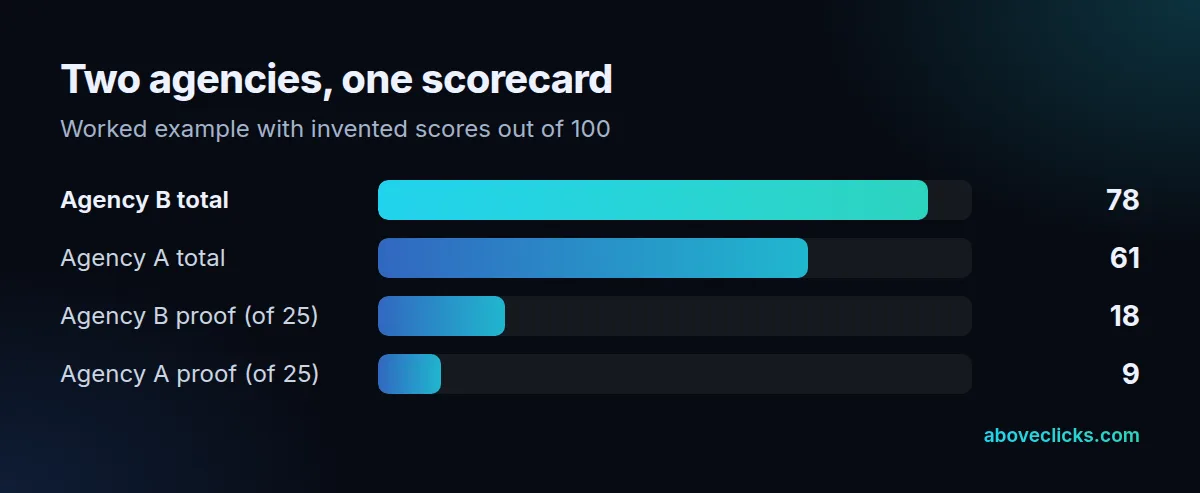
| Part (points) | Agency A | Agency B |
|---|---|---|
| Fit and proposal (25) | 20 | 17 |
| Proof (25) | 9 | 18 |
| Account access (20) | 8 | 20 |
| Measurement (20) | 14 | 15 |
| People and process (10) | 10 | 8 |
| Total (100) | 61 | 78 |
Agency A won the pitch: a polished proposal and a fast, friendly team. But its case studies had no periods or baselines, no client could be called, and the accounts ran under its own login. Agency B’s proposal was plainer, yet three of its results traced to named references and every account would sit in the store’s name. These scores are invented to show the method, not data from any real agency.
With this method you can evaluate a marketing agency in an afternoon. If two totals are within 5 points, decide on proof and access, not on price, because those are the two parts you cannot repair later. A free audit from each finalist is a cheap tie-breaker.
How do you evaluate marketing agency performance after you hire?
The second round of how to evaluate a marketing agency happens at day 90: re-score the same card at day 90, using the agency’s real work as the evidence. By then the first fixes and tests should have run, and the report should show what they did.
Each time you evaluate a marketing agency, write the evidence next to the score. At day 90, ask five questions:
- Did the first 30 days happen as the proposal said, with dates?
- Does the report use the metrics named in the proposal, from the sources named there?
- Do the numbers match what you can see yourself in the ad platform, analytics and your store?
- Can the agency explain at least one thing that did not work, and what it changed?
- Do you still hold the admin role on every account?
To evaluate a marketing agency’s results, read them against the same weeks last year, not only last month. For search, Google’s guide to traffic drops suggests setting the Performance report to the last 16 months and comparing a similar period, so seasonal swings are not credited to the agency or blamed on it.
Give it time where time is real. Google says changes can take from a few hours to several months to show in search, so judge a paid-ads test on weeks and an SEO plan on quarters. Use our sample report as a model of what a monthly report should contain.
When should you change agency?
Change when the day-90 score drops 15 points or more against the pitch, or a red flag appears that the agency cannot explain in writing. A lower score alone is a reason to ask for a plan, not to leave.
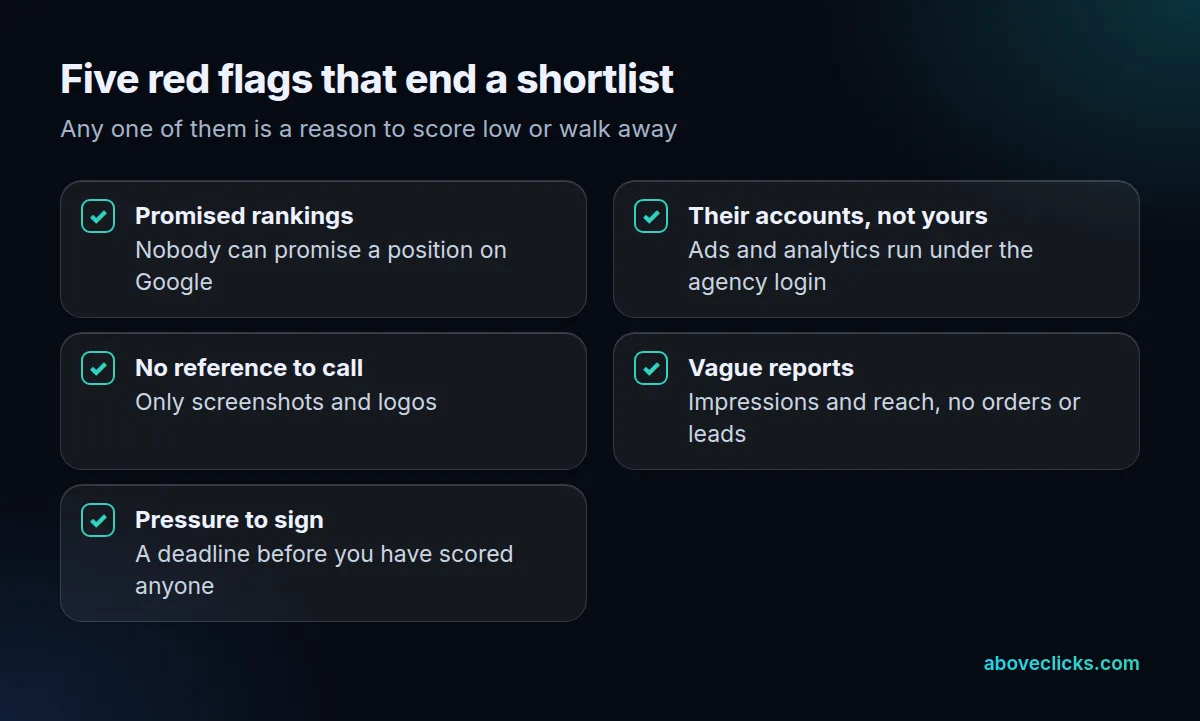
The red flags above are quick to check as you evaluate a marketing agency. Promised rankings contradict Google’s own guide. Accounts under the agency’s login make leaving costly. A missing reference means the proof was never tested. Vague reports hide whether orders or leads moved. Pressure to sign before you have scored anyone is a signal about how the relationship will run.
You can evaluate a marketing agency again at any point with the same card. Before you leave, read the contract for the minimum term, the notice period and the handover of accounts, content and the fix log. If your store needs a plan before you pick anyone, our ecommerce consulting service starts with the same audit-first approach. If you are weighing a different route altogether, in-house vs agency marketing compares hiring someone with hiring a team. More guides are in buying guides.