Convertibles vs SplitBase for Shopify CRO is a choice between two agencies, not two tools: one builds and ships its own test winners, the other leads with a data audit. Choose by your order volume, who ships the changes and which number gets reported.
This guide reads the two agencies from their own pages, so you can see what each one says it does, who it says it is for, and which checks to run before you sign either. Every figure about them below is a vendor claim, read on 8 November 2026.
What is the difference between Convertibles and SplitBase for Shopify CRO?
In Convertibles vs SplitBase, the first runs a continuous build-and-test program, and the second starts with a two-week audit and then a retainer for testing. Each is a Shopify CRO agency that sells conversion work to stores that already have traffic.
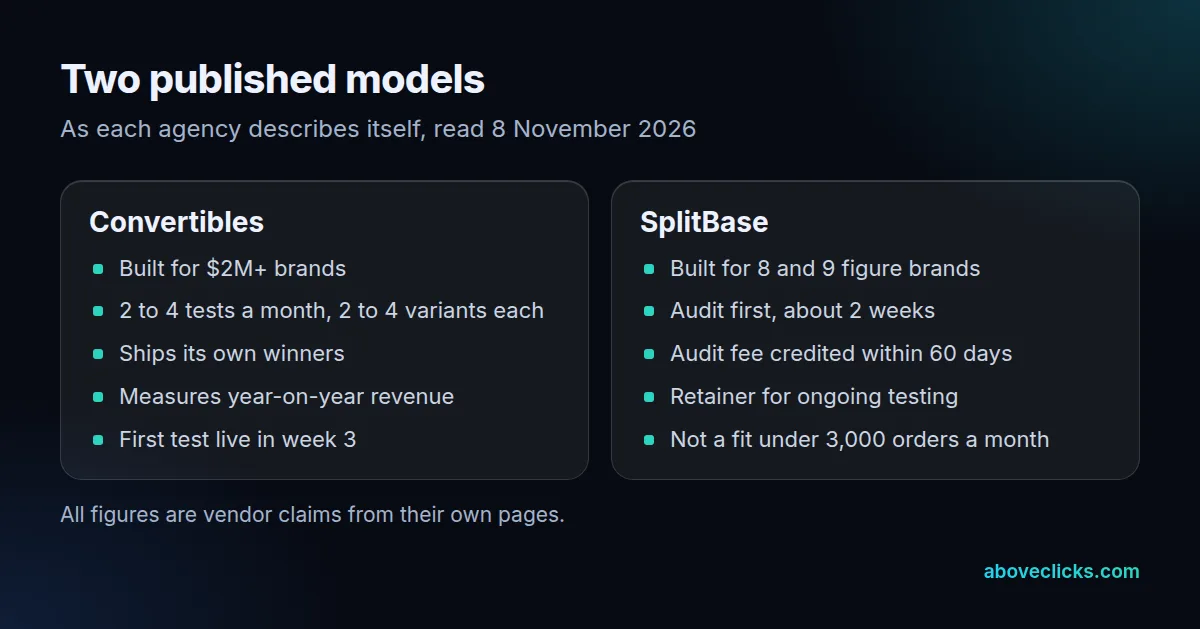
On its A/B testing page, Convertibles says it runs 2 to 4 experiments a month, with 2 to 4 variants per test, and owns both the test and the development work so winners ship in days. It says it reports year-on-year revenue growth rather than test win rate, and names Intelligems and its own TestBuddy tool as its testing tools.
SplitBase describes itself on its audit page as a brand-aligned CRO agency for 8 and 9 figure ecommerce brands. It organizes its research into three kinds, patterns, perception and proof, and the audit covers the first.
Neither appears in Shopify’s app store under that name, so treat both as service firms. If you want software to run tests yourself, that is a different purchase from hiring a Shopify CRO agency.
Which store size does each Shopify CRO agency say it fits?
Convertibles says $2M a year in revenue or more; SplitBase says at least 3,000 orders a month. Both also say they are not for stores with too little traffic to finish a test.
The Convertibles page lists three groups it is not for: brands under $2M a year or with low traffic, brands wanting a self-serve tool, and brands that want to optimize for test win rate. SplitBase’s FAQ says it is not a fit when a brand lacks stable traffic or has fewer than 3,000 orders per month, or when the brand sells to businesses rather than consumers.
In Convertibles vs SplitBase, those floors are the most useful facts on either site, because they are a published reason to say no. They also tell you something about the test length. At 3,000 orders a month, about 1,400 orders arrive in two weeks (3,000 × 14 ÷ 30), which is the same two-week cycle Convertibles says most of its tests need. That is simple arithmetic on their numbers, not a promise about your store.
If you sit below both floors, a CRO agency of this type is probably too early for you. The A/B testing glossary entry explains why a test needs enough visitors and orders to separate a real change from noise.
How does each agency run tests for Shopify CRO?
On Convertibles vs SplitBase for Shopify CRO testing, Convertibles tests continuously with its own developers, while SplitBase uses the audit to decide what to fix and what to test, then runs A/B tests, usually with 2 to 4 variants.
Convertibles’ home page shows its first 30 days: a kickoff call, wireframes within days, a build on a copy of your live theme, and the first test live in week 3. You approve each concept with a yes, no or maybe.
SplitBase’s FAQ says it sets a clear hypothesis, a minimum meaningful lift and decision rules before a test launches. A test only counts as a winner when it beats that lift with enough data. It also says it does not promise specific results.
Whichever you pick, the test itself should respect search. Google’s guide to A/B testing gives four rules:
- Do not cloak: show Googlebot the same pages users get. Google’s spam policies define cloaking as presenting different content to users and search engines to manipulate rankings.
- Use on alternate test URLs, pointing to the original.
- Use a 302 (temporary) redirect when you send users to a variant URL.
- Run the experiment only as long as necessary.
Ask any Shopify CRO agency how it follows those rules. A good answer takes one sentence.
Should you start with a CRO audit?
Yes, if you cannot yet say where visitors leave. An audit should check tracking first, then follow the buyer from the ad to the order confirmation.
SplitBase sells exactly this: a review of GA4, Shopify and heatmap data over about two weeks, ending in a live walkthrough. It says the fee is credited to your first month if you start a program within 60 days, and refunded if the walkthrough is not useful. Those are vendor terms, so get them in writing.
Convertibles folds its audit into the first step of its program, which it calls finding the money: an audit of your store, ads and data with opportunities ranked by impact.
When we review a store, we check GA4 revenue against Shopify revenue before we read any report, because a test cannot beat a number you cannot trust. Our free audit is a read-only PDF review, and our Shopify CRO and conversion rate optimization pages describe the work that follows.
Whoever audits you needs access. Shopify’s collaborator account rules let you approve a partner’s request with a request code and give it only the roles it needs, and access expires if the collaborator has not logged in for 90 days. Use that instead of sharing an owner login.
How should you read an agency’s case studies?
As the best results the agency can show, unless it also shows what a typical client sees. Both sites lead with big numbers, so ask for the range behind them.
As of November 2026, Convertibles says individual tests have produced $60K to $110K a month in extra revenue for brands at scale, and SplitBase shows results such as an extra $800,000 a month. These are the agencies’ own claims about large clients.
The FTC’s endorsement guidance is a useful yardstick. It says a note such as “results not typical” does not change how a results claim is read; the advertiser either needs proof that the result is typical or has to say what people generally get. So ask each agency what a typical client sees and over what time.
What do you keep if you stop?
In Convertibles vs SplitBase for Shopify CRO, as with any Shopify CRO agency, your data, your test plan and any designs or code built for your store should stay with you. Settle that before the first invoice, because it decides how hard it is to leave.
SplitBase’s audit page is a useful model: it says you keep the audit deck and the test plan either way, and that your own team can ship the fix-now list and run the tests in a tool such as Intelligems. Convertibles builds on a copy of your live theme, so for Convertibles vs SplitBase for Shopify CRO ask who owns that work and the test history if you part ways.
Four things to put in writing:
- Who owns the test results, the screenshots and the hypotheses.
- Who owns any code, sections or landing pages built for your store.
- How the collaborator access is removed on the last day. Shopify’s collaborator rules expire access after 90 days without a login, but do not wait for that.
- How much notice either side must give, and what is billed in it.
In a Convertibles vs SplitBase comparison, the agency that answers these without hesitation is usually one that expects to keep you through results, not through lock-in.
How do you choose in Convertibles vs SplitBase for Shopify CRO?
Score your own store on six checks, then ask both agencies the same questions in writing. The table below is the list we would use for any Shopify CRO agency, and it settles Convertibles vs SplitBase better than a feature list does.
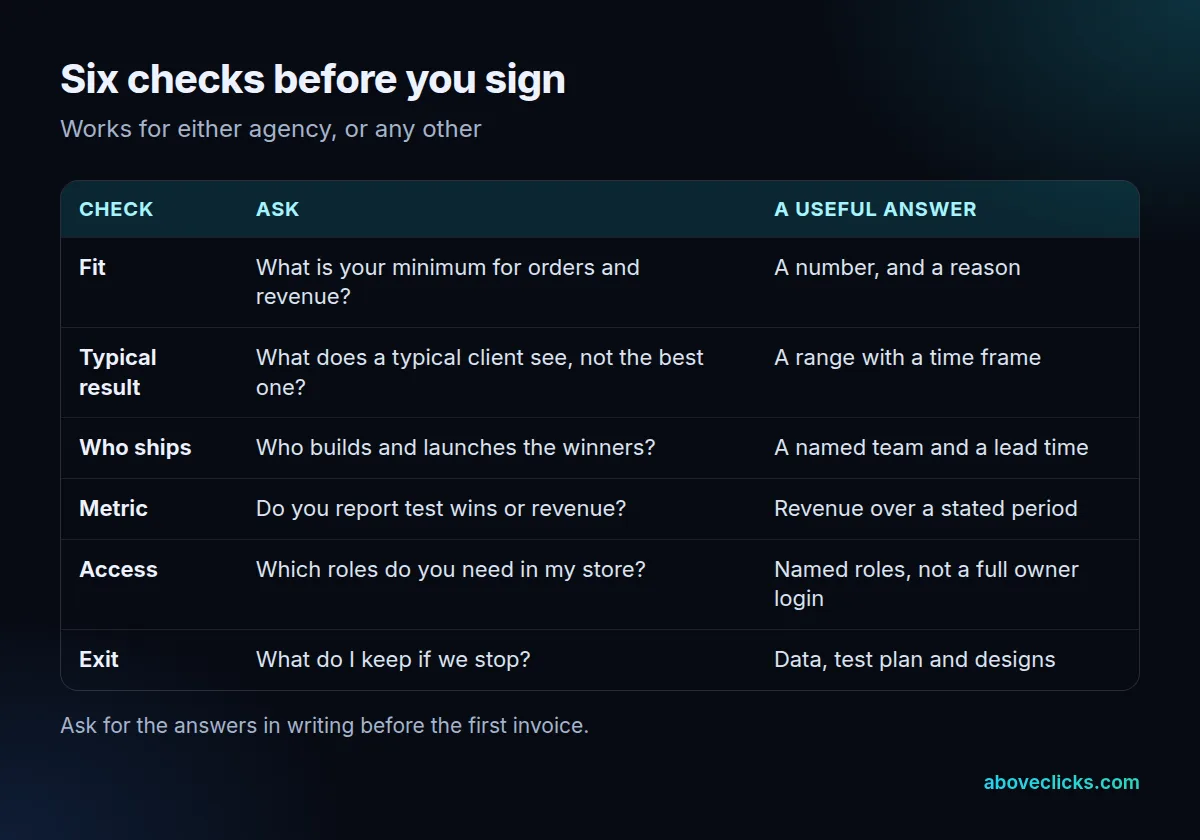
Worked example, with illustrative figures for a hypothetical Shopify store (not a client result). A store makes $5M a year from 2,200 orders a month. It clears the Convertibles revenue floor ($2M) but sits below SplitBase’s 3,000-order floor, so on published rules only one of the two is open to it. A second store makes $14M from 4,500 orders and clears both, so Convertibles vs SplitBase for Shopify CRO comes down to the questions above: who ships, which metric and what you keep.
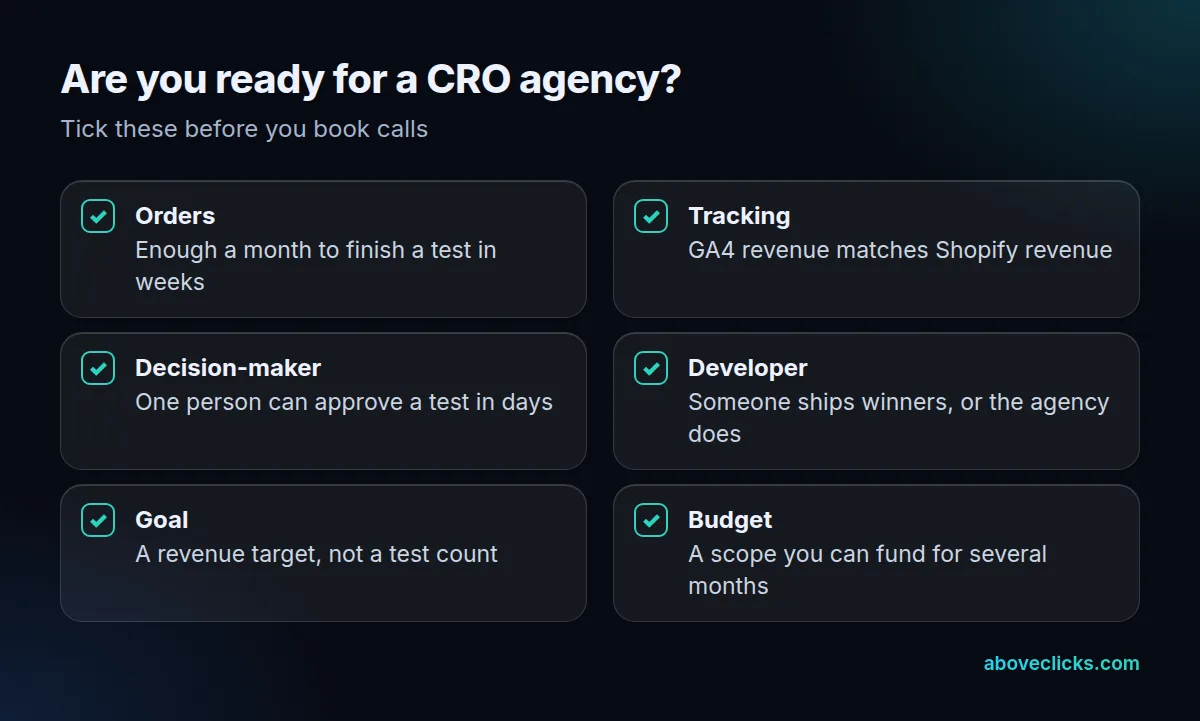
If several of those boxes stay empty, fix them before you pay any Shopify CRO agency. You can spend a few months on tracking and speed and still come out ahead, because tests run on bad data teach the wrong lesson. If you are deciding between an agency and hiring, the in-house vs agency guide compares them, and the pricing models guide explains retainers and the other ways CRO fees are billed. Neither agency publishes a price list we could find, so get a written scope and fee before the call about results.
More buyer guides are in buying guides.