A large language model (LLM) is an AI model trained on huge amounts of text to predict the next token, a word or part of a word, which lets it write, summarise and answer questions. Because it predicts likely text rather than looking facts up, it can sound certain and still be wrong, so its output needs sources.
A large language model (LLM) is an AI model trained on huge amounts of text to predict the next token, a word or part of a word, which lets it write, summarise and answer questions. It can sound certain and be wrong.
How does a large language model work, in simple terms?
It predicts text one piece at a time. Google’s ML Crash Course says LLMs “predict a token or sequence of tokens, sometimes many paragraphs worth of predicted tokens”, where a token “can be a word, a subword (a subset of a word), or even a single character”.

Training on enormous amounts of text gives it a sense of which tokens tend to follow which, across topics and languages. That’s why it can write a fluent product description or answer a question about returns: it has seen countless similar sentences. It hasn’t seen your product, so a 14-karat ring and an 18-karat ring look equally plausible to it.
Google’s LLM course frames the job the same way: a language model estimates “the probability of a token or sequence of tokens” occurring in a longer sequence.
Why do LLMs get facts wrong?
Because likely text and true text aren’t the same thing. Google’s course says it plainly: LLMs hallucinate, “meaning their predictions often contain mistakes”, and the original retrieval paper lists “updating their world knowledge” as an open problem for models without access to documents (Lewis et al., 2020).
We have our own evidence. The glossary pages in this run were drafted with a large language model, and on 17 October 2026 our checks against saved sources caught 5 confident, wrong statements in 18 drafts before any of them shipped.
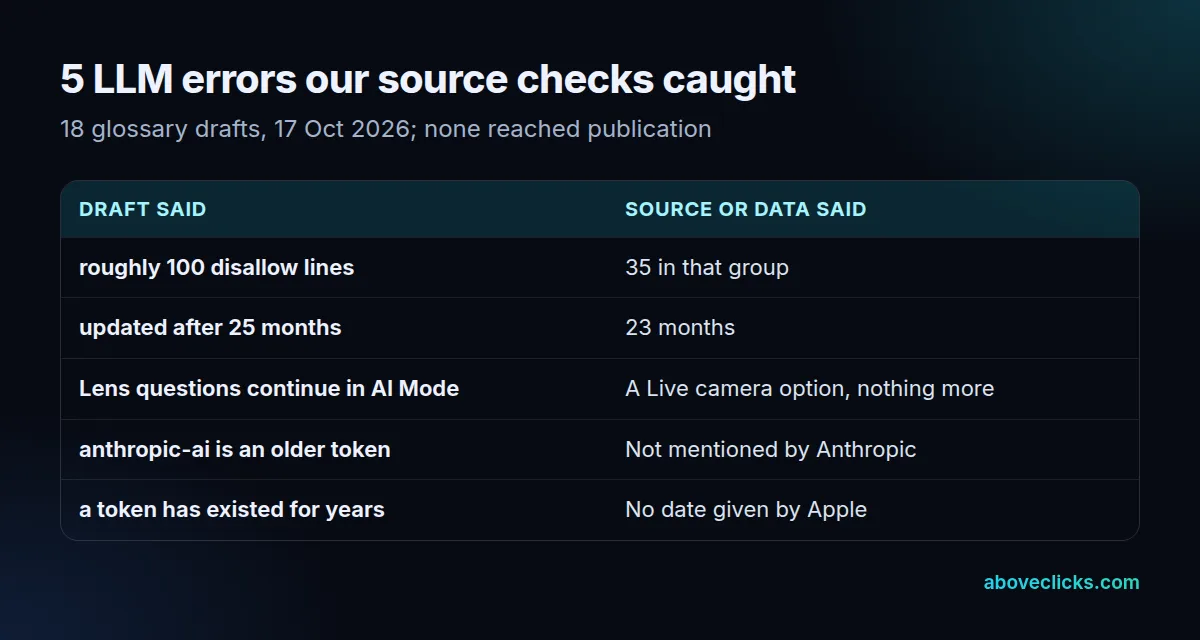
Each one was plausible: a count rounded up from 35 to roughly 100, a 23-month gap stated as 25, two claims no source made. None would have been caught by reading the draft alone.
Is an LLM the same as AI?
No. AI is the broad field; an LLM is one kind of AI model, the kind that works with language. Image generators, recommendation systems and fraud filters are AI too, but they aren’t LLMs. The “large” refers to size: Google’s course notes that training an industrial-strength LLM takes enormous amounts of expertise, computing power and time, which is why only a handful of companies build them from scratch. Most people now meet one through search: in Pew Research Center’s March 2025 data, 18% of Google searches already showed an AI-written summary (Pew).
Generative AI is the closer cousin: it covers models that create text, images or audio, and LLMs are its text branch. The AI search tools in this glossary combine an LLM with search, which is the retrieval step that lets them cite sources and use facts newer than their training data.
What does an LLM mean for a store?
Two things, both already visible in the 18 pages of this run. First, the AI tools shoppers use to research products are LLMs that search before they answer, so your pages are their raw material. Second, a large language model can draft your own content quickly, as long as someone checks every fact.
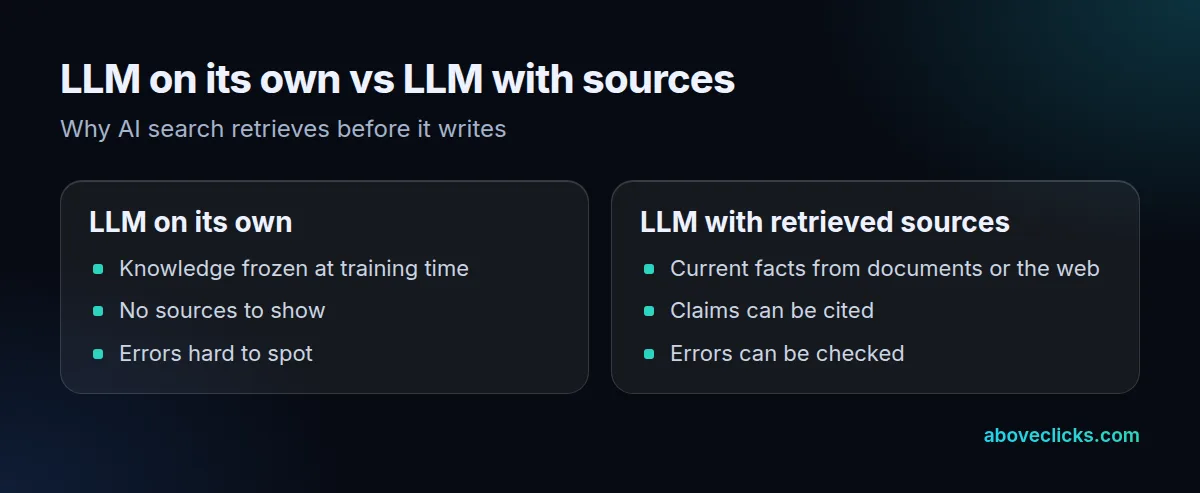
Our rule from this run: give the model sources, and check its output against them line by line. It took 5 corrections across 18 drafts, about 1 in every 4 pages. Our AI product descriptions service works that way, our AI consulting team scopes wider uses, and the AI search optimization hub covers how LLM-based search finds stores.