ChatGPT-User is the user agent ChatGPT uses when a person's request makes it visit a web page. It doesn't crawl the web on its own schedule, OpenAI says robots.txt rules may not apply to it, and it plays no part in deciding what appears in ChatGPT search.
ChatGPT-User is the user agent ChatGPT uses when a person’s request makes it visit a web page. It doesn’t crawl the web on its own, and OpenAI says robots.txt rules may not apply to it because a ChatGPT user started the request.
When does ChatGPT-User visit a page?
Only when a ChatGPT user’s question or action in ChatGPT, a custom GPT or a GPT Action leads it to your URL. OpenAI’s crawler overview says “ChatGPT-User is not used for crawling the web in an automatic fashion”.
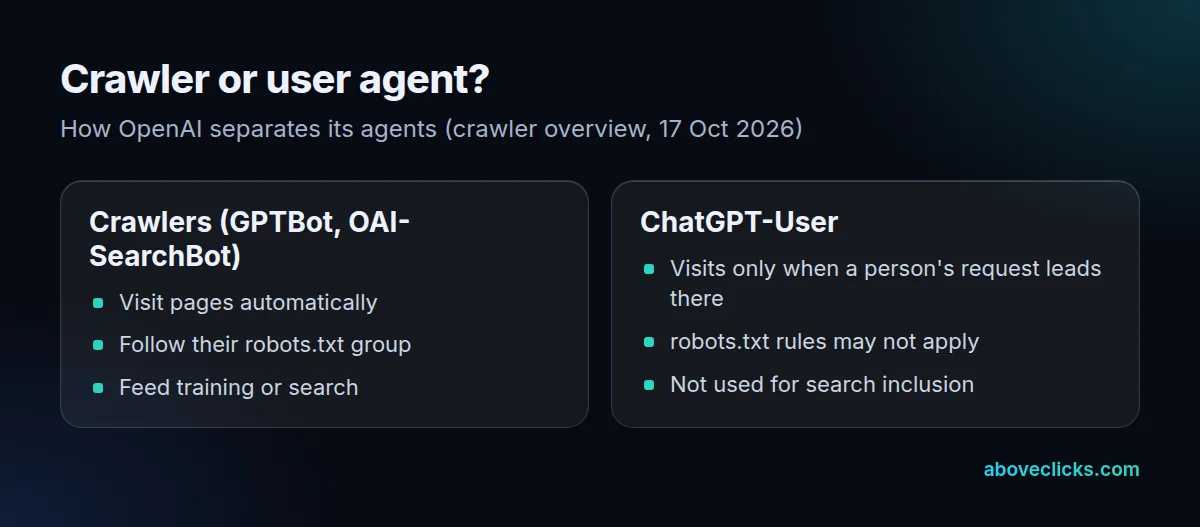
Its full user agent string currently ends in version 1.0 plus a link to OpenAI’s bot page. Of OpenAI’s bots, it’s the busiest by published infrastructure: 234 IP ranges against 39 for OAI-SearchBot. It also has no say in rankings: OpenAI states it “is not used to determine whether content may appear in Search”, and points site owners to OAI-SearchBot for search opt-outs.
Does ChatGPT-User follow robots.txt?
Not reliably, by design. OpenAI writes: “Because these actions are initiated by a user, robots.txt rules may not apply.” A Disallow aimed at this ChatGPT user agent is a request, not a lock.
Compare that with OAI-SearchBot, which OpenAI says needs about 24 hours to pick up a robots.txt change: that crawler follows the file, this agent may not. If you truly need to keep a page away from it, robots.txt isn’t the tool: use a login, or block the published IP ranges at your server or CDN. For a public product page that’s rarely wise, since the visit exists because a shopper asked about you.
How do other AI assistants handle user-triggered visits?
Each company sets its own rule for its user-triggered fetcher, and they don’t match. Among the OpenAI bots, only this one acts for a ChatGPT user in real time.

Perplexity’s docs say Perplexity-User “generally ignores robots.txt rules”. Anthropic says Claude-User “allows site owners to control which sites can be accessed through these user-initiated requests”, and warns that disabling it may reduce visibility. So one robots.txt line can mean 3 different things across 3 assistants. Their published IP lists differ just as much: on 17 October 2026 Perplexity-User had 4 ranges, Anthropic’s shared list 38 and ChatGPT-User 234.
For a store, the practical rule is the same for all three: like a ChatGPT user visit, these come from people asking about your products, so treat them like referrals, not like scrapers.
How do you spot ChatGPT-User in your logs?
Filter server or CDN logs for the ChatGPT user agent string, then confirm the IP. On 17 October 2026 OpenAI’s chatgpt-user.json listed 234 IPv4 ranges, 13 times as many as GPTBot’s 18. The file had been regenerated on 7 October, so fetch it fresh rather than copying it once.
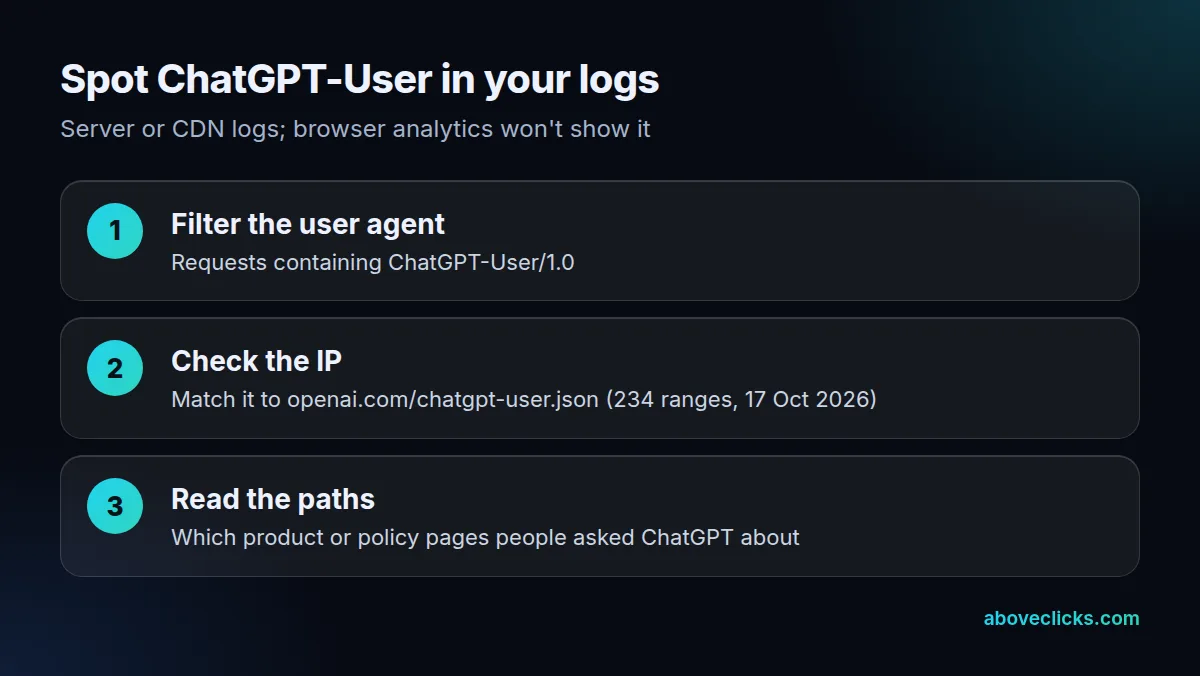
Browser analytics such as GA4 rely on the page’s JavaScript, so a server-side fetch like this one usually won’t appear as a session there; logs are the record. The paths it requests show which products people ask ChatGPT about, which makes the log a free, if partial, view of AI demand for your catalog. Our tracking and analytics service can set up that log view; for getting cited, see ChatGPT visibility and the AI search optimization hub.