Web design and SEO packages combine a website build with the SEO work that makes the new site findable: a page plan, clean structure, redirects and launch checks. A good package lists that SEO work phase by phase in writing, instead of promising an “SEO-ready” site.
This guide splits web design and SEO packages into the 5 phases of a website project, lists the launch traps that cost rankings, and helps you decide when to bundle the two and when to buy them separately. There are no prices here: the checklists work with any quote.
What should web design and SEO packages include?
A page plan based on what people search for, a URL and redirect map, mobile layouts with full content, fast templates, unique titles and a launch check. Anything less is a website with SEO settings, not a web design and SEO package.
Many builds stop at a plugin and a title field. The difference shows on launch day, when old pages need somewhere to point and the new site needs to be visible to Google straight away. Google itself calls a site redesign a great time to bring in SEO help, and adds that the earlier it starts, the better.
That’s why the written scope matters more than the label. Two web design and SEO packages with the same headline can differ by a whole phase of work, and the gap only shows after launch.
Ask any provider to fill in this list before you sign:
- Page plan: which pages exist, which searches each one targets, and which old page each one replaces. Start with your top 20 pages by traffic or sales.
- Redirect map: every old URL with its new URL, in a spreadsheet you keep.
- Mobile content: the same text, images and links on phones as on desktop.
- Speed budget: target Core Web Vitals for the main templates.
- Titles and headings: 1 unique title per page, written, not generated.
- Launch and aftercare: who checks the site on launch day, and for how many days afterwards.
What happens in each of the 5 phases?
Plan, design, build, launch and the first 30 days each carry their own SEO work. Website design and SEO packages that bunch it all into the build phase usually miss the redirect map and the aftercare.
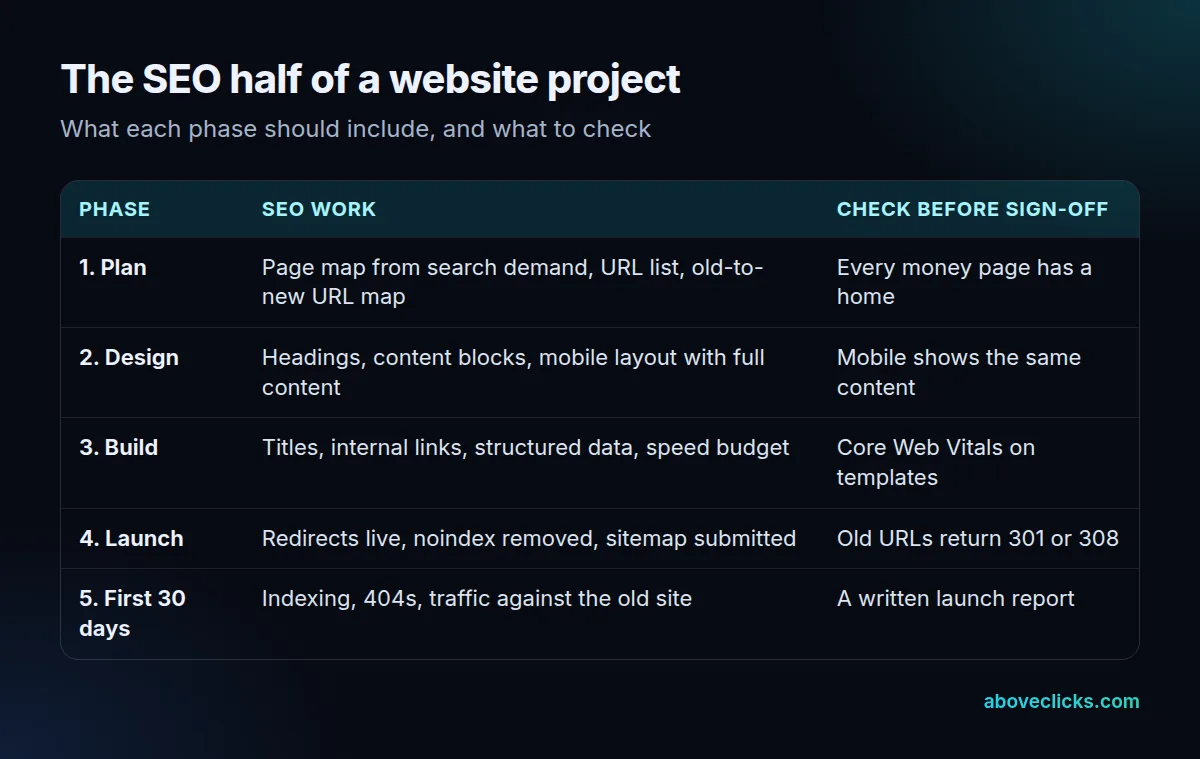
Plan. The page map decides what can rank, so it comes first in any web design and SEO package. Every product group, service or location that people search for needs a page. On a redesign, this is also when the old-to-new URL map is made, while the old site is still live and easy to crawl.
Design. Headings and content blocks decide how much text a page can hold. Google uses the mobile version of a site’s content for indexing and ranking, so a mobile design that hides text behind removed sections loses it for search too.
Build. Titles, internal links, structured data and speed are set here. Google advises a distinct, descriptive title for each page; boilerplate titles make two pages impossible to tell apart.
Launch. Redirects go live, the noindex rule comes off, and the new sitemap goes to Search Console.
First 30 days. Someone watches indexing, broken links and traffic, and compares them with the old site. A web design and SEO package without this phase hands you the site at the riskiest moment.
Which launch traps cost rankings?
A noindex rule left on from staging, missing or chained redirects, mobile pages with less content, and duplicate titles. Each is easy to prevent in a checklist and slow to fix after Google has recrawled.
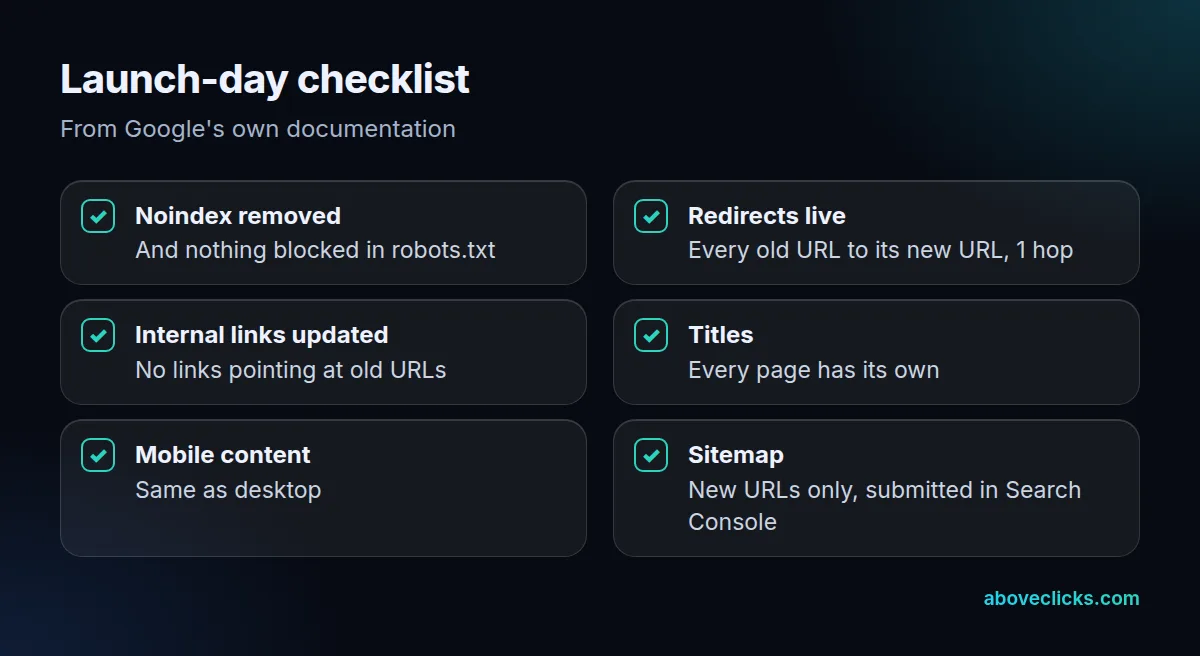
Noindex left on. Staging sites are often hidden with a noindex rule. If it survives launch, Google drops those pages. Google’s noindex guide adds 2 details that trip people up: a page blocked in robots.txt can’t have its noindex rule seen at all, and noindex inside robots.txt isn’t supported. Our glossary entry on noindex covers the rest.
Redirects. Google’s site-move guide recommends server-side permanent redirects, such as 301 or 308, from every old URL straight to its new one. Googlebot can follow up to 10 hops in a chain, but Google advises keeping chains to 3 or fewer and under 5. Keep the redirects for as long as possible, generally at least 1 year.
Thin mobile pages. If phones get a shorter version of a page, that shorter version is what Google indexes.
Duplicate titles. A template that gives 200 pages the same title wastes the strongest on-page signal you have.
The launch checklist is where website design and SEO packages earn their keep. Ask who runs it, on which day, and where the results are written down. If nobody is named, the checks usually don’t happen.
Do Core Web Vitals belong in the package?
Yes: speed is set by the templates, so it’s cheapest to get right during the build. Ask for targets in the contract and a test of the main templates before launch.
Web Vitals sets “good” thresholds for 3 metrics: Largest Contentful Paint within 2.5 seconds, Interaction to Next Paint of 200 milliseconds or less, and Cumulative Layout Shift of 0.1 or less. They’re measured at the 75th percentile of page loads, split by mobile and desktop, so a fast office laptop isn’t a fair test.
What to write into website design and SEO packages:
- Target thresholds for the home, category or service, and product or article templates.
- A test on a mid-range phone before launch, not only on a desktop.
- Image sizes and formats agreed up front, so editors can’t undo the speed work after launch.
Speed targets also protect you later: web design and SEO packages that put thresholds in the contract give you something to measure the handover against.
If an existing site already struggles, our Core Web Vitals optimization work fixes templates without a full rebuild.
What should happen in the first 30 days?
Daily checks for the first week, then weekly: indexing, 404 errors, redirects and traffic compared with the same weeks on the old site. The aim is to catch problems before Google settles on them.
A simple 30-day routine:
- Day 1: crawl the old URL list and confirm each returns a 301 or 308 to the right new page, in 1 hop.
- Days 1 to 7: check Search Console daily for pages excluded by noindex, and for new 404 errors.
- Weeks 2 to 4: compare clicks with the same weeks before launch, page by page for the top 20 pages.
- Day 30: a written launch report listing what was fixed and what’s still open.
Google notes that 301 and other permanent redirects don’t cause a loss in PageRank, so a complete map protects the links your old pages earned. When we review a launch, we start with exactly that: the old URL list against the redirect map, then indexing in Search Console, using read-only access. Our SEO migration service runs this routine for platform moves. Whoever runs it, the 30-day watch belongs inside the web design and SEO package, not in a separate quote you’re sent after something breaks.
How much do web design and SEO packages cost?
It depends on the number of templates and pages, whether content is written for you, and whether old URLs must be redirected. We don’t quote ranges here, because a figure without your page count is a guess.
Three scope questions move a quote most:
- Templates: a 5-template brochure site is a different build from a store with 12 templates and filters.
- Content: writing 30 new pages costs more than moving the text you already have.
- Migration: a site with years of rankings needs a full redirect map; a brand-new domain doesn’t.
Compare 2 quotes for web design and SEO packages by asking each provider to fill in the 5-phase table. A web design and SEO package that leaves the first 30 days blank is cheaper for a reason. Our web development page shows our own starting price cards.
Should you bundle web design and SEO, or buy them separately?
Bundle when one team builds a new site with nothing to protect; buy separately when the site already ranks, the move is complex or you need content every month. The job decides, not the bundle discount.
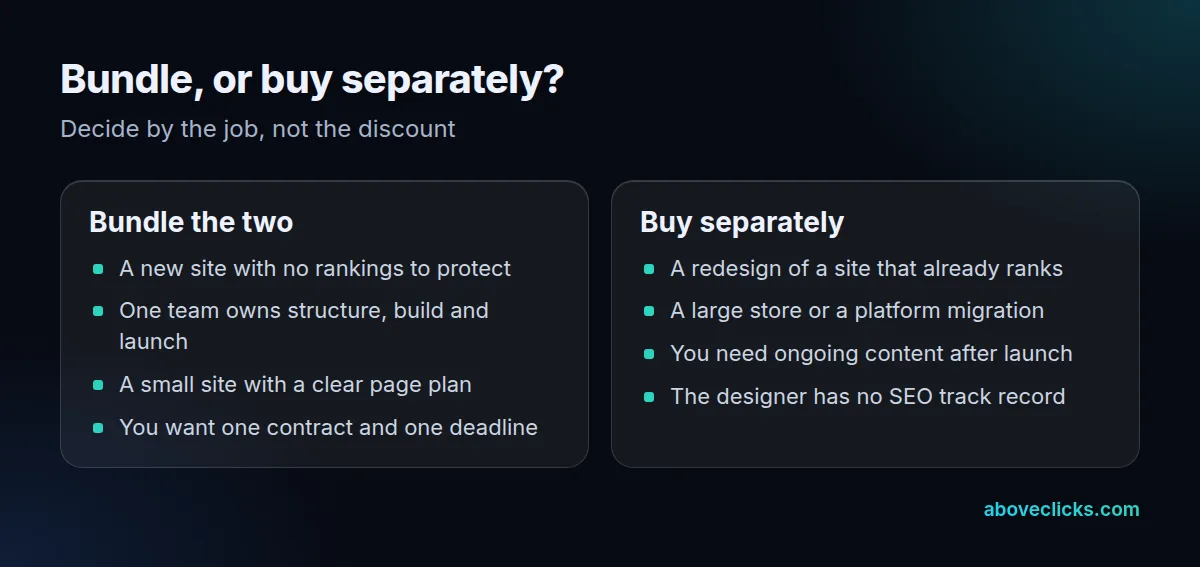
The biggest reason to separate the two is a redesign of a site that already earns traffic, especially one with 3 years or more of rankings and links. There, an SEO specialist who owns the redirect map and the launch check is cheap insurance. For a brand-new site, a single team that understands both is usually faster, and website design and SEO packages from one provider avoid the hand-offs where details get lost.
A middle route works too: one provider builds, and an SEO specialist reviews the page plan, the redirect map and the launch check at 3 fixed points. That keeps a web design and SEO package affordable while putting an expert on the riskiest steps.
Whichever route you take, keep the redirect map, the Search Console ownership and the launch report yourself. If you’d like a second pair of eyes on a planned redesign, our free audit reviews the current site with read-only access before anything moves. More guides are in buying guides.