Shopify website development cost is the one-time build plus the recurring plan, theme, domain, apps and payment fees that keep a store running. Shopify publishes most of the recurring numbers, while the build and any migration come from a developer’s quote.
This guide separates the two so you can check what is published yourself, then shows a first-year cost sheet, a break-even test for plan upgrades and a checklist for comparing quotes. All Shopify figures are in US dollars as of October 2026.
What is included in Shopify website development cost?
Six lines: the build, a theme, a plan, a domain, apps and payment fees. The first is a quote from a developer; the other five have numbers you can look up, starting with the 4 plans on Shopify’s pricing page as of October 2026.
| Cost line | When you pay | Who sets the number |
|---|---|---|
| Build or customization | Once | The developer’s quote |
| Migration from another platform | Once | The developer’s quote, or your own time |
| Theme | When you buy it | Shopify’s theme store listing |
| Plan | Every month | Shopify’s pricing page |
| Domain | Every year | The extension you pick, in Shopify’s domain generator |
| Apps and payment fees | Every month | App developers and Shopify’s card rates |
Treat the two halves differently. Published lines can be checked in ten minutes and move only when Shopify changes them. Quoted lines vary by developer, so the only protection is a written scope.
The same split explains why broad dollar ranges mislead. A range for Shopify website development cost mixes a $29 plan with a custom build, and neither number tells you what your store needs. We do not publish a market range here, because it would be out of date within months.
How much does it cost to build a Shopify store?
It costs the sum of the published lines plus one quote, so the honest answer is a formula, not a range. Nobody can publish a build quote for your store without seeing its catalog, theme and features.
Here is the shopify store setup cost for an invented store, using the cheapest published options. The apps line is an assumption, because app developers set their own fees.
| Line | Worked example | First-year cost |
|---|---|---|
| Plan | Basic, billed yearly: $29 × 12 | $348 |
| Theme | One paid theme, listed at $320 | $320 |
| Apps | 4 apps at $15 a month, assumed: $15 × 4 × 12 | $720 |
| Subtotal | Before domain, build and payment fees | $1,388 |
Now add your quote. With a $2,000 quote from a developer, the first year comes to $3,388 before the domain and payment fees. Replace each row with your own plan, theme and app list and the formula still works.
What the quote covers decides whether the sheet is complete. A launch should include payments, shipping zones, taxes, legal pages, analytics and ad pixels, Search Console, a clean collection structure and redirects from any old domain. Leaving those out lowers the quote and raises the real Shopify website development cost, because fixing them after launch takes longer than setting them up first.
What does the Shopify plan cost each month?
As of October 2026, Basic is $29 a month billed yearly, Grow is $89, Advanced is $359 and Plus starts at $2,300, according to Shopify’s pricing page. Billing monthly instead of yearly costs more on the first three.
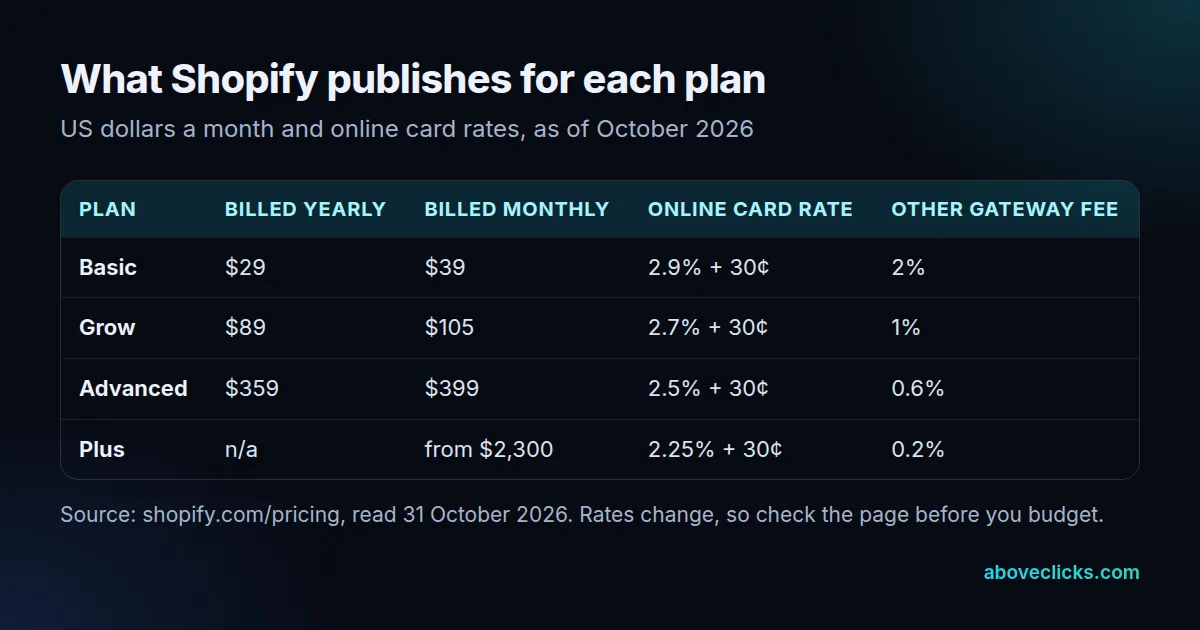
As of October 2026, the same pricing page offers a free 3-day trial, then $1 a month for the first 3 months before standard fees begin. That promotion is not part of the long-run cost, so budget with the table.
Higher plans lower the card rate, which makes the choice a volume question. As of October 2026, per the pricing page, Grow costs $60 a month more than Basic when billed yearly and takes 0.2 points off the online card rate, so it breaks even at $60 ÷ 0.002 = $30,000 a month in card sales. The step from Grow to Advanced costs $270 more for the same 0.2 points, which breaks even at $135,000.
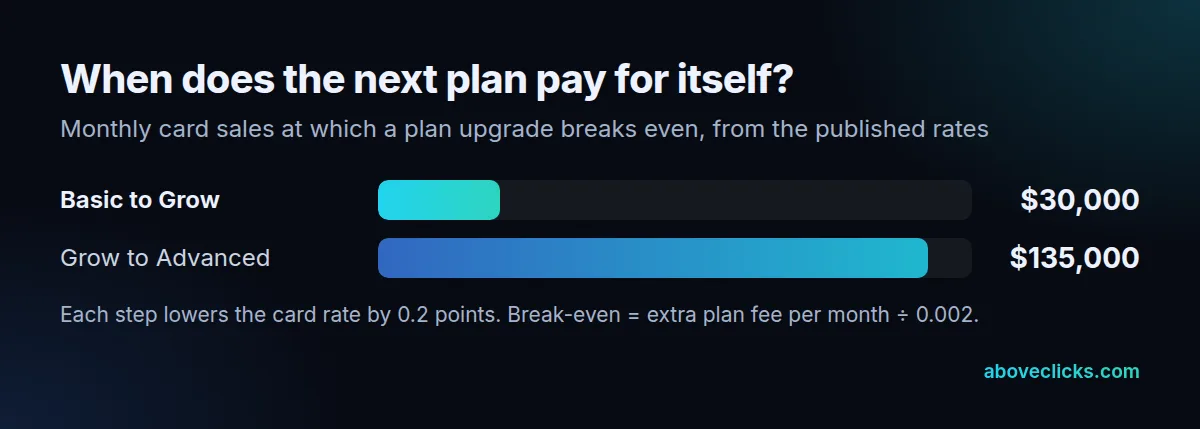
Below those volumes, the cheaper plan wins on fees alone. Staff accounts or reports can still justify an upgrade, but count them separately. Plan choice is the part of Shopify website development cost you can change later without rebuilding anything.
How much does a Shopify theme cost?
Free themes exist, and paid themes were listed at $280 to $420 on the Shopify Theme Store home page in October 2026. A shopify theme cost is only the starting point, because the theme still needs your products, tracking and edits.
Most stores should customize a well-built theme rather than commission one from scratch. It is faster, cheaper and easier to keep updated when the theme maker releases a new version, which is why we usually take that route on our Shopify development projects.
A full custom theme is the exception. It makes sense for a brand with a layout no theme can reach, and it should be quoted separately, with a designer, rather than folded into a build line. It is the line that moves Shopify website development cost the most, so ask for it as its own number.
Our published timing for a customization project is the scope within 2 workdays, the build in 2 to 4 weeks depending on size, then testing, launch and handover in the final week. Ask any developer for dates that specific.
What do apps, a domain and payment fees add?
Apps add a monthly fee set by each app’s developer, a domain adds a yearly fee set by its extension, and payment fees add a percentage of every order. All three keep running after launch, so in year two they weigh more in Shopify website development cost than the build does.
For apps, Shopify’s app guide says apps with the Built for Shopify badge cannot decrease your storefront speed by more than 10 performance points. Apps using Shopify App Pricing are billed on your Shopify invoice, so one bill lists them. Before adding an app, ask whether the theme can already do the job.
For the domain, Shopify’s domain help says the cost depends on the extension you choose, so check the domain generator for your exact name.
Payment fees are the line owners forget. Example, as of October 2026, using the online card rates on Shopify’s pricing page: an invented store takes 300 orders of $80 a month on card. The result:
| Plan | Fee on one $80 order | Fees on 300 orders |
|---|---|---|
| Basic | 2.9% × $80 + $0.30 = $2.62 | $786 a month |
| Grow | 2.7% × $80 + $0.30 = $2.46 | $738 a month |
As of October 2026, per the published rates, Grow saves $48 in fees but costs $60 more in plan fees, so Basic is cheaper at this volume.
When does custom development raise the cost?
When the store needs behavior no theme or public app provides. The biggest jump is custom apps with Shopify Functions, which Shopify says only Plus stores can use, while public apps that contain Functions work on any plan.
That makes the shopify developer cost for a custom discount, shipping or payment rule more than the build: Shopify Functions rules written as a custom app also need a plan from $2,300 a month as of October 2026, per the pricing page. Ask whether a public app can do the job first.
Developers build and test in dev stores, which Shopify describes as testing environments they own and control, created from a Partner account. We also build changes on a duplicate of your live theme and publish only after you approve, with the old theme kept as a backup. A quote should say how changes are tested before they go live.
Keep the maintenance line in view too, because it is the part of Shopify website development cost that repeats every month. A store that keeps changing needs monthly Shopify maintenance or a block of developer time, and a quote that ignores it understates the second year.
How do you compare a Shopify developer cost quote?
Compare what each quote lists, not its total. Two quotes with the same total can cover different amounts of work if one leaves out migration, tracking or handover, and that gap is where Shopify website development cost grows after signing.
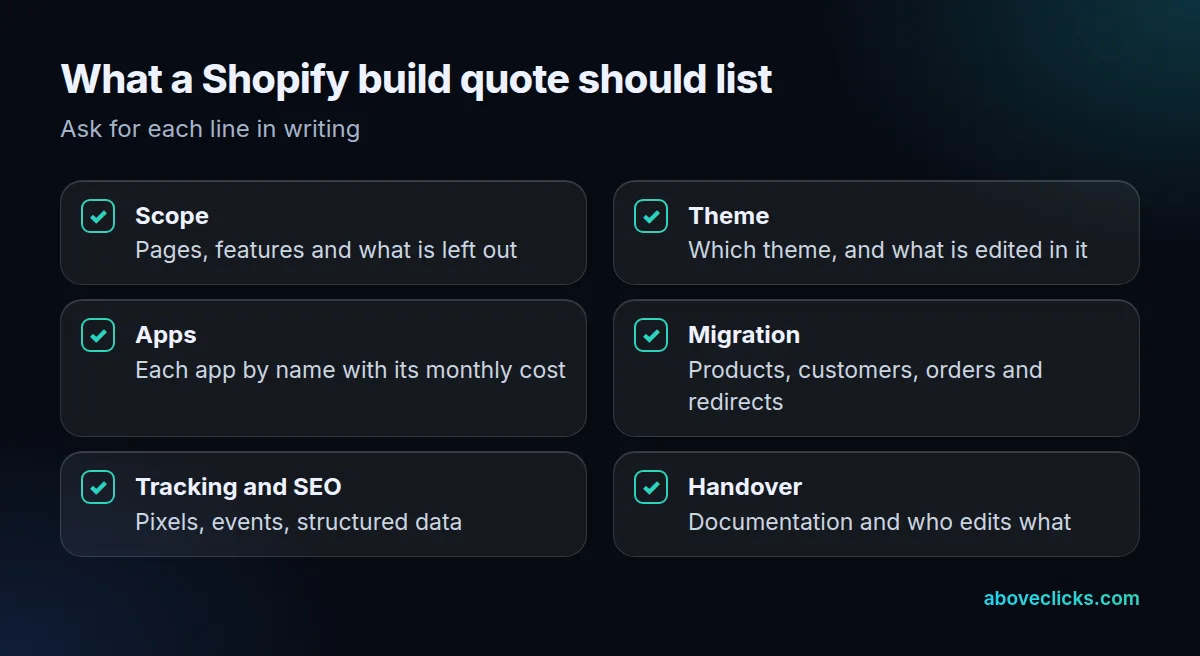
Shopify’s Partner directory lets you refine partners by price, location and services, and notes that the partners work independently. That means no two quotes are built the same way, so use the checklist above to put them side by side. When one shopify developer cost is far below the others, look first for the line it left out.
Migration is the line that varies most, and it belongs in any honest Shopify store setup cost. Shopify’s migration guide lists 5 routes, from copying content by hand to a custom migration through the API, and says a catalog of 250 products likely needs a CSV import or a migration app. Our Shopify migration page covers redirects and tracking, which a quote should name. If you are still choosing a platform, our Magento vs Shopify guide compares the upkeep.
Our starting prices for store builds and monthly development are on the service page, and your exact cost is fixed in writing before work begins. For a second opinion on a quote you already hold, send your store to our free audit. More guides are in buying guides.