Metaobjects are custom record types in Shopify, such as a size chart, an FAQ or an ingredient, each with its own fields and entries. Products, collections and pages point to those entries through metafields, so one entry can be edited once and shown in many places.
Metaobjects are custom record types in Shopify, such as a size chart, an FAQ or an ingredient, each with its own fields and entries. Products, collections and pages point to those entries through metafields, so one entry can be edited once and shown in many places.
What is the difference between metaobjects and metafields?
A metafield adds one field to something Shopify already has, like a product. A metaobject is a new kind of record, with up to 40 fields, that metafields can point to.
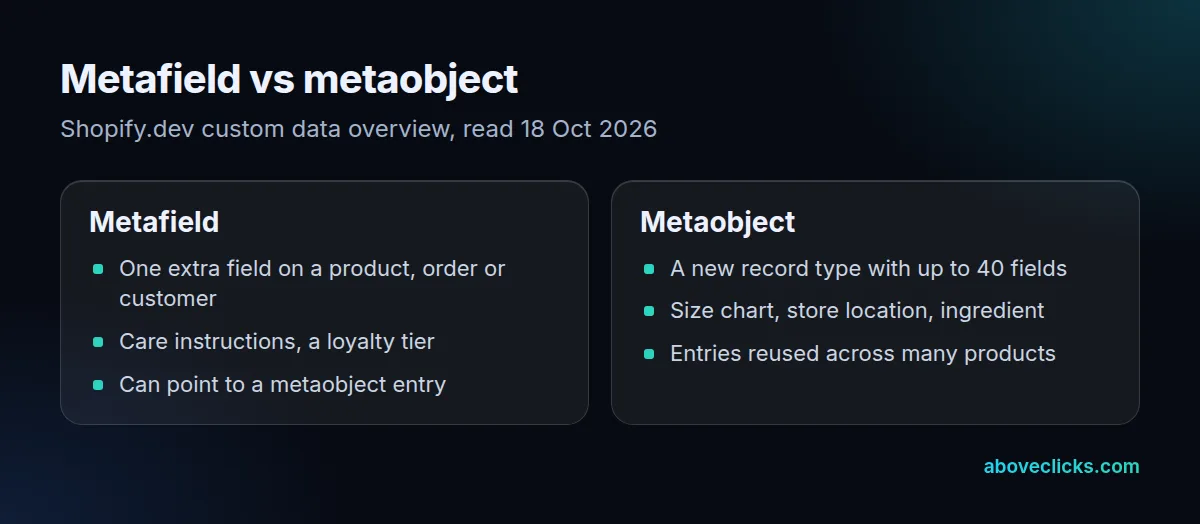
Shopify’s metaobjects help page draws the line simply: “If your data is best represented by multiple fields, you can use a metaobject to create an object with multiple fields.” Each one has two parts. The definition, set in Settings > Custom data, names the fields and their types. The entries, kept in Content > Metaobjects, hold the actual content. Fields can carry validation rules, such as character limits, minimum and maximum values or preset values, and one field serves as the display name that labels each entry in the admin.
The custom data overview notes that most builds use both: a metaobject defines the record and a metafield attaches it to the products it applies to. A list metafield can reference up to 1,024 metaobject entries.
What are some Shopify metaobject examples?
Shopify’s own docs name product highlights, FAQs, event appearances, size charts, store locations, ingredients and product reviews. Its product taxonomy also runs on metaobjects: category metafields such as colour take their values from metaobject entries.
The category metafields page shows why that matters: rename the colour entry black to graphite and every variant using it updates, and colour entries can drive swatches.
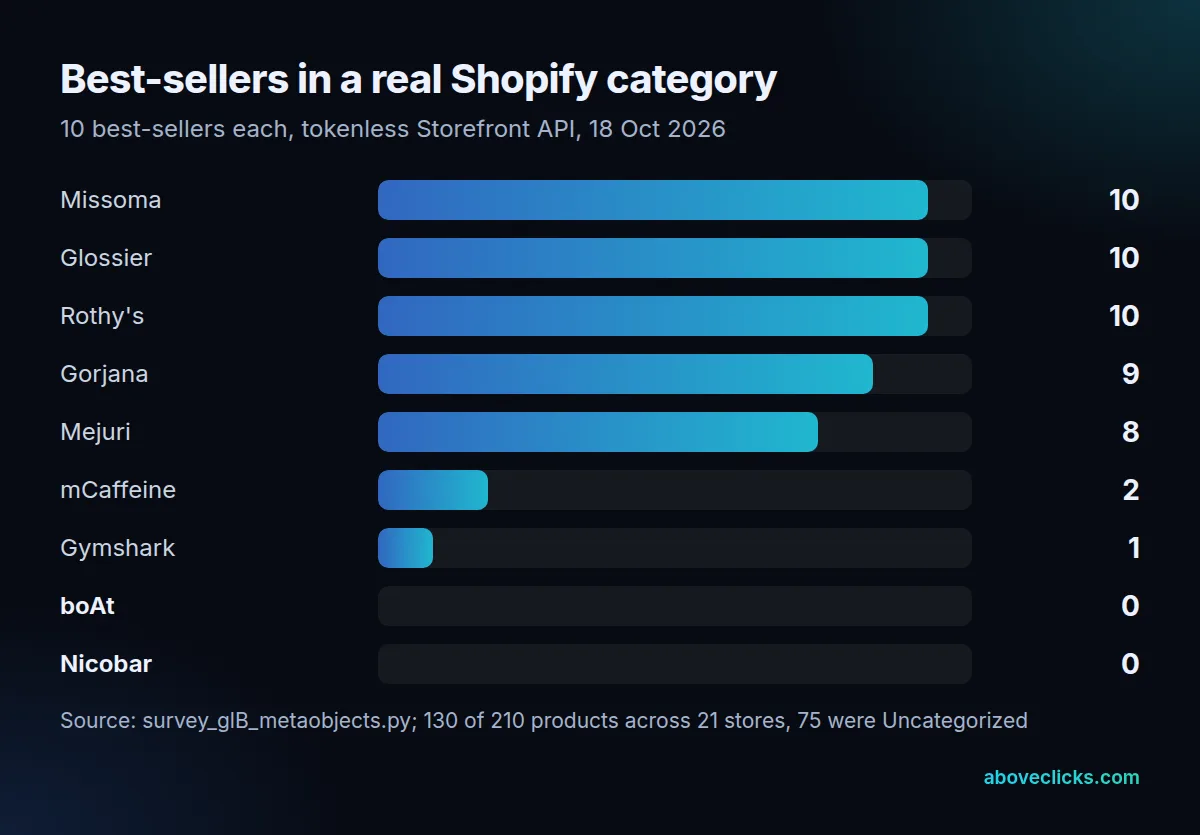
On 18 October 2026 we asked 21 live stores’ Storefront APIs for the category of their 10 best-sellers. 130 of 210 products sat in a real Shopify category; 75 came back Uncategorized. Yet none of 23 collection pages we read filtered on category metafields, so the metaobject-backed attributes mostly sit unused.
What are the metaobject limits?
Basic, Shopify and Advanced plans get 128 metaobject definitions and Plus gets 256, each definition takes up to 40 fields and 1,000,000 entries, and each app can add 128 definitions of its own.

The tighter limits are on the page, per the metaobject limits page. A Liquid loop over a metaobject list returns only the first 50 entries without the paginate tag, a paginated page holds 250, and a page render can look up only 20 handles of one type. Headless storefronts also need a token: in our test, all 21 stores refused a metaobjects query sent without one.
Example (a hypothetical skincare store): it keeps 45 ingredient entries, each with a name, a role and a source, shared across 120 products. A product page lists its 6 ingredients and an ingredient guide lists all 45, both under the 50-entry loop. At 300 ingredients the guide needs paginate, or it quietly stops at 50. Our Shopify development service designs metaobject models like this and builds the theme sections that display them.