Metafields are custom fields that add your own data to Shopify objects such as products, variants, customers and orders. Each one follows a definition with a name, a namespace and a type, so a store can show care instructions, filter by material or feed data to apps.
Metafields are custom fields that add your own data to Shopify objects such as products, variants, customers and orders. Each one follows a definition with a name, a namespace and a type, so a store can show care instructions, filter by material or feed data to apps.
What can you store in a metafield?
For facts Shopify has no field for: care instructions, dimensions, a size chart, a customer’s loyalty tier. Once defined, the same value can appear in the theme, in filters, in checkout logic and in reports.
Shopify’s metafields help page puts it in one line: “Metafields allow you to extend an existing platform data model, such as products, customers, and orders with your own custom data.” Every metafield should start with a definition, which gives it a typed editor, validation and a place in search and filters. The custom data overview warns what happens otherwise: “An undefined metafield is stored as a plain string that merchants can’t search or validate.”
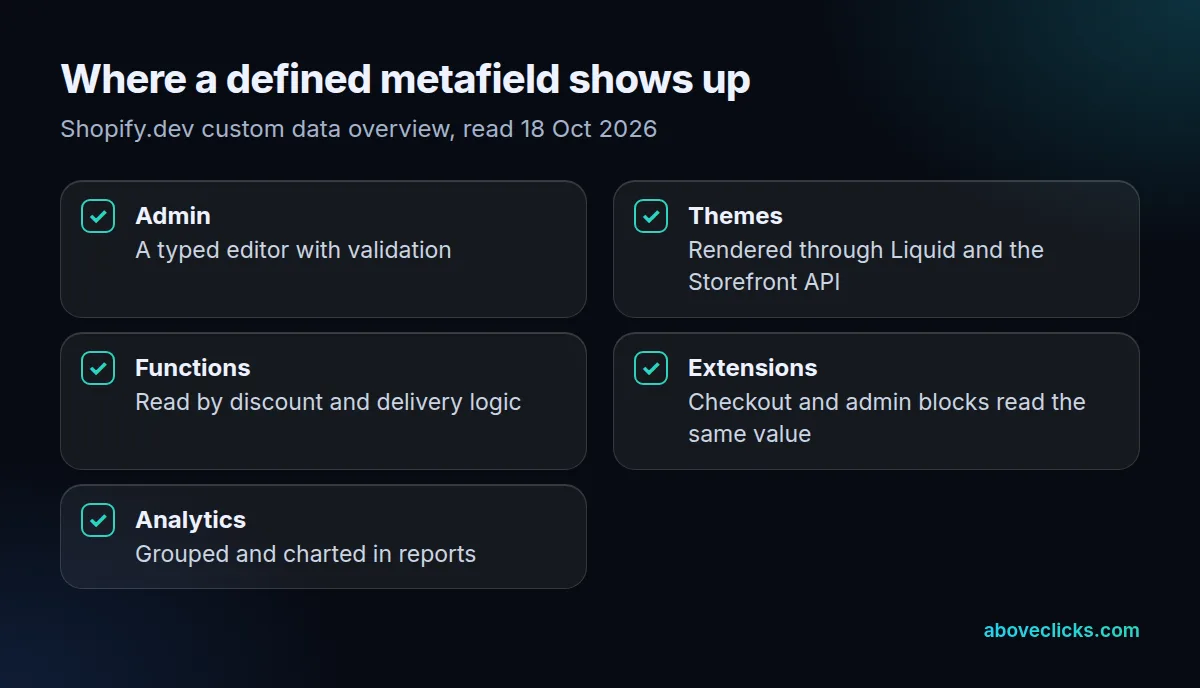
Up to 50 definitions per resource type can be pinned in the admin. Themes print the value with Liquid, and Shopify Functions can read it to decide a discount or a delivery option.
Should you filter with metafields or tags?
For anything a shopper filters on, use a defined metafield. Shopify’s filters run on product options, metafields and metaobjects, and tag filters only show in your store’s default language.
The Search & Discovery filters page sets the frame: up to 25 filters per store, up to 100 values shown in each, and metafield filters for 7 value types, including true or false, decimal and metaobject references. Filters on collection pages are the core of faceted navigation.
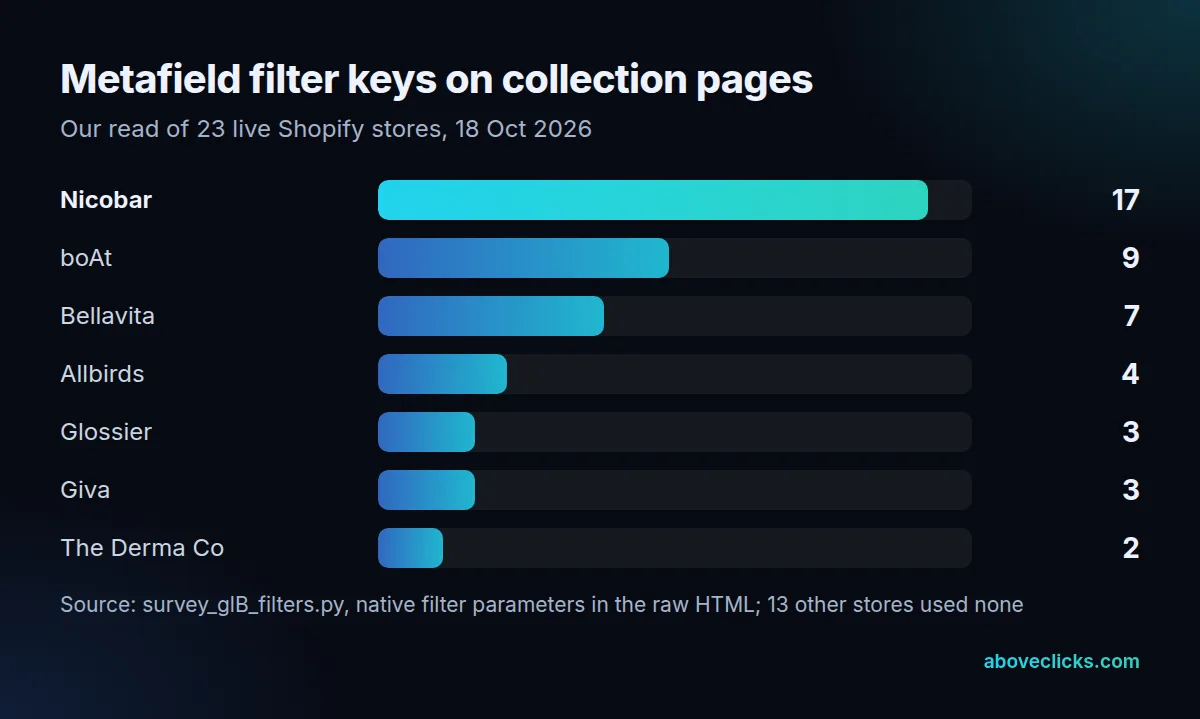
On 18 October 2026 we read the collection pages of 23 live Shopify stores. 10 filtered on metafields, from 1 key (Brooklinen) to 17 (Nicobar). Glossier filters on skin concern, skin type and refillable; boAt on playback and noise cancellation. None of the 23 used Shopify’s category metafields, the standard attributes that come with a product category.
Example (a hypothetical ceramics store): 140 of its 300 products carry a dishwasher-safe tag. As a tag filter it vanishes for shoppers browsing the French version of the store. As a true or false metafield it gets a checkbox in the product editor, a translatable filter label and no risk of a mistyped tag.
What are the metafield limits?
Each resource type takes 256 definitions from you and 256 from every app, most values hold up to 64 KB, and lists hold 128 items, or 1,024 metaobject references.
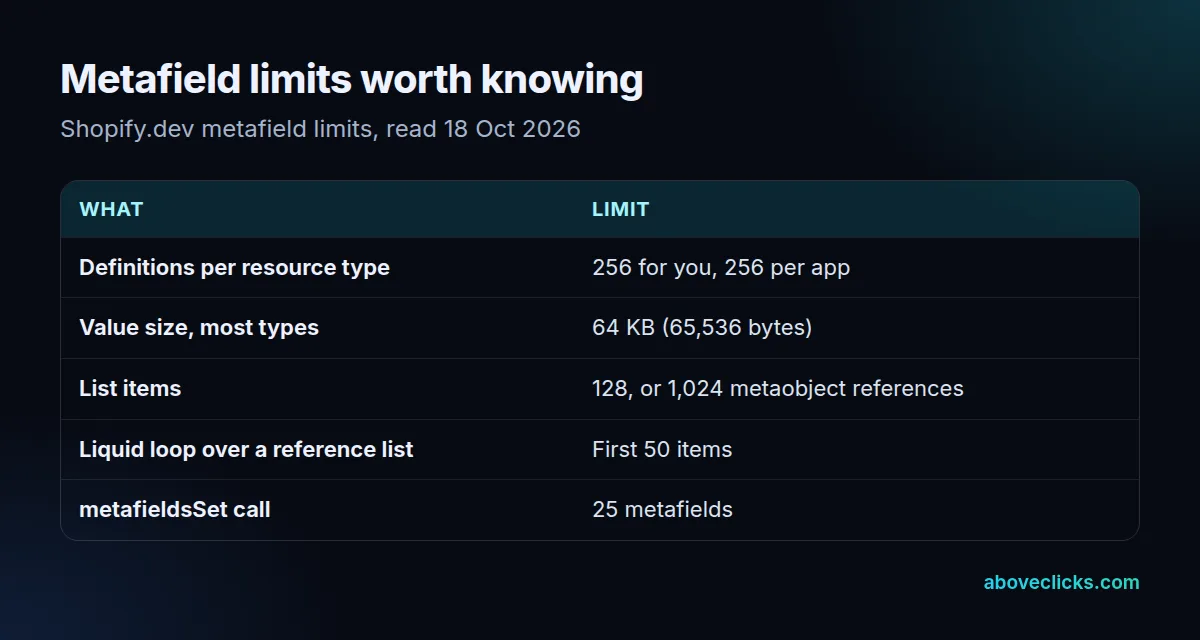
The metafield limits page adds two that catch developers: a Liquid loop over a reference list returns only the first 50 items, and one metafieldsSet call writes at most 25 metafields. Metafields are also private by default on the Storefront API, which needs an access token for them. In our tokenless test on 18 October 2026, all 21 stores that answered refused the metafield read.
Our Shopify development service plans metafield definitions, filters and theme sections together, so product data is entered once and used everywhere.