llms.txt is a proposed Markdown file at a site's root that gives AI agents a short summary of the site and links to the pages worth reading. It's a voluntary proposal, not a standard or a ranking factor, and Google says no AI text files are needed for AI Overviews or AI Mode.
llms.txt is a proposed Markdown file, placed at a site’s root, that gives AI agents a short summary of the site and links to the pages worth reading. It’s a voluntary proposal, not a standard, and not a ranking factor for search.
What goes in an llms.txt file?
A title, a summary and lists of links, in that order. The llmstxt.org proposal says the H1 with the site’s name “is the only required section”, followed by an optional blockquote summary and H2 sections that list Markdown links with optional notes.
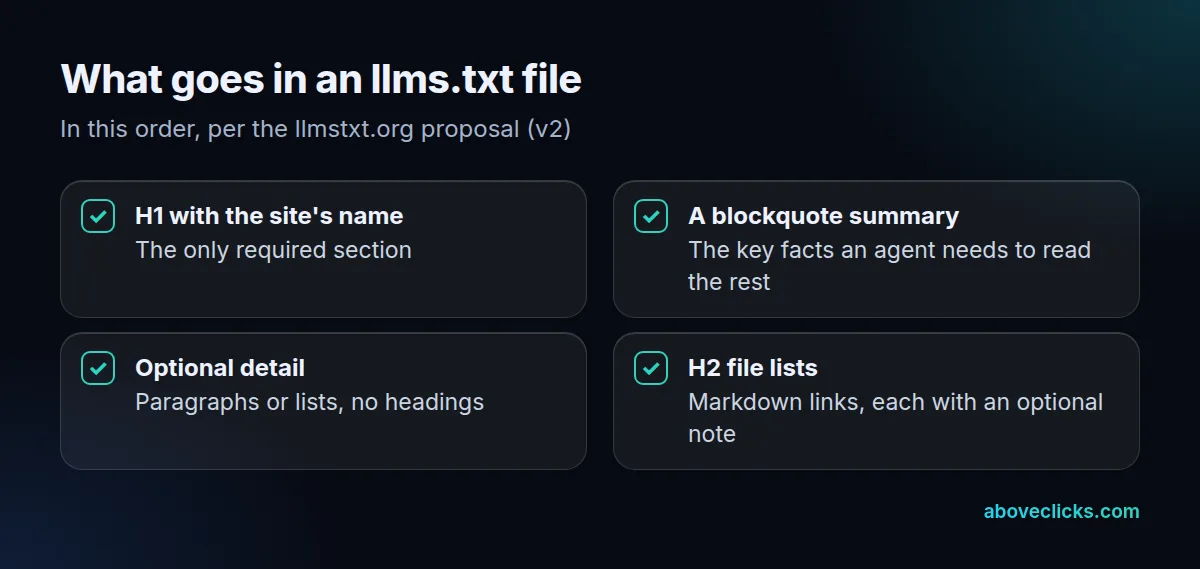
The idea is to save agents from parsing navigation and scripts, so the file “stays small enough to fit in context” and the detail lives behind its links. Pages can also offer a Markdown copy at the same URL with .md added. For a store, the natural links are the pages agents get asked about: shipping, returns, sizing, care and the main collections.
Is llms.txt a standard?
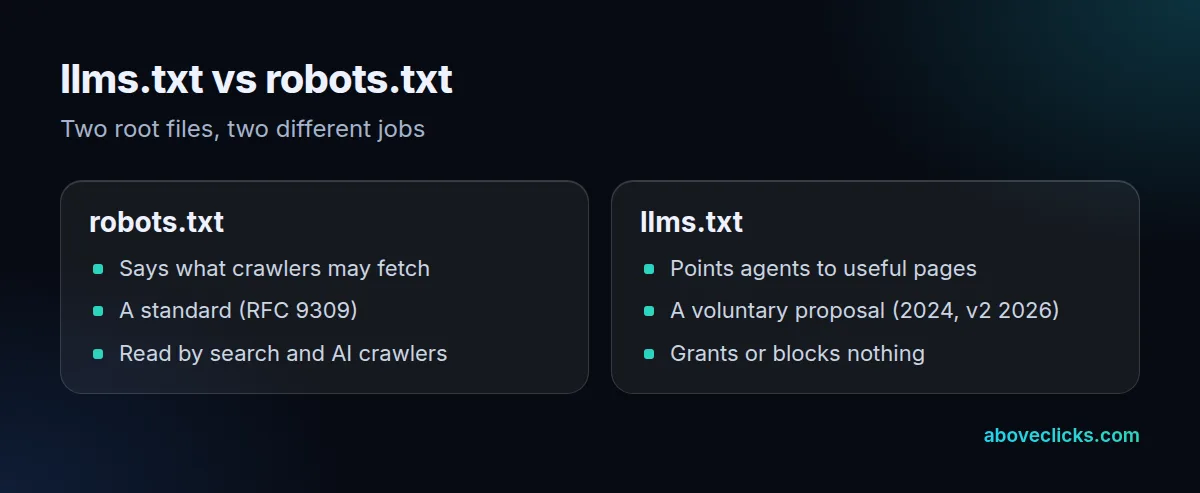
No, it’s a proposal. Jeremy Howard published it on 3 September 2024, and the v2 page was last modified on 10 August 2026. It reports wide adoption, especially for software documentation, but no search engine has adopted it as a requirement.
Unlike robots.txt, which is an IETF standard (RFC 9309), an llms.txt file grants or blocks nothing.
Does it help you rank in AI search?
There’s no evidence that it does, and Google says it isn’t needed. Google’s AI features documentation states: “You don’t need to create new machine readable files, AI text files, or markup to appear in these features.”
What it can do is help an agent that reads it find the right pages faster, such as your shipping policy or size guide. Treat it as a small convenience, not a visibility tactic. The proposal itself makes no ranking claim, and its v2 page, updated 23 months after the first version, says these files are used most heavily for software documentation.
If a vendor promises AI rankings from an llms.txt file, ask which engine has documented using it for ranking. None of the crawler and AI search documents we read on 17 October 2026, from Google, OpenAI, Anthropic and Perplexity, describe it as a ranking input.
Do Shopify stores already have one?
Many do, apparently without writing it. On 17 October 2026 we requested /llms.txt from 30 well-known jewelry, fashion and beauty stores: 18 returned a real file, and 12 of those were the same “Agent Instructions” template, which points AI agents to Shopify’s Shop skill and to UCP.
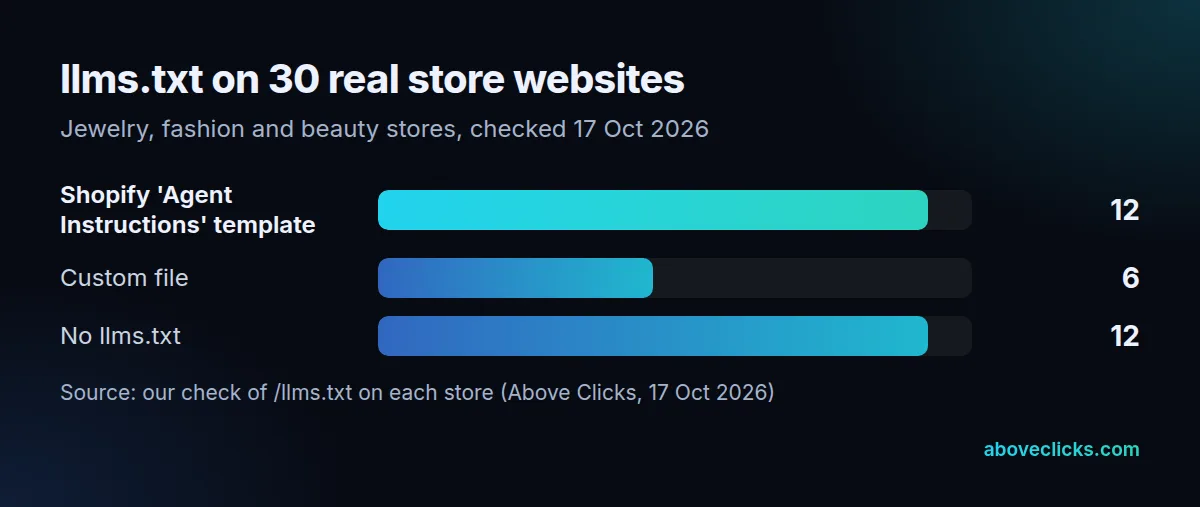
The identical wording across 12 Shopify stores suggests the platform generates it (our inference). The 6 custom files ranged from 3,280 bytes to 4,238,822 bytes; that last one, a full product list, is far from small. Check yours at yourdomain.com/llms.txt before paying for a generator, and read it: a template that points agents to checkout tools may be all a small store needs. Our Shopify development team can adjust it, and our generative engine optimization work and the AI search optimization hub cover what does move AI visibility.