A custom audience is a Meta ads audience made from people who already know your business: visitors tracked by the Meta Pixel or Conversions API, app users or a customer list you upload. You can target it, exclude it or use it as the seed for a lookalike audience.
A custom audience is a Meta ads audience made from people who already know your business: visitors tracked by the Meta Pixel or Conversions API, app users or a customer list you upload. You can target it, exclude it or use it as the seed for a lookalike audience.
You’ll also see it called a Facebook custom audience. It’s the same thing, used across Facebook and Instagram ads.
Types of custom audience
Stores mostly use two sources:
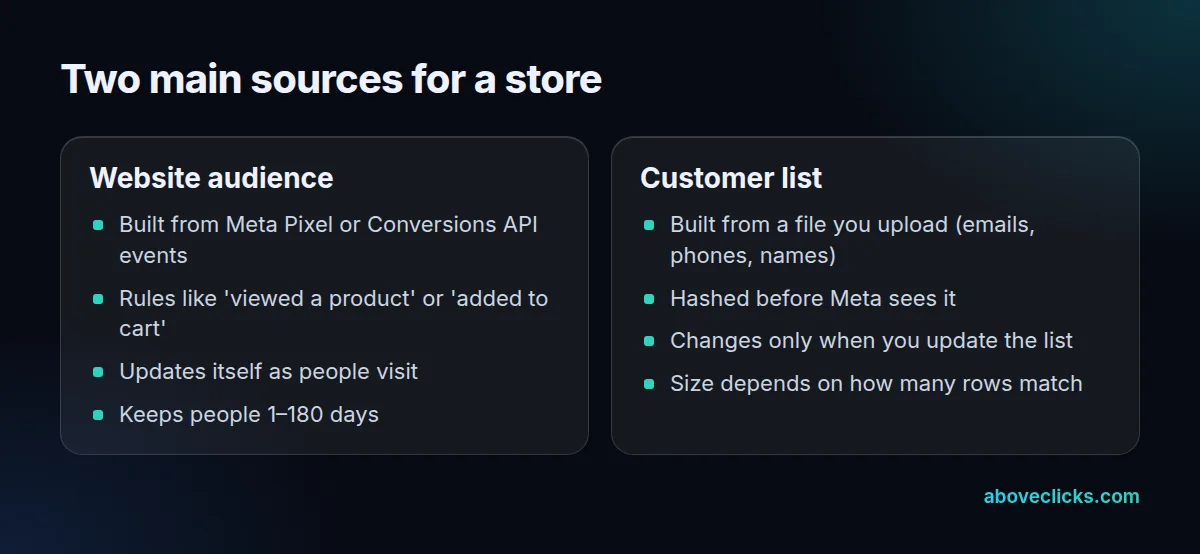
A website custom audience comes from events your Meta Pixel or server sends. Meta’s website custom audiences documentation says the audience updates automatically based on the retention you set, between 1 and 180 days. Someone who comes back and matches the rule again stays in the audience.
A customer list works differently. You upload hashed emails, phones and names, and Meta compares them with its own hashed data. Nobody gets added who can’t be matched. Google Ads has the same idea under another name: Customer Match uses your online and offline customer data to reach and re-engage your customers across Search, the Shopping tab, Gmail, YouTube and Display.
Worked example: a 4-list custom audience setup
Example: a hypothetical furniture store sets up four lists. Its buying cycle is long, so product viewers stay in the audience for two weeks.
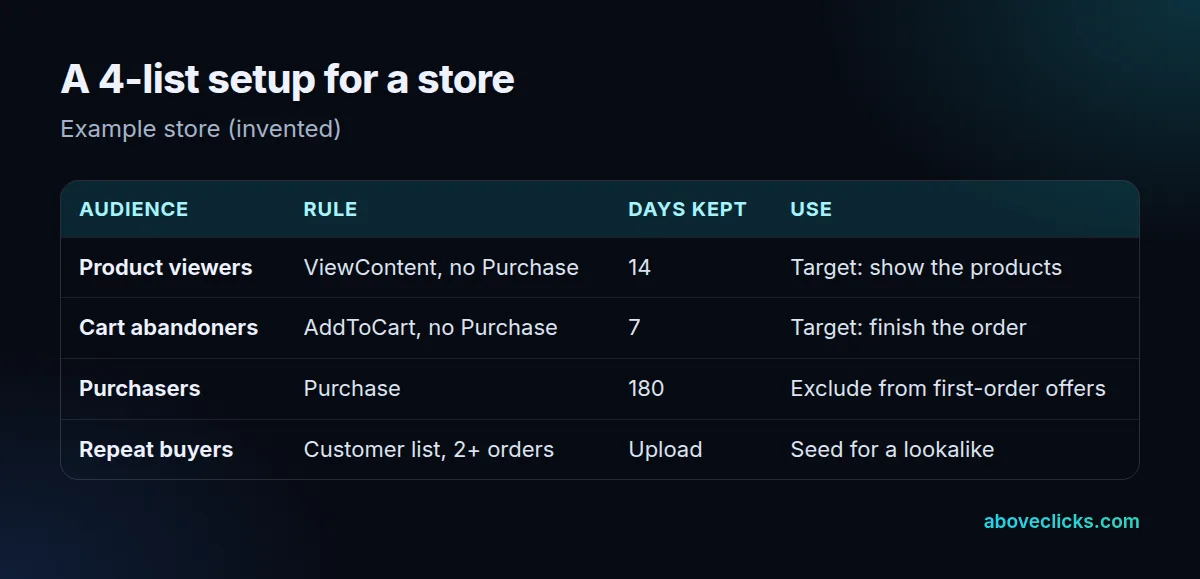
Each list has a job. The first two power retargeting. The purchasers audience is an exclusion, so new-customer discounts don’t go to people who already bought. In our client work, that exclusion is usually the first list we set up on a new account, because it’s the quickest way to stop paying for people who already ordered. The repeat-buyer list becomes the seed for a lookalike audience.
The windows are the store’s choice, not Meta’s rule. A store selling $20 items might keep cart abandoners for 3 days. One selling sofas might keep them for 30.
Check the sizes before you split further
In a typical month the example store’s lists hold about 9,000 product viewers, 1,100 cart abandoners and 2,400 purchasers. Those sizes set the budget each list can absorb.
Put $50 a day behind 1,100 cart abandoners and the same people see the ad again and again. So the store keeps that ad set’s budget small and watches frequency. If a list is too small to matter, merge it into the one above, for example viewers and abandoners together, rather than slicing it thinner.
Exclusions need no minimum. Excluding the 2,400 purchasers from a prospecting campaign keeps first-order offers for new people, and it stops the store paying to show a welcome discount to someone who ordered last week.
How a customer list custom audience matches
The same store uploads 5,000 customers. With email only, 3,100 rows match: 62%.
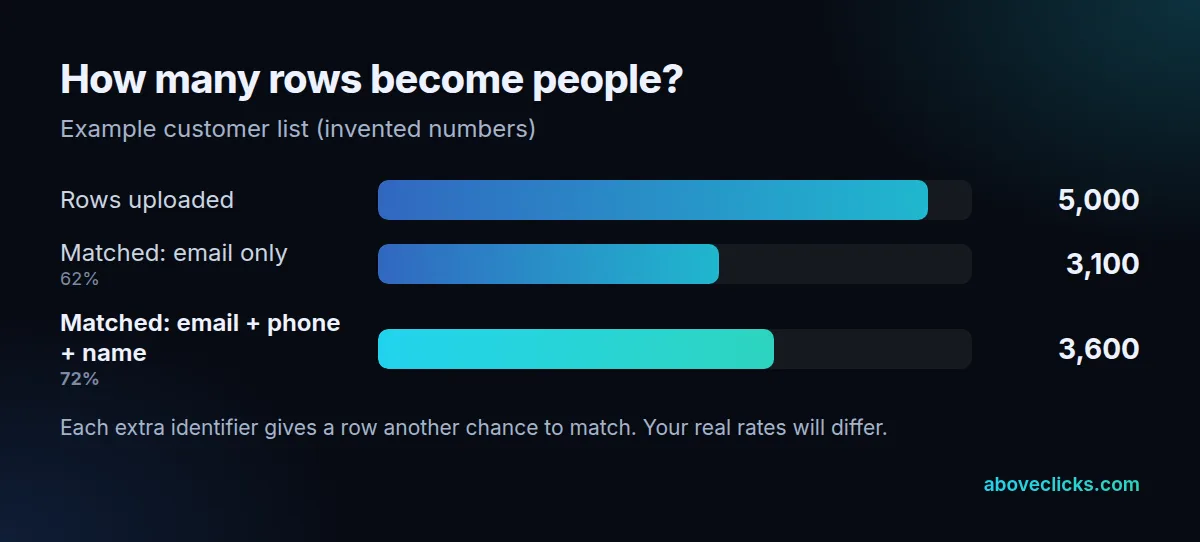
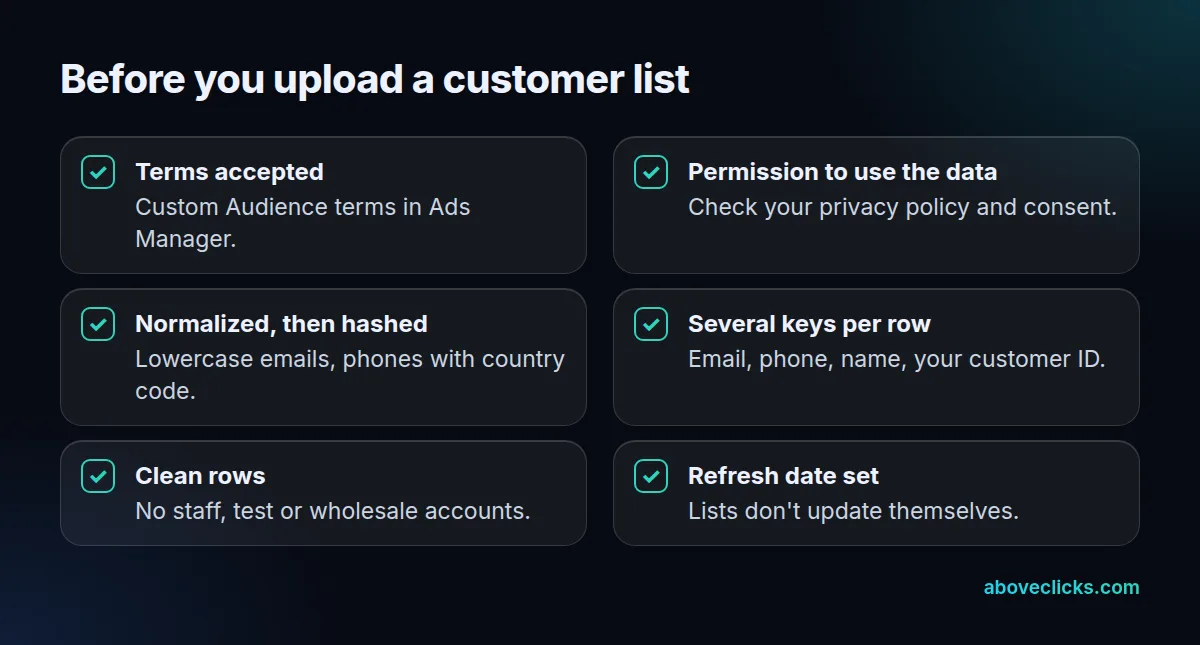
Meta’s customer file documentation says you raise the match rate by sending several keys per person, such as your customer ID, last name, first name and email. Data that’s hashed incorrectly doesn’t match at all, so normalize first: trim spaces and lowercase emails.
Why it matters for e-commerce
Custom audiences decide who sees which message. Without them, a returning customer can get the same first-order discount as a stranger, and the people who left a full cart get nothing specific.
The Meta ads for e-commerce guide shows how retargeting, exclusions and prospecting fit together. If your audiences are a tangle of old lists, our Meta ads service can rebuild them around your store’s buying cycle.