Consent mode is a Google tag feature that passes each visitor's cookie-consent choice to Google Analytics and Google Ads, so tags change behavior when consent is denied. In the advanced setup, tags then send cookieless pings that Google uses to model the conversions you can't observe directly.
Consent mode is a Google tag feature that passes each visitor’s cookie-consent choice to Google Analytics and Google Ads, so tags change behavior when consent is denied. Advanced setups then send cookieless pings that Google uses to model lost conversions.
What is consent mode v2?
Consent mode v2 is the name most people use for consent mode with all 4 consent types in place. Google’s consent mode overview lists them: ad_storage and analytics_storage for cookies, plus ad_user_data and ad_personalization for sending data to Google for ads and for personalized ads.
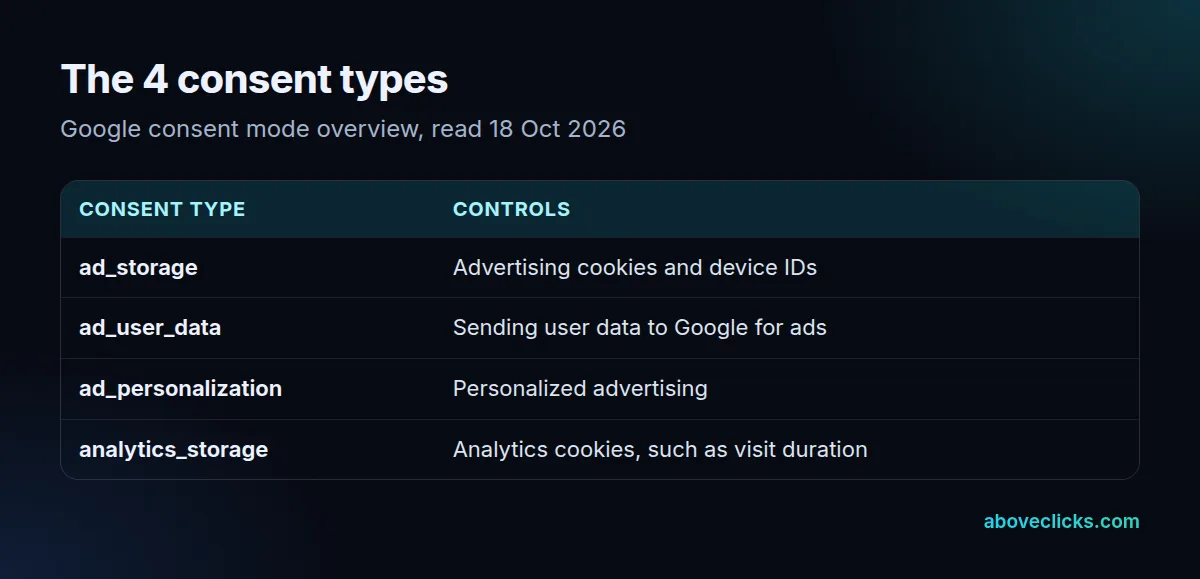
Each type is either granted or denied. Your consent banner sets the default when the page loads and updates it when the visitor chooses, and Google tags read the state before they write cookies or send data. Example: a visitor who accepts analytics but rejects ads ends up with 1 of 4 types granted (25%), analytics_storage, so GA4 can set its cookies while Google Ads tags can’t.
What is the difference between basic and advanced consent mode?
Basic consent mode blocks Google tags until the visitor chooses; advanced consent mode loads them straight away with consent denied by default. Google’s overview says that with basic, when a user declines, “no data is transferred to Google at all – not even the consent status.”

With advanced consent mode, denied visitors still send measurements without cookies, and Google says this gives an advertiser-specific model instead of a general one. Example: if 40% of a hypothetical store’s visitors decline, basic sends Google nothing about those 40%, while advanced sends a cookieless ping for each of their page views and conversions. The trade-off is privacy posture against modeling quality, and your legal adviser should weigh in on which fits the markets you sell in.
When does Google model the missing conversions?
Only above a traffic threshold. Google Ads requires 700 ad clicks over a 7 day period, per country and domain grouping, according to its consent mode modeling page. For GA4, behavioral modeling needs at least 1,000 events a day with analytics_storage denied for at least 7 days, plus 1,000 daily users with it granted on 7 of the previous 28 days.

Example for a hypothetical store: 1,200 weekly ad clicks split 900 from the United States and 300 from the United Kingdom. The US clears the 700-click line; the UK doesn’t, so its denied-consent conversions go unmodeled until traffic grows.
How many stores set a consent default?
Few do it in the page source. On 18 October 2026 we fetched 30 store homepages; 28 answered. 6 of 28 contained a consent default command in their raw HTML before other tags: Missoma, Vrai, Brooklinen, The Reformation, Cupshe and Kylie Cosmetics.
Others may set consent later through a consent app or Shopify’s privacy tools, which a raw-HTML check can’t see. That gap matters, because the order is the point: a default that arrives after the first tag fires lets that tag run without any consent state. Test yours in Tag Assistant, and check that the default appears before any tag fires on the first page view. Our checkout tracking service checks consent alongside Google Tag Manager and Google Analytics 4 setups, and the tracking and analytics hub lists the rest.