Free tool

How much can I pay to win a new customer?

This free max CAC calculator gives your safe maximum cost per new customer, from first-order profit, repeat orders and how long you can wait.

Your customers

Average value of a new customer’s first order.

Leave empty if it’s the same as the first order.

After product cost, shipping, fees and returns.

Extra orders per customer, counted from the first order

0.2 by month 3 = 20 repeat orders for every 100 new customers. Shopify’s customer cohort analysis report shows this.

How long you can fund a new customer before their orders repay the cost.

Ad spend ÷ new customers in the same month.

Shows the cash that steady growth ties up.

Pay at most

–

–

Limit from your payback window
–
Limit from a 3 : 1 lifetime ratio
–
Your current cost is paid back
–
Cash tied up by growth
–

Results update as you type.

The example values are placeholders; replace them with your own. Nothing you enter is stored or sent, unless you ask us to email you the result.

Free · no newsletter

Email me this result + 3 fixes

Your numbers, the result and three fixes in one email, to keep or forward to your team.

How to use the max CAC calculator

The max CAC calculator sets two limits on what a new customer can cost, and takes the lower one. Both limits come from your own customer numbers, not from an industry average.

  1. Order values: the first order value, and the repeat order value if it differs.
  2. Contribution margin: after product cost, shipping, fees and returns.
  3. Repeat orders: extra orders per customer by months 3, 6, 12 and 24, counted from the first order.
  4. Payback window: the months you can wait to be paid back.
  5. Optional: what a new customer costs you now, new customers a month and the cash you can put into growth, to see your payback month and the cash growth ties up.
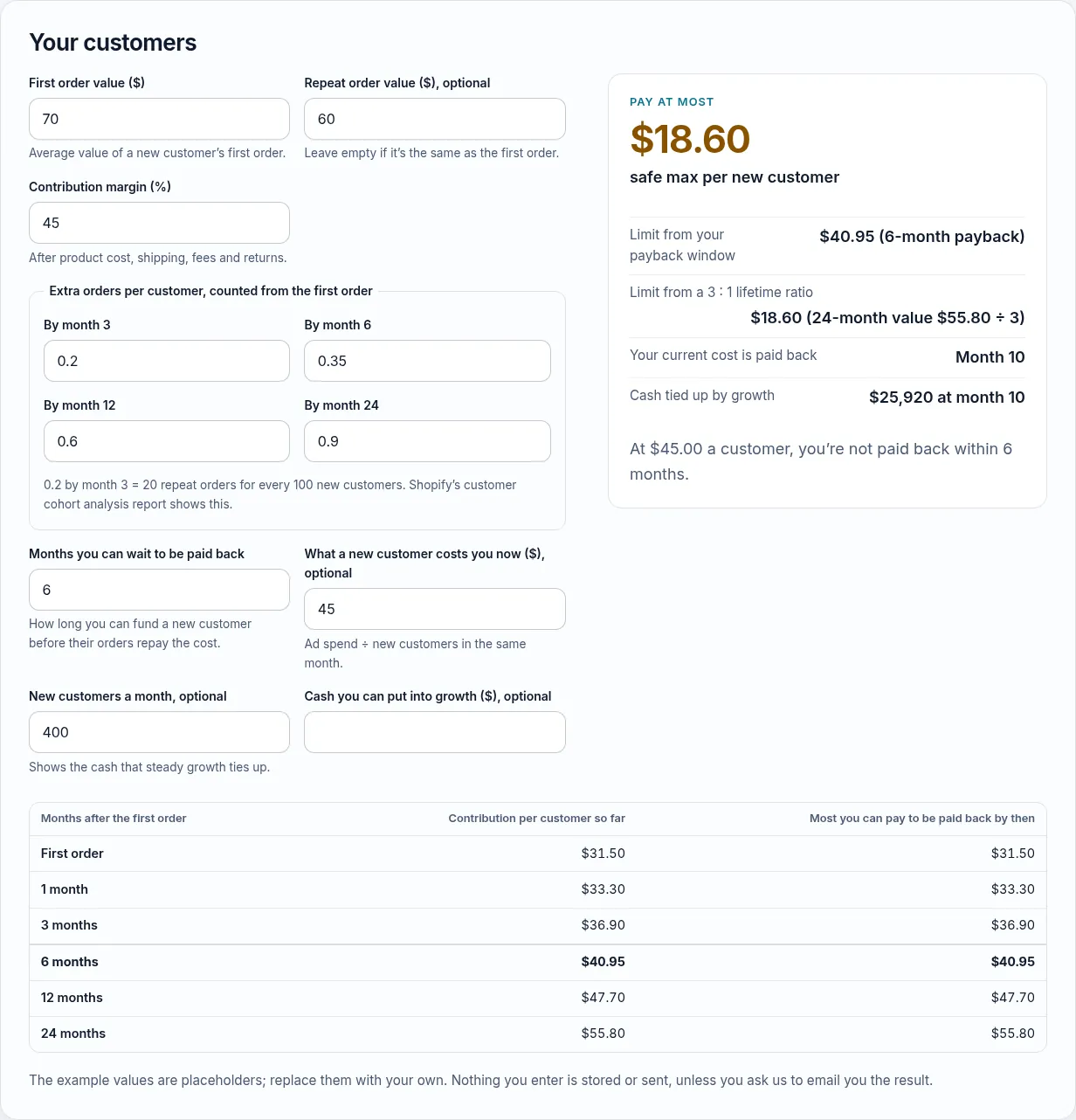
Max CAC calculator with the example values: pay at most $18.60 per new customer, the lower of the $40.95 payback limit and the 3 to 1 lifetime limit
The max CAC calculator with its example values: pay at most $18.60 per new customer, the lower of the $40.95 payback limit and the 3 : 1 lifetime limit.

Under the result come three fixes to start with. For the example they are: bring acquisition cost under the payback line, make the first order worth more, and work on the second order.

The 3 fixes the max CAC calculator suggests for the example store
The three fixes it suggests for the example store.

On a phone, the limit and the payback month sit under the inputs.

Max CAC calculator result on a phone
The result on a phone.

In Google Ads, a cost limit like this is what you would enter as the target in Target CPA bidding, when a new customer’s purchase is the conversion you bid on. The LTV CAC calculator shows where you stand today.

How it works

The tool builds a curve of the contribution a new customer brings over 24 months:

  • At the first order: first order value × contribution margin.
  • Then, the repeat orders you enter (extra orders per customer by months 3, 6, 12 and 24, with straight lines in between) × repeat order value × margin.

From that curve it gives two limits on what you can pay for a new customer:

  • Payback limit: the contribution a customer has brought by the end of your payback window. Pay more and you won’t be paid back in time.
  • Lifetime limit: the 24-month contribution ÷ 3, from the common 3 : 1 LTV:CAC rule of thumb, which leaves room for overheads and profit. It’s a convention, not a law; change your plan if your overheads are unusually low or high.

The safe maximum is the lower of the two. Enter your current cost per new customer to see in which month it pays back.

The cash growth ties up

Acquisition is paid up front; contribution arrives over months. With new customers a month, the tool runs 24 months of steady acquisition at your current cost (or at the safe maximum) and shows the lowest point of cumulative cash flow: the cash you need to fund that growth before it pays for itself.

Where to get the inputs

Repeat orders come from cohort data: of the customers who first ordered in a month, how many more orders they placed later. Shopify’s customer cohort analysis report shows this; so do most email and retention tools. Use cohorts that are at least as old as the month you enter. For a single-number check, see our LTV:CAC calculator.

Monthly email

One practical e-commerce marketing guide a month

The month’s most useful guide on Meta Ads, Google Ads, SEO or tracking, in one short email.

FAQ

Straight answers.

Can’t find yours? Ask on WhatsApp or by email and we’ll answer it.

What is CAC?

Customer acquisition cost: ad spend divided by the new customers it brought in the same period.

Why two limits?

The payback limit protects cash: a customer has to repay their cost within the months you can fund. The 3 : 1 lifetime limit is a common rule of thumb for leaving room for overheads and profit. The safe maximum is the lower of the two.

Where do repeat-order numbers come from?

Your store’s cohort data: of the customers who first ordered in a given month, how many orders did they place in the following 3, 6, 12 and 24 months.

Does this tool store my data?

No. It runs in your browser and nothing you paste is uploaded. If you ask us to email you the result, the data is sent once so our server can rebuild the result, and only the request is saved.

Free growth audit

Find out what’s holding your store back.

Tell us about your store. We’ll review your tracking, campaigns and SEO and send you a written audit with the top fixes, ranked by impact.

  • Written audit as a PDF, delivered within 2 workdays (see a sample)
  • A video meeting to go through it, if you want to discuss next steps
  • Free and no obligation
  • Read-only access or screenshots are enough

Free audit
Chat on WhatsApp