How to use the LTV CAC calculator
The LTV CAC calculator needs six numbers. Take them from the same period, so they describe the same customers.
- Marketing spend in the period: ads plus any agency or tool fees, for one month or quarter.
- New customers in the same period: first-time buyers only.
- Average order value: total revenue ÷ orders.
- Contribution margin: what’s left of an order after product, shipping, fees and returns.
- Orders per customer per year, and years a customer keeps buying: from your store’s customer reports.
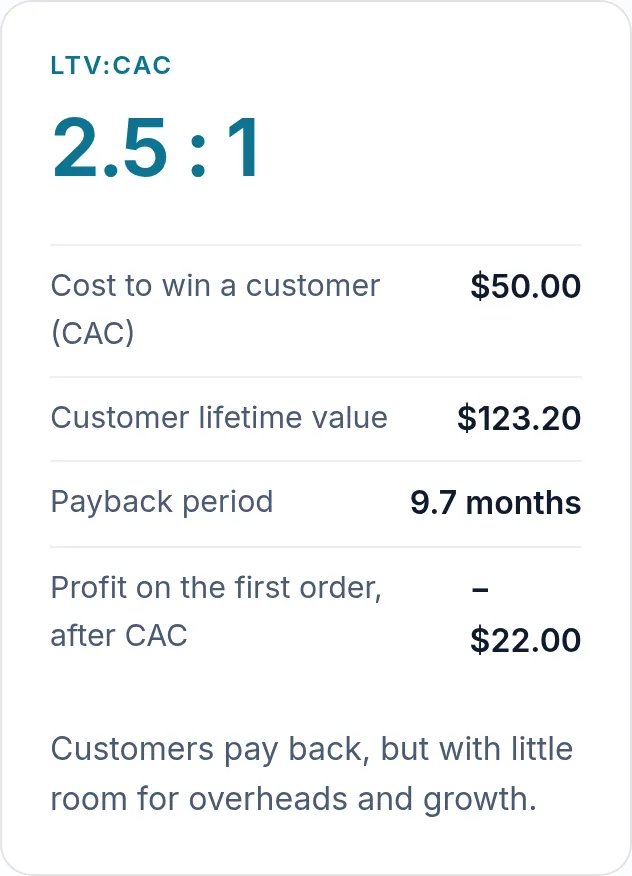
- Read the result: the LTV:CAC ratio, what a customer costs to win, the customer lifetime value, the payback period and the profit on the first order after CAC.

Under the result come three fixes to start with. For the example they are: bring customers back, raise the average order value, and watch the payback period.

On a phone, the ratio and payback period sit under the inputs.
If you bid in Google Ads, its help page on customer lifecycle goals shows how to bid higher for new customers than for returning ones; what a new customer is worth to you is the number to start from. The max CAC calculator turns these numbers into a spending limit.
What LTV:CAC measures
LTV:CAC compares what a customer is worth over their whole relationship with your store (lifetime value) with what it cost to win them (customer acquisition cost). A ratio of 3 : 1 means each customer brings in three times their acquisition cost in contribution over their lifetime.
It answers a question ROAS can’t: whether paying more than the first order is worth to win a customer still makes sense once repeat purchases are counted.
The formulas
CAC = marketing spend ÷ new customers (same period)
LTV = average order value × contribution margin × orders per year × years a customer stays
Payback period (months) = CAC ÷ (monthly contribution per customer)
For example, $15,000 of spend that wins 300 new customers is a CAC of $50. A customer who orders 2.2 times a year at $70 with a 40% margin brings in $61.60 of contribution a year; over two years that’s an LTV of $123.20, a ratio of about 2.5 : 1, with the CAC paid back in about 9.7 months.
This calculator uses contribution (what’s left after product, shipping, fees and returns), not revenue. Revenue-based LTV looks bigger but pays for nothing.
Reading the result
A ratio around 3 : 1 is a common rule of thumb for a healthy business, not a law. How to read the bands:
- Below 1 : 1: customers never pay back what they cost. Check the inputs, then bring CAC down or raise first-order contribution.
- 1 to 3 : 1: customers pay back, with little left for overheads and growth. Retention usually moves this faster than ad tweaks.
- 3 to 5 : 1: healthy. Keep an eye on the payback period, which you fund in cash.
- Above 5 : 1: customers are worth far more than they cost. You may be able to grow faster by spending more.
Getting honest inputs
- Count only first-time buyers as new customers. Returning customers in the count make CAC look lower than it is.
- Use real repeat data: your store’s customer reports show orders per customer. If you’re under a year old, be conservative with “years a customer stays”.
- Include everything you spend to acquire customers: ads, plus agency and tool fees if you want the full cost.
Limits of this calculator
Averages hide differences between channels and cohorts: customers from one channel or month may be worth much less than others. Once you have a few months of data, measure LTV by the month customers first bought. The ROAS calculator covers the first-order view.