Social proof is evidence that other people already buy or recommend a product: star ratings, review counts, bestseller badges, customer photos or press mentions. Shoppers lean on it when they can't judge a product themselves. That's why it sits close to the price and the Add to cart button.
Social proof is evidence that other people already buy or recommend a product: star ratings, review counts, bestseller badges, customer photos or press mentions. Shoppers lean on it when they can’t judge a product themselves. That’s why it sits close to the price and the Add to cart button.
What are social proof examples in ecommerce?
Ratings and reviews, review counts, bestseller labels, customer photos, low-stock notes and press logos. On 18 October 2026 we read the newest product page of 26 real stores, and star ratings in the page markup were the most common real signal, on 10.

The words best seller turned up on 16 pages, which looks like a popular tactic until you strip out menus: on 10 of them it sat only in menus, links or the footer. Outside menus and links the phrase was on 6, and only 2 used it as a label on a product, Allbirds in a recommendations row and True Classic as #1 Best Seller in a comparison.
Urgency wording outside menus appeared twice, once on a product and once in a cart drawer telling the shopper their items are selling fast, whatever is in the basket. These are floors, since review stars and photo galleries often load later by script. Still, they show how much social proof on a product page is a menu link rather than evidence about the product in front of the shopper.
Which social proof does the FTC ban faking?
Reviews, testimonials and social media numbers. The FTC’s Consumer Reviews and Testimonials Rule took effect on 21 October 2024 and lets courts impose civil penalties for knowing violations.
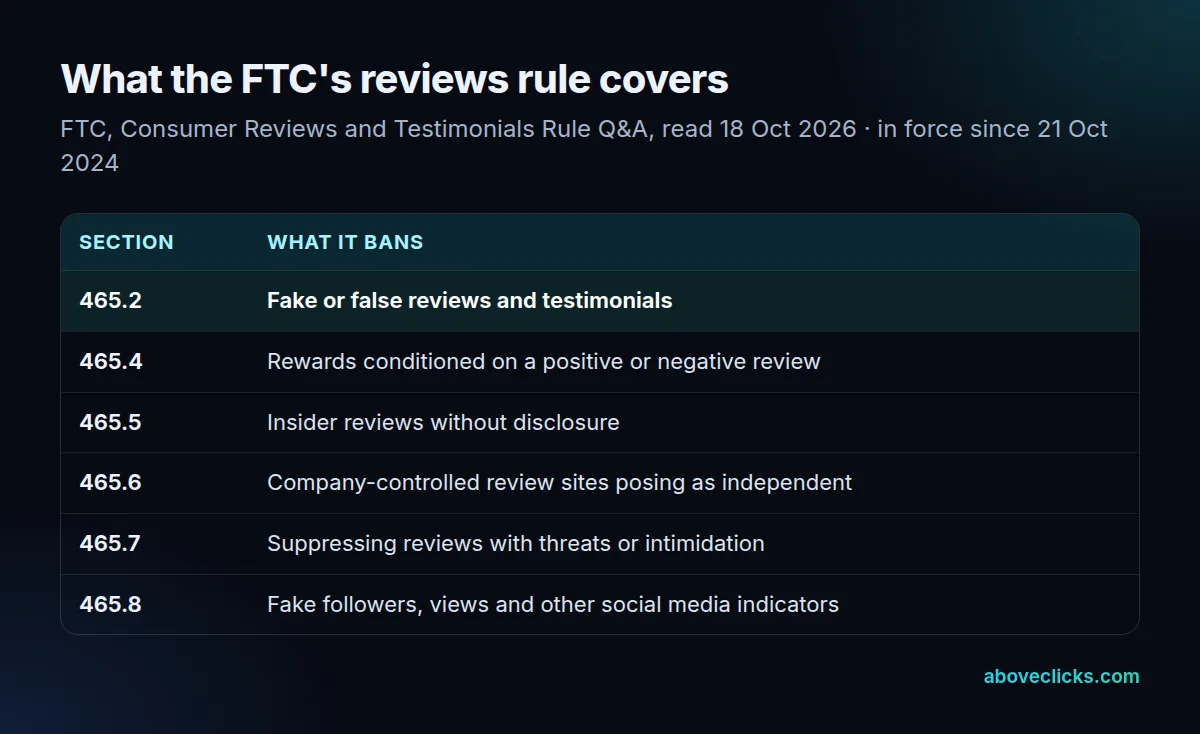
The FTC’s announcement names AI-generated fake reviews among the targets. Its sections cover fake or false reviews and testimonials, rewards that depend on a review being positive or negative, undisclosed reviews by insiders, review sites a company controls while posing as independent, review suppression by threats or intimidation, and fake followers or views.
Some social proof practices stay allowed: per the FTC’s own answers, sorting reviews so the most helpful ones show first isn’t suppression, and you may contact unhappy reviewers to fix their problem. Asking only happy customers isn’t banned by the rule itself, but FTC staff warn it could still break the FTC Act.
Where should ratings and badges go on a page?
Put social proof next to the decision it supports: the rating by the product title and price, reviews below the fold for shoppers who want detail, a delivery or returns note near the button. And always show the count with the stars.

The same read gave a clear contrast: one newly listed product showed 5.0 stars from 3 ratings, another 4.2 from 3,618. The second is the stronger proof, because one bad review would barely move it, while a single 1-star review would drop the first to 4.0. If you mark the rating up for search, Google’s review snippet rules also require that shoppers can see that rating on the page. Test a change like this as an AB test on conversion rate, not by feel.
Keeping it believable
Only show what’s true and current: a low-stock note that never changes, or a bestseller badge on every product, teaches shoppers to ignore both. A cart message that calls any basket selling fast, like the one we found on 1 of the 26 pages, is the same problem in miniature.
Social proof works when it is specific: a count, a date, a named publication. Low-stock wording should come from real inventory, never a fixed script. The most persuasive social proof, reviews and customer photos, is user-generated content, with its own disclosure rules when you reward it. Our landing pages service builds pages where every claim can be checked, and the CRO hub covers the rest.