Performance Max is a Google Ads campaign type that runs one campaign across all Google Ads inventory, from Search and YouTube to Display, Discover, Gmail and Maps. Google AI picks the bids, placements and ad combinations from the goals, assets and product feed you give it.
Performance Max is a Google Ads campaign type that runs one campaign across all Google Ads inventory, from Search and YouTube to Display, Discover, Gmail and Maps. Google AI picks the bids, placements and ad combinations from the goals, assets and product feed you give it.
How does Performance Max work?
You set the goal and supply the raw material; Google AI decides where and how each ad runs. Google’s About Performance Max page lists 4 inputs you control: conversion goals, creative assets, audience signals, and budget plus brand safety settings. Give a hypothetical store a 400% target ROAS, and Smart Bidding bids for the auctions it predicts will return about $4 in sales per $1 spent.
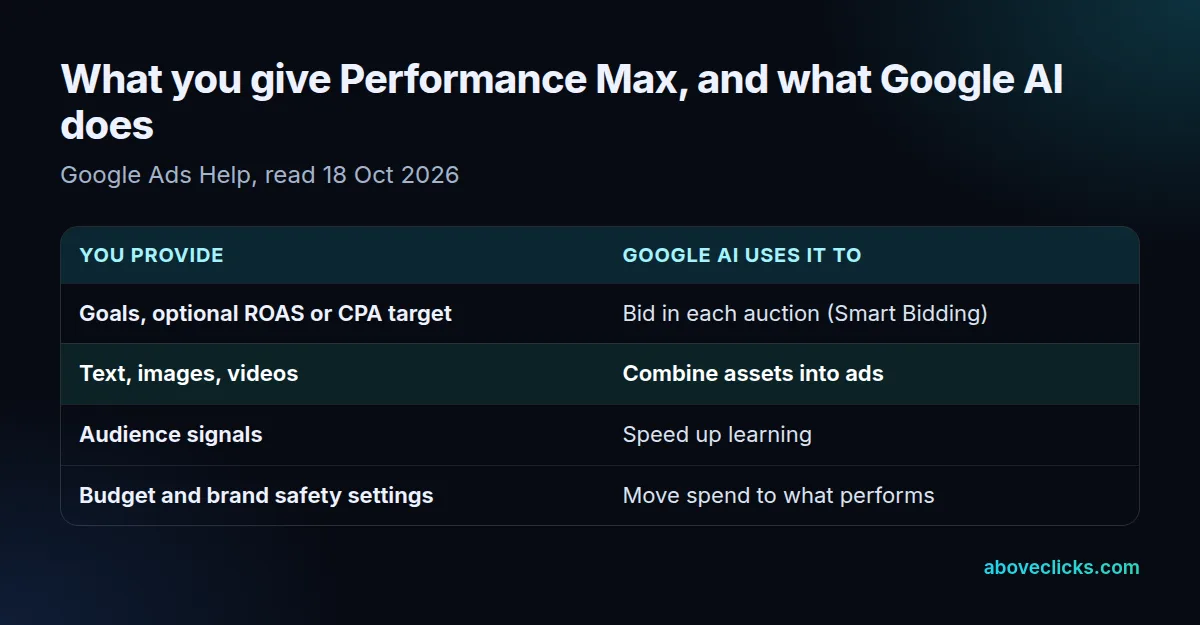
It doesn’t take every search from your other campaigns. When a query hits an exact match keyword in a Search campaign, that campaign is prioritized over Performance Max, and PMax search themes carry the same priority as phrase and broad match keywords. The same page lists brand exclusions, negative keywords, final URL expansion and text customization as the main controls.
What goes into a Performance Max asset group?
An asset group is a themed bundle of headlines, descriptions, images, logos and videos that Google mixes into ads. The specs page sets headlines at “30 characters max; include at least one with 15 characters or less”.

Long headlines and descriptions get 90 characters. Videos are optional: if you add none, Google may auto-generate them from your other assets, and Google says you must upload all 3 orientations yourself to reach Excellent ad strength and stop that. A retailer can also attach a Merchant Center feed so the asset group serves Shopping ads; the minimum asset counts in the table apply to groups without one.
Can your product titles double as ad headlines?
Mostly not as written. On 18 October 2026 we read 3,635 product titles from 16 public Shopify catalogs: 1,122 (31%) are 30 characters or fewer, and only 179 (about 5%) meet the 15-character mark Google asks for in at least one headline.

The spread is the useful part. Ring Concierge’s short ring names fit 99% of the time, Glossier’s 95%, while Allbirds and Gymshark sit at 1%, because titles like “Men’s Cruiser Slip On – Natural Black (Blizzard Sole)” (53 characters) carry colour and sole. Nearly all, 3,633 of 3,635, would fit a 90-character long headline. So write short headlines around the collection or benefit, and let full product titles live in the feed and long headlines.
How long does the learning phase take?
Google’s setup page says automated bidding is “typically 1-2 weeks, but sometimes up to 6 weeks” in its learning phase, and asks you to avoid frequent or large changes to budget, bid strategy or targeting during it.
Expect 24-48 hours before data appears and 1-2 days for ad review. If there are no impressions after 3 business days, Google points you to its troubleshooting steps. Take an illustrative example store, Fernhill Linen, launching on 2 November with a $60 daily budget: it shouldn’t judge the campaign before mid-November, and it should change a target gradually, not halve it in week 1. Remarketing lists need more than 100 active users in the last 30 days for the best coverage.
For how PMax compares with Shopping campaigns, read Performance Max vs Standard Shopping; the Google Ads for e-commerce guide covers the wider account, and our Google Ads management team builds and runs these campaigns.